


Previously in America 251. For our final post in the series, we ask the question that sits beyond all the others: Can we imagine a better future, and what helps us believe it’s possible?
If you’re catching up on the series, here are links for our posts on: Belonging, Connection, Joy and Meaning, Identity, Change, and the Nation.
Hope can feel difficult to talk honestly about right now. Americans are living through political division, economic pressure, institutional distrust, loneliness, climate anxiety, and constant exposure to crisis. Cynicism often feels safer than optimism.
And yet people continue to hope anyway.
Not always in grand or abstract ways, but in deeply human ones: caring for family, building community, mentoring young people, creating things, helping neighbors, imagining better futures, and continuing to show up for one another even when the future feels uncertain.
Hope is not denial. It is a form of investment in the future, even when the future is unclear.
Hope Lives Closest to Home
Americans are not equally hopeful about everything. They are most hopeful about the parts of the future that feel closest to them. Roughly two-thirds say they feel hopeful about their own lives (66%). A smaller majority feel hopeful about the future of their communities (54%). Hope drops considerably when people think about the future of the United States (38%) and the world (36%).
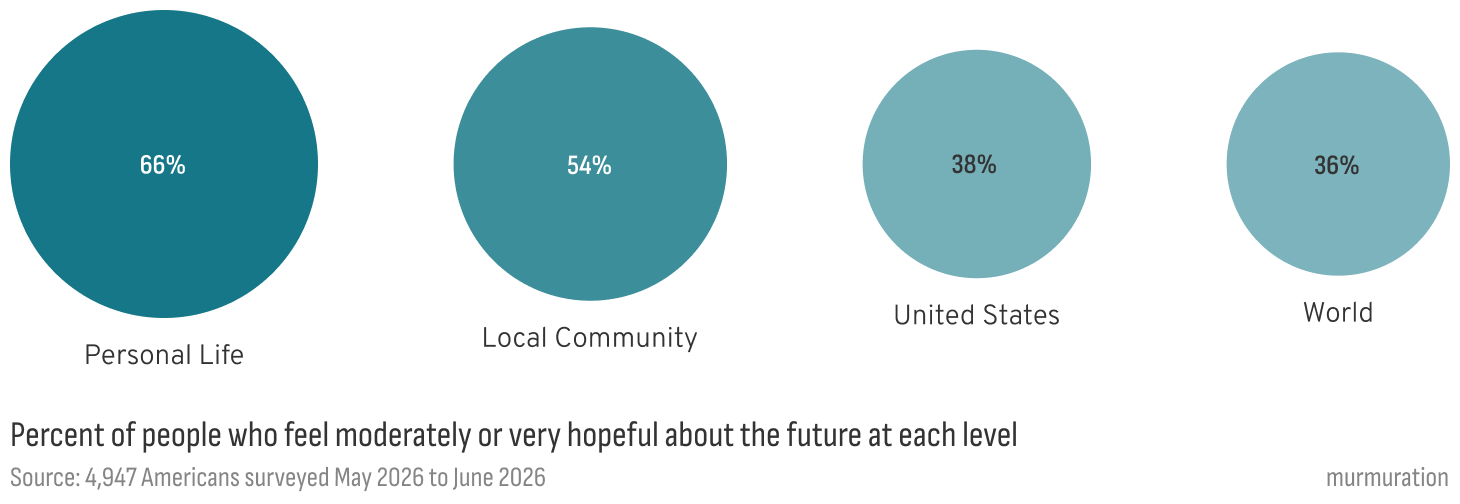
In some ways, this finding echoes what we found throughout the series. Belonging was local. Connection was local. Change was local. It seems that Americans have not lost hope but they may have relocated it.
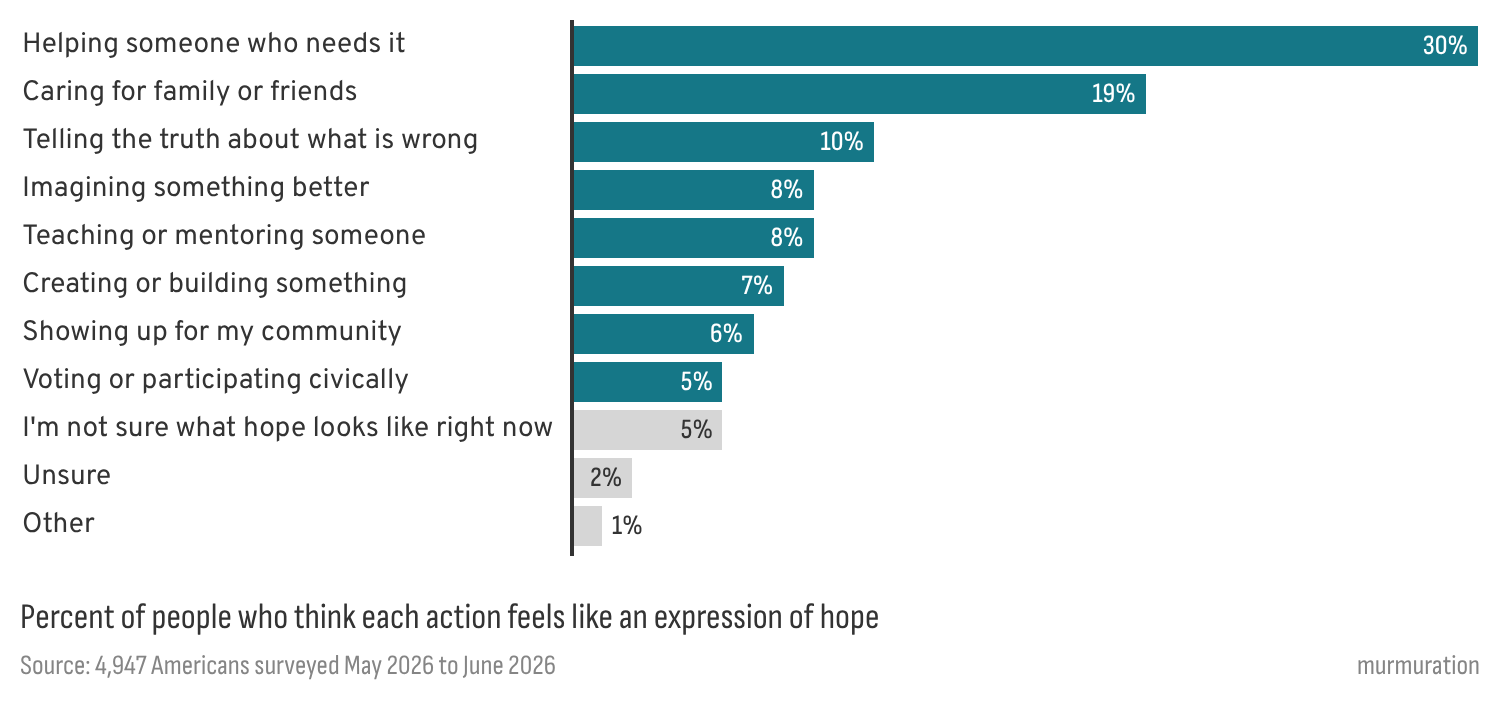
When Americans describe hope, they talk about people. Asked which actions best reflect hope for the future, Americans overwhelmingly choose helping someone who needs it (30%) and caring for family and friends (19%). Far fewer point to voting (5%), creating or building something (7%), or showing up for their community (6%).
This local focus is also clear when we ask people to recount a recent experience that gave them hope. There, 21% mention witnessing kindness in their community, 17% mention personal progress, and 16% mention family milestones. Only 15% mention national events, and only 11% say some version of “nothing”.
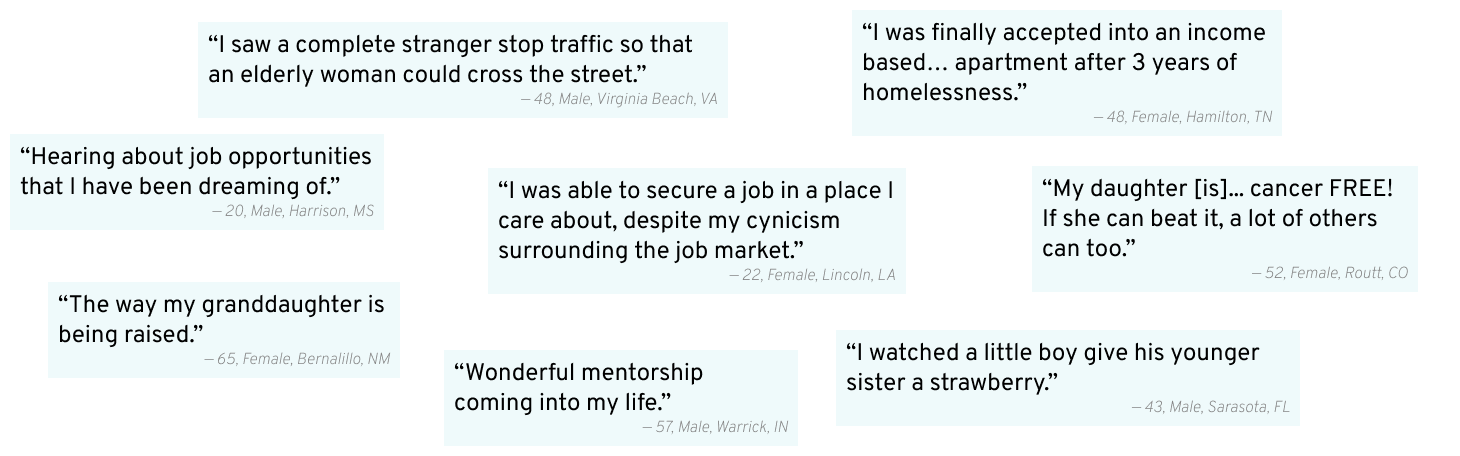
This finding is easy to overlook because it feels ordinary. But perhaps that is the point. Much of modern political life asks people to think about the future through institutions, elections, and large-scale systems change. Americans, by contrast, seem to experience hope through everyday acts of care and contribution.
But while Americans largely agree on what hope looks like, they do not experience it equally. Again, Americans who are financially comfortable are substantially more likely to feel hopeful about their own lives (83% of Prosperous vs. 38% of Struggling), their communities (68% vs. 37%), the country (67% vs. 24%), and the world (51% vs. 24%). They are also far less likely to identify financial stress as an obstacle to hope (10% vs. 44%).
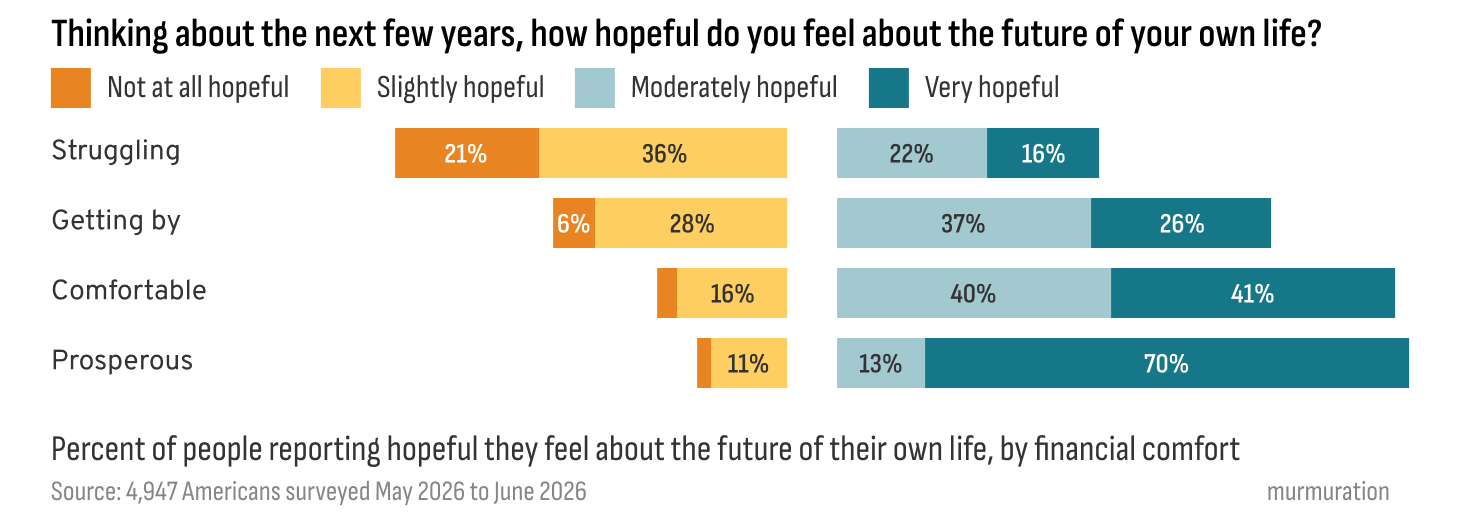
Those who are struggling financially tell a different story. Financial stress looms larger. Confidence in the future is lower. The future itself can feel less certain and less attainable.
The Future Americans Want
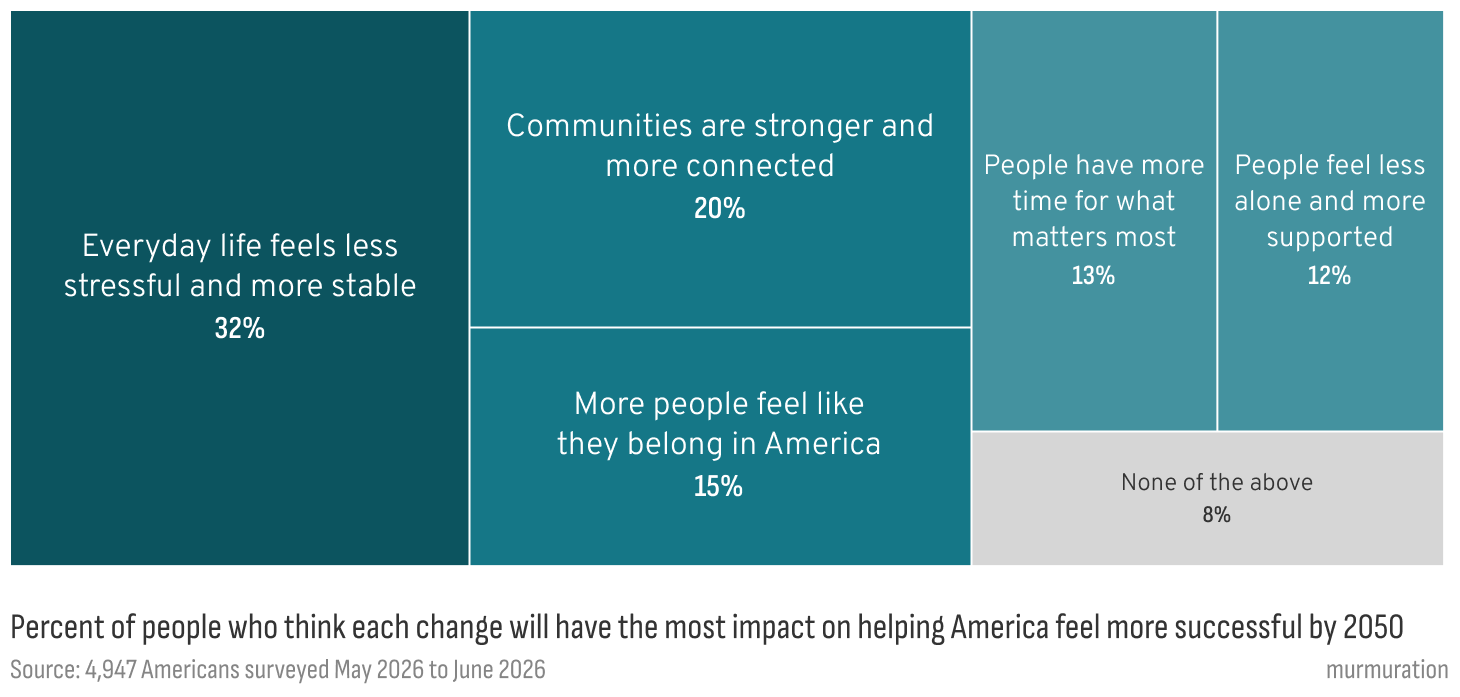
When asked what would make America more successful by 2050, Americans point first to less stressful and more stable lives (32%). Others emphasize stronger communities (20%), more belonging (15%), more time for what matters (13%), and less loneliness (12%). Those who feel hopeful about their own lives are more likely to think stronger and more connected communities are the most important factor in America’s future success, while those who do not feel hopeful emphasize less stress and more stability.
When asked what would make the biggest difference for the country’s future, the most common answer is clear: more people being able to afford a stable and secure life (43%). Americans also point to smaller economic and social divides (18%), better physical and mental health (13%), and more opportunity (12%).
The same pattern appears when people think about democracy itself. Americans say democracy would improve if the government worked better for ordinary people (33%) and if people could disagree without hating one another (30%). But the priorities differ sharply based on how hopeful they feel about the country’s future. Among those who are very hopeful, 41% say the biggest need is learning to disagree without hating one another. Among those who are not at all hopeful, 45% instead point to a government that works better for ordinary people.
Interestingly, when we asked people to describe something they hoped they would see in their lifetime, the most common answers were about political changes. One in five (20%) cited political changes, the most common response. Another 14% mentioned world peace, and 10% described equality and social progress. Fourteen percent described accomplishing personal goals, and another 14% described family milestones.
Final Thoughts
People thrive when they have roots, relationships, and room to pursue what matters. They thrive when they feel recognized, empowered, included, and hopeful about the future. And while the specifics changed from survey to survey, one pattern remained remarkably consistent: the clearest divide in the data was between those with enough stability to participate fully in their lives and communities and those still struggling to secure that foundation.
So we will leave you with a few questions for the next 250 years:
How do we build communities where more people feel they belong?
What creates the conditions for people not just to survive, but to participate, contribute, and thrive?
And how do we ensure that hope is not a privilege reserved for those with the greatest resources and security?
Across seven surveys, the future Americans described was not extraordinary. In many ways, it was remarkably human: more connection, more dignity, more opportunity, more participation, and more hope.
Perhaps the challenge of America’s next 250 years is not imagining a better future. It is creating the conditions that allow more people to experience it.
We are in. Who wants to join us?
As America marks its 250th anniversary, this State of Us series looks beyond nostalgia and national myth toward the future we still have the chance to build—one grounded in belonging, connection, dignity, and the everyday realities of American life.
Murmuration is a non-profit that organizes a network of partners and equips them with the insights, tools, and services needed to help communities build and activate the power to transform America into a nation where everyone thrives. murmuration.org