


Previously in America 251. We began with a simple question: Where do we belong? What we found was that people feel most connected to a place when they have stability, strong social ties, and reasons to invest in the communities around them. This week, we turn from place to people. If belonging answers where we feel rooted, connection asks who helps us feel at home.
The desire for connection remains everywhere. People still long for the kinds of relationships and routines that make life feel shared: the friend you call first with good news, the familiar faces at a local coffee shop, the weekly ritual that gives shape to your life, the neighbor who notices when you’re gone.
What we found in our new data is more complicated than the conventional story of isolation. Americans are not as disconnected as often claimed. Most still have people they can rely on, places they gather, and neighbors they help. At the same time, many worry that the communities around them are becoming more fragmented, withdrawn, and divided.
The challenge facing America may not simply be a lack of connection. It may reflect a difference between the connections people experience firsthand and the social fabric they believe exists around them.
The Connections We Still Have
For all the concern about loneliness, the data reveal a country that remains surprisingly connected in everyday ways.
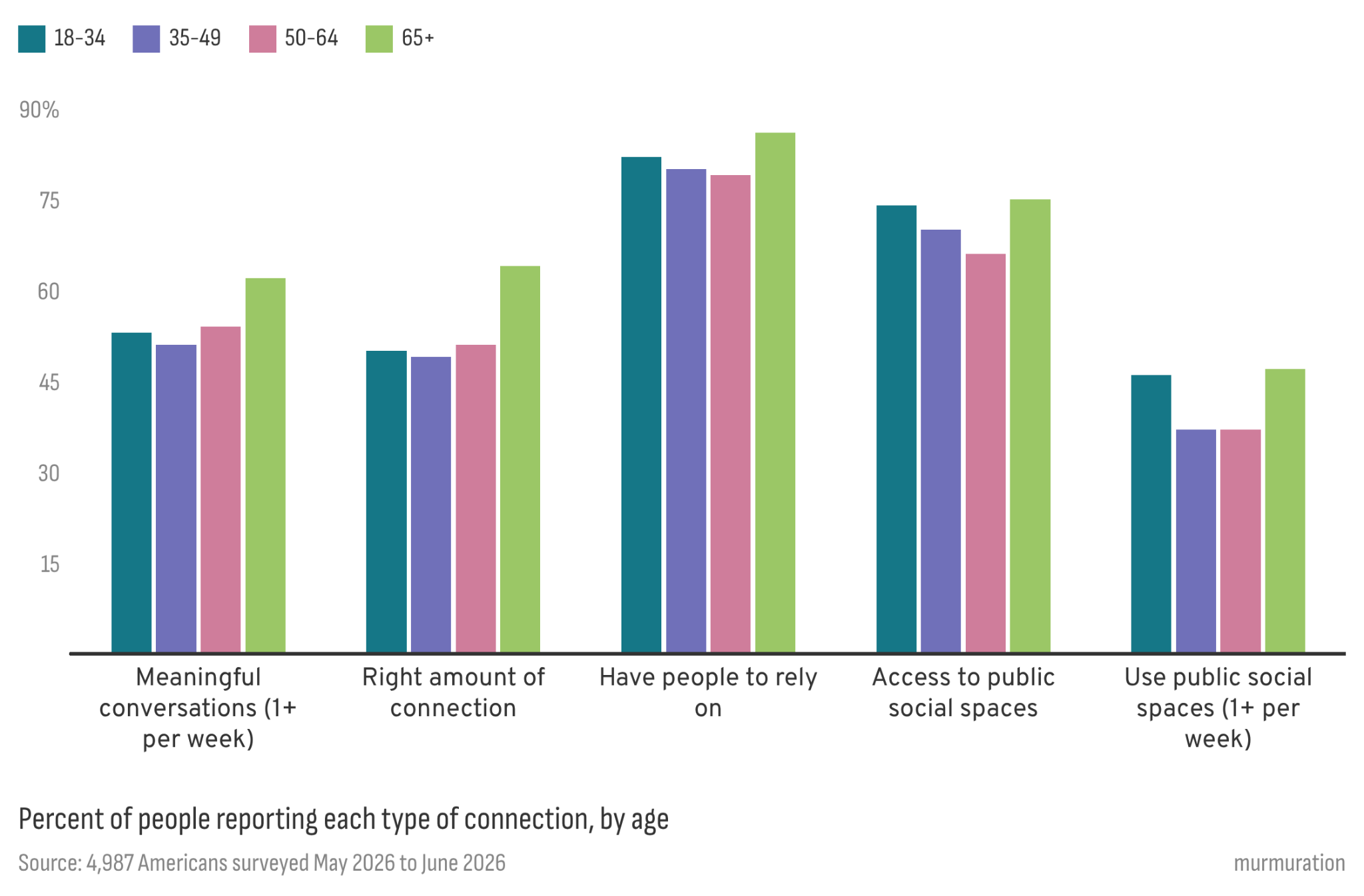
Most Americans report having meaningful conversations with someone outside of work or family at least a few times a week (54%). More than half say they have about the right amount of connection in their lives (53%). When asked how many people in their community they could rely on if they needed help, only a small share said they have no one at all (13%). Most can identify at least a few people they could turn to in a time of need.
When asked who they first tell good news to, 44% named a partner or spouse, 17% a parent, 11% a child, and 10% a friend. Only 3% said they tell no one. Of course, life stage changes these connections. Among Gen Z, a third named a parent, while only 8% of those 55+ did so. Those older adults most often name partners (48%) or children (18%).
A majority of Americans also seem to have social rituals they enjoy. Roughly two-thirds of people described at least one ritual, including shared meals (18%), get-togethers with friends (18%), outdoor activities (13%), among others.
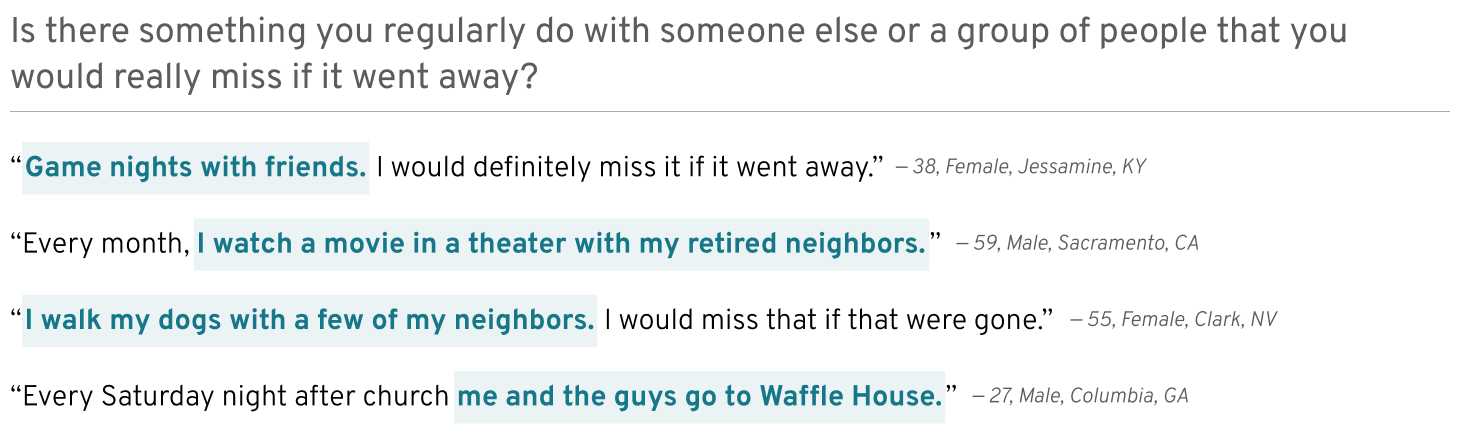
Perhaps most strikingly, nearly seven in ten Americans say they helped a neighbor or someone nearby in the past month (69%). Many report doing so multiple times. These aren’t grand gestures. They are favors, errands, check-ins, rides, meals, and moments of support. And they’re even more common among those who say they completely trust their neighbors (81%). Among those who say they don’t trust or only somewhat trust their neighbors, those numbers are lower: 52% and 65%, respectively. We can’t say for certain which comes first, but trust and neighborly acts of support clearly go hand in hand. Communities where people help one another tend to be more trusting, and that trust may encourage even more helping in return.
The data also suggest that connection is tied to place. Most Americans say they have at least a few places in their community—outside of home and work—where they enjoy being around other people (72%). Most spend time in these spaces at least a few times each month (78%).
Whether it’s a church, library, coffee shop, park, volunteer organization, community center, or local business, these third spaces create opportunities for the repeated interactions that allow relationships to form.
Alone Together?
While Americans generally describe their own relationships positively, they are far less positive when describing the broader communities around them. Most people say they have the right amount of connection in their lives. Most people have people they can rely on. Most people have meaningful conversations and regularly help others.
Yet only about a third describe the people in their communities as connected (35%). Similar shares describe their communities as cohesive (33%) or engaged (38%). Large numbers instead see their communities as isolated, divided, or withdrawn.
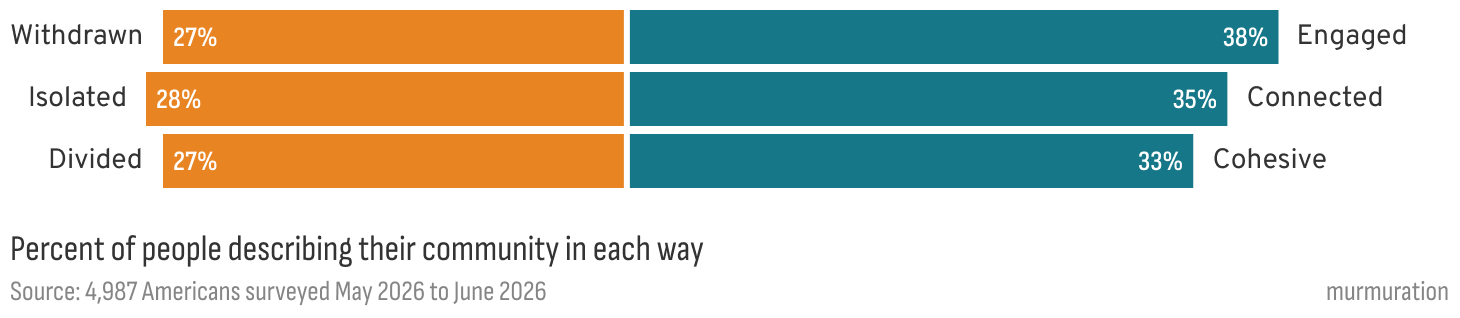
This discrepancy appears throughout the data. Americans seem considerably more confident about their own relationships than they are about the connections and cohesion within their communities. But here again, we see a critical role for interpersonal trust to play. Among those who completely trust their neighbors, 55% see their broader communities as connected, 47% as cohesive, and 55% as engaged, rates that are +39pp, +34pp, and +40pp higher than those who say they don’t trust their neighbors.
Connection Has an Economic Gradient
Just as financial comfort shaped whether people felt rooted in our belonging data, it also appears to shape whether people feel connected.
Across nearly every measure, financially comfortable Americans report being more likely to trust the people who live near them (63% of Prosperous vs. 34% of Struggling). They are more likely to report daily meaningful conversations outside of work and family (41% vs. 18%). They are more likely to feel they have the right amount of connection in their lives (66% vs. 34%). They are also more likely to have places in their community where they enjoy spending time around other people (81% vs. 55%), more likely to have multiple people they could rely on for help (89% vs. 70%), and more likely to feel confident they could build new relationships if they needed to start over (66% vs. 30%).
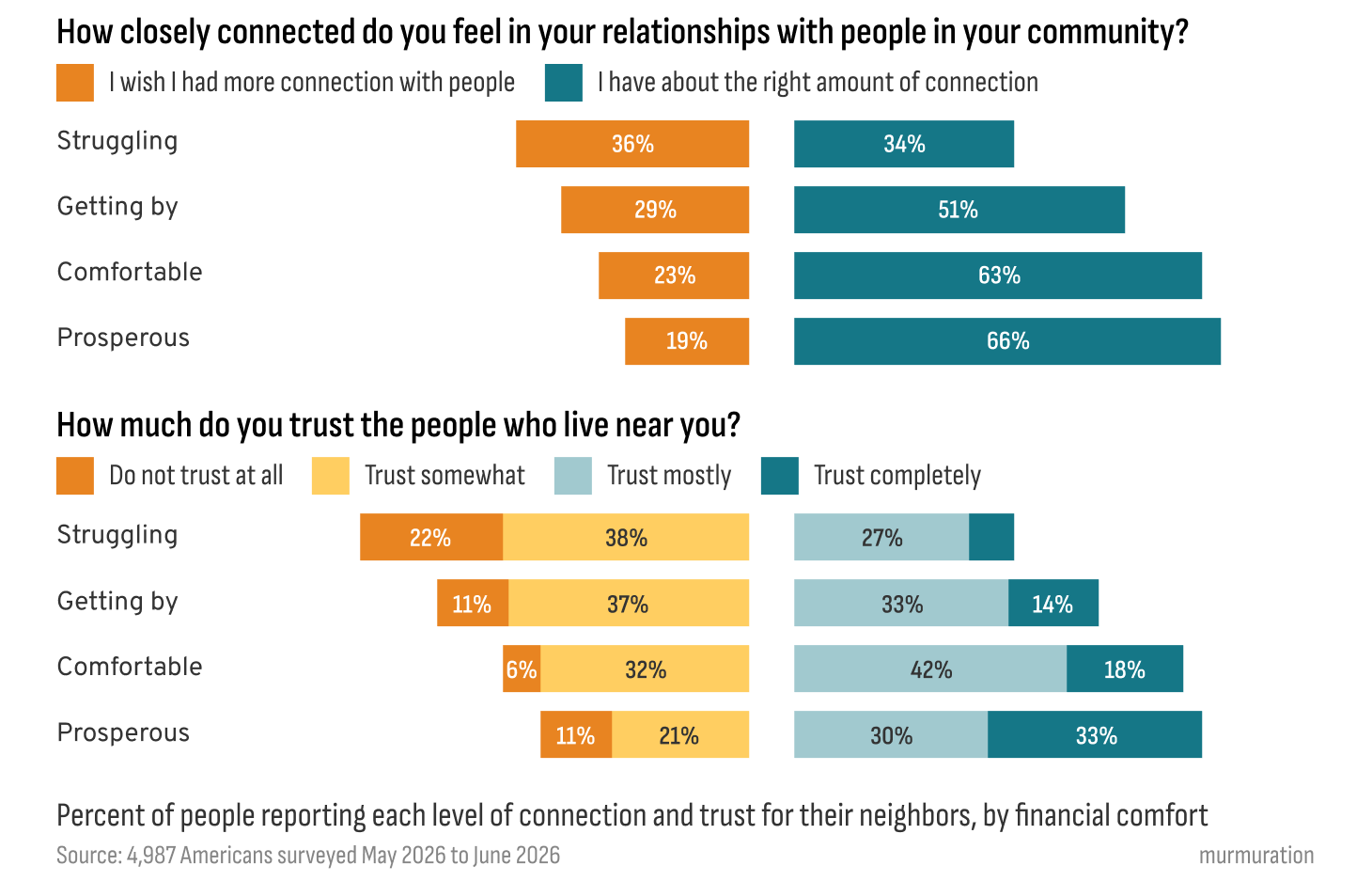
The same pattern appears when people evaluate their communities. Americans who are financially comfortable are substantially more likely to describe their communities as connected, cohesive, and engaged. Those who are struggling are far more likely to describe them as isolated, divided, and withdrawn.
Final Thoughts
The story in these data is not that connection has disappeared. Americans are still helping neighbors, relying on one another, and finding places where community can take root. But those connections are not as secure or widely shared as we might hope.
Throughout the data, a paradox emerges: people remain confident in their own relationships while believing the broader social fabric is fraying around them. Many continue to build trust and connection in their daily lives while worrying that those same bonds are weakening in society at large.
And, much like belonging, these perceptions are closely tied to financial stability. Americans who feel financially secure are more likely to describe their communities as connected, trustworthy, and engaged, while those facing financial strain are more likely to experience disconnection—not just in their own lives, but in the places around them.
The findings point to several tensions worth exploring:
Why do Americans remain confident in their own relationships while losing confidence in the social fabric around them?
What conditions help transform individual relationships into a broader sense of community trust and cohesion?
As more of life moves online, what kinds of places and experiences still create the shared bonds that hold place-based communities together?
Our findings on belonging and connection suggest that community is not a single feeling. It is a web of relationships, routines, and opportunities that help people feel rooted in both the places they call home and the people around them.
Community doesn’t happen by accident.
As America marks its 250th anniversary, this State of Us series looks beyond nostalgia and national myth toward the future we still have the chance to build—one grounded in belonging, connection, dignity, and the everyday realities of American life.
Murmuration is a non-profit that organizes a network of partners and equips them with the insights, tools, and services needed to help communities build and activate the power to transform America into a nation where everyone thrives. murmuration.org