


America turns 250 this July. There will undoubtedly be no shortage of retrospectives, reenactments, and arguments about the founding. The story of America has always been contested, but its future is still unwritten. So at State of Us, we’re interested in a different question: What should America become?
Most Americans are not spending their days thinking about semiquincentennials or constitutional originalism. They’re thinking about whether they belong where they live. Whether they can build a meaningful life. Whether they feel connected to other people. Whether joy, dignity, purpose, safety, and hope still feel attainable. Whether democracy can still deliver something human.
Over the coming weeks, in this seven-part series, we’ll explore the themes that lie beneath politics, yet shape civic life every day: belonging, connection, joy, identity, change, nationhood, and hope.
Together, these questions point toward something larger. What are the conditions that allow people not just to survive, but to thrive? What helps people build meaningful lives, contribute to their communities, and imagine a better future?
Welcome to America 251.
Americans move more than almost anyone else in the world. We leave hometowns for opportunity, reinvent ourselves in new places, and often build lives far from the people and communities that raised us. Mobility has long been celebrated as a hallmark of freedom and success. But it comes with a tradeoff: many people are left searching for a sense of belonging.
Belonging is more than identity. It is rootedness—a feeling that you know a place, are known by others, and matter to the community around you. Yet many Americans describe their communities as fragmented, transient, or isolating. Third places are disappearing, housing instability disrupts roots, and more interactions are taking place online than they are in person.
As America approaches its 250th anniversary, belonging is not just a personal question. It is a civic one. Democracy depends not only on institutions but on people feeling connected to the places and communities they call home.
Belonging Starts With Stability
Americans often talk about belonging as a feeling. But our data suggest it may begin with something more concrete: stability.
Most Americans say they feel at least some sense of belonging where they live, and many have lived in the same community for years. Yet beneath those toplines, belonging looks very different depending on whether people feel financially secure.
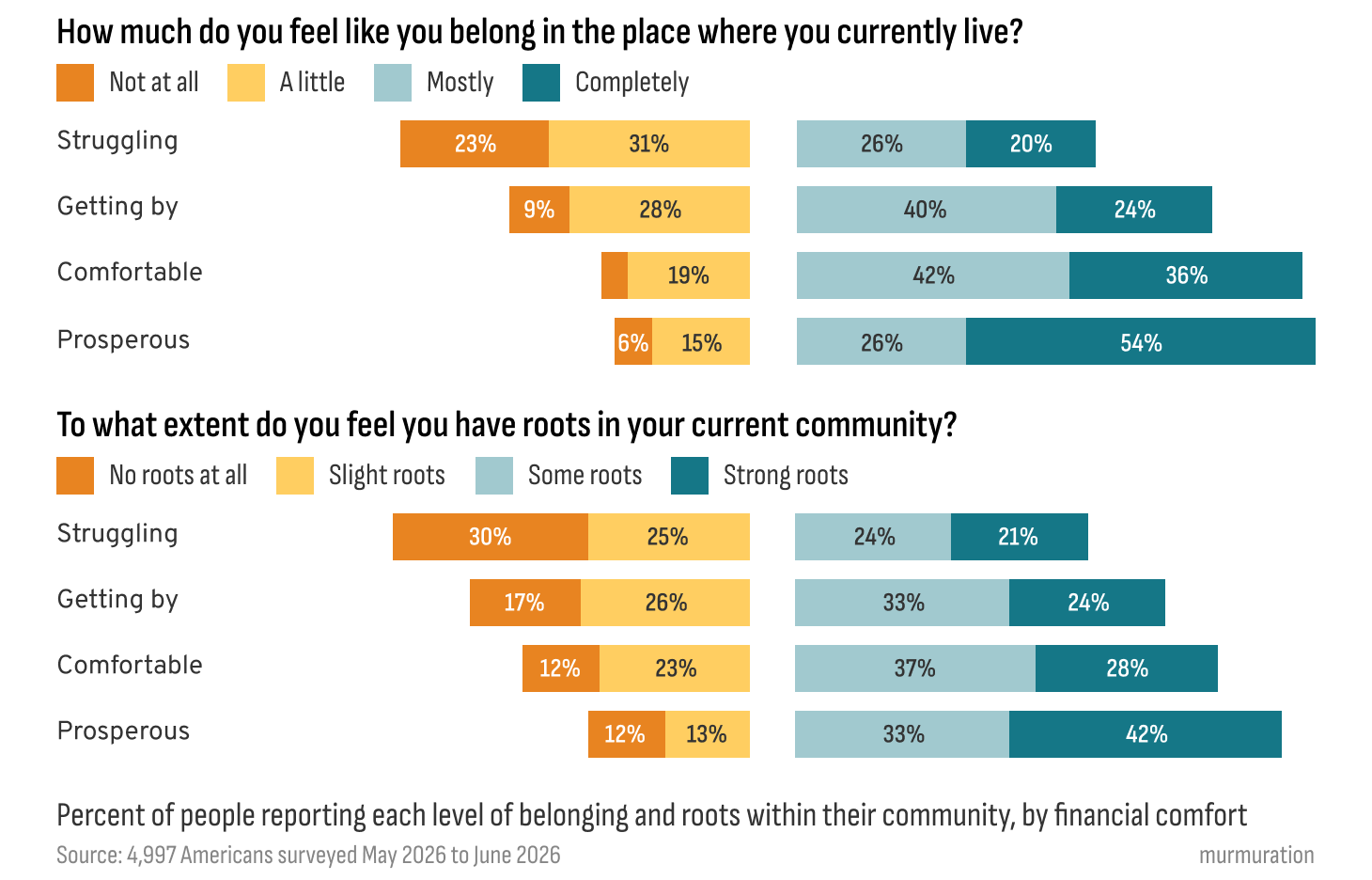
As shown above, those who are financially comfortable are far more likely to report strong roots in their communities than those who are struggling. They are also dramatically more likely to say they completely belong where they live, know many of their neighbors by name, and feel they have a lot in common with the people around them.
The pattern extends beyond relationships. Financially secure Americans are more likely to say the place they live is “very important” to their identity (42% of Prosperous, 18% of Struggling), that their community provides outdoor spaces “very well” (57% versus 30%), and that “all or most” of the things they need in daily life are located nearby (72% versus 44%). Those who are struggling are more likely to say they have no roots at all (30%) and know few or none of their neighbors (73%).
But stability alone does not appear to create belonging. Relationships also play a big role. Among those who say they completely belong where they live, 70% report having a lot in common with their neighbors. Among those who do not feel they belong at all, that number falls to just 5%. Similarly, people who feel they belong are much more likely to know their neighbors by name. More than half know most or all of their neighbors, compared with just 16% of those who do not feel they belong.
We Stay for People, Not Places
When we asked people why they live where they do—and why they would stay—the answers were remarkably consistent.
The most common reason Americans live where they do is simple: family (30%). Another large share say they remain where they grew up (22%). Fewer cite lifestyle (18%), work (14%), or affordability (11%) as their primary reason for being there.
And when looking toward the future, relationships become even more important. The leading reason people would choose to stay in their community long-term is that family and friends are there (31%).
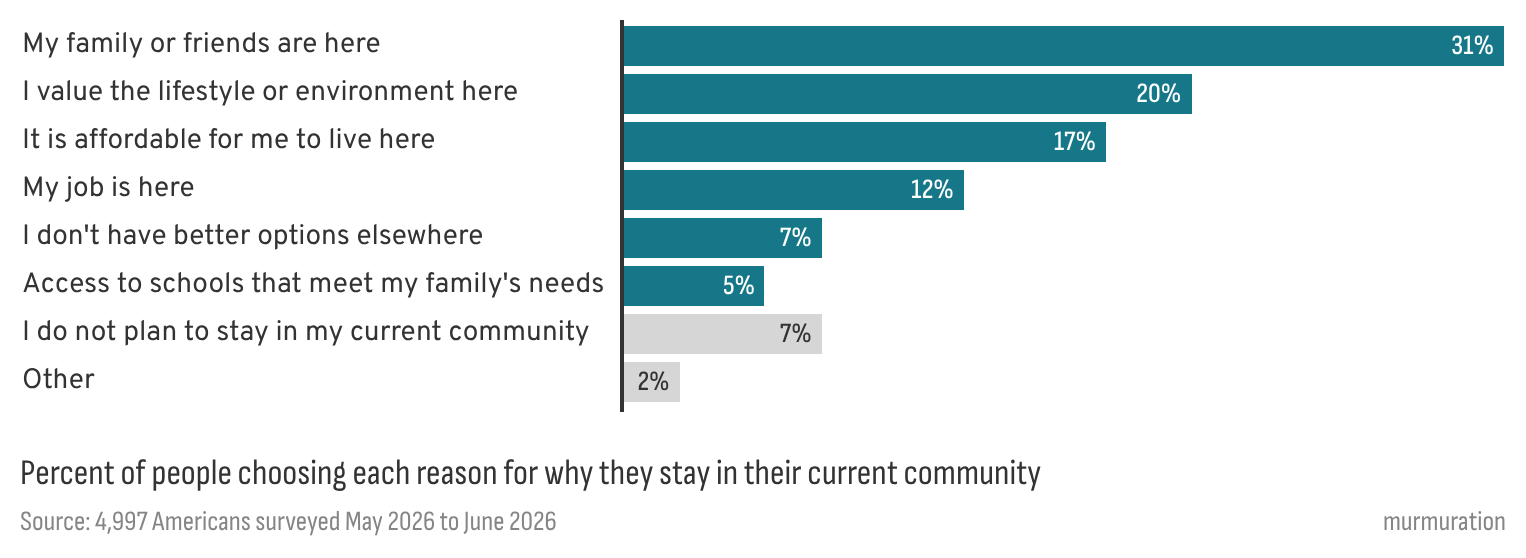
That connection to place matters more than it might seem. Among Americans with strong roots in their communities, nearly four in ten say they live where they do because it is where they grew up. Among those with no roots at all, only 8% say the same. The importance of social ties becomes even clearer when we look at who feels most rooted. Among Americans with strong roots in their community, 44% say family and friends are the primary reason they would stay long-term. Among those with no roots at all, that figure falls to just 16%.
Interestingly, people who feel a strong sense of belonging are also more likely to say they stay because they value the lifestyle or environment where they live. Those who do not belong are much more likely to say they stay because they lack better options elsewhere.
Final Thoughts
For generations, mobility has been one of America’s defining features. We celebrate the freedom to move, reinvent ourselves, and pursue opportunity wherever it leads. But belonging asks something different of us. It asks us to stay long enough to know our neighbors, build relationships, and become part of a shared story.
What this data makes clear is that belonging is not evenly distributed. Some people feel deeply rooted in the places they call home, while others feel disconnected from the communities around them. The biggest differences are not about who people are. They are about the conditions of their lives: whether they feel financially secure, know their neighbors, have roots in a place, and see themselves as part of a community.
That raises important questions about the future of civic life.
If financial security is one of the strongest predictors of feeling rooted, what does that mean for communities facing rising housing costs, displacement, and economic uncertainty?
As families become more geographically dispersed, where will future generations find the relationships that anchor them to place?
And what does belonging look like in an era when finding connection may be broader than ever, but less deeply rooted?
The challenge is that belonging depends on conditions that feel increasingly fragile: stable housing, economic security, welcoming public spaces, and strong social ties. When those foundations are present, people put down roots. They invest in their neighborhoods, build relationships, and see themselves as part of something larger than themselves.
When those foundations are absent, community can begin to feel temporary—even when people never leave.
Find your place. Find your people.
As America marks its 250th anniversary, this seven-part State of Us series looks beyond nostalgia and national myth toward the future we still have the chance to build—one grounded in belonging, connection, dignity, and the everyday realities of American life.
Murmuration is a non-profit that organizes a network of partners and equips them with the insights, tools, and services needed to help communities build and activate the power to transform America into a nation where everyone thrives. murmuration.org