


Previously in America 251. We've found a common story: Americans thrive when they have strong relationships, meaningful opportunities to participate in community life, and the freedom to live authentically. We also encountered an unexpected pattern. Financial comfort consistently shaped whether people felt rooted, connected, joyful, and recognized. This week, we explore another topic at the heart of American life: agency.
Many Americans look around and see reasons for concern. Rising costs, political division, loneliness, declining trust in institutions, and a sense that many of the systems meant to support people are not working as well as they should. Given that backdrop, it is not surprising that many are uncertain about the country’s direction.
The deeper question is what happens next. When people see problems that feel larger than themselves, do they believe change is possible? And if so, who do they believe is responsible for making it happen? These questions matter because agency sits at the heart of civic life.
What we found in this survey is more hopeful than the national mood might suggest. Americans remain deeply frustrated by many of the challenges they face. Yet they have not given up on change. Instead, they appear to be rethinking where change comes from and what meaningful action looks like. Rather than looking exclusively to national leaders or institutions, many place their faith closer to home—in local communities, personal relationships, and the belief that small actions can still add up to something larger.
Ordinary People Matter Most
For all the discussion about cynicism and distrust, Americans still believe in the power of ordinary people. More than nine-in-ten say ordinary people can help change things in their communities at least somewhat (92%). More than half believe ordinary people can make a difference “a lot” or “a great deal” (52%). Most Americans also report having at least some control over the direction of their own lives (91%), with a majority saying they have “a lot” or “a great deal” of control (51%).
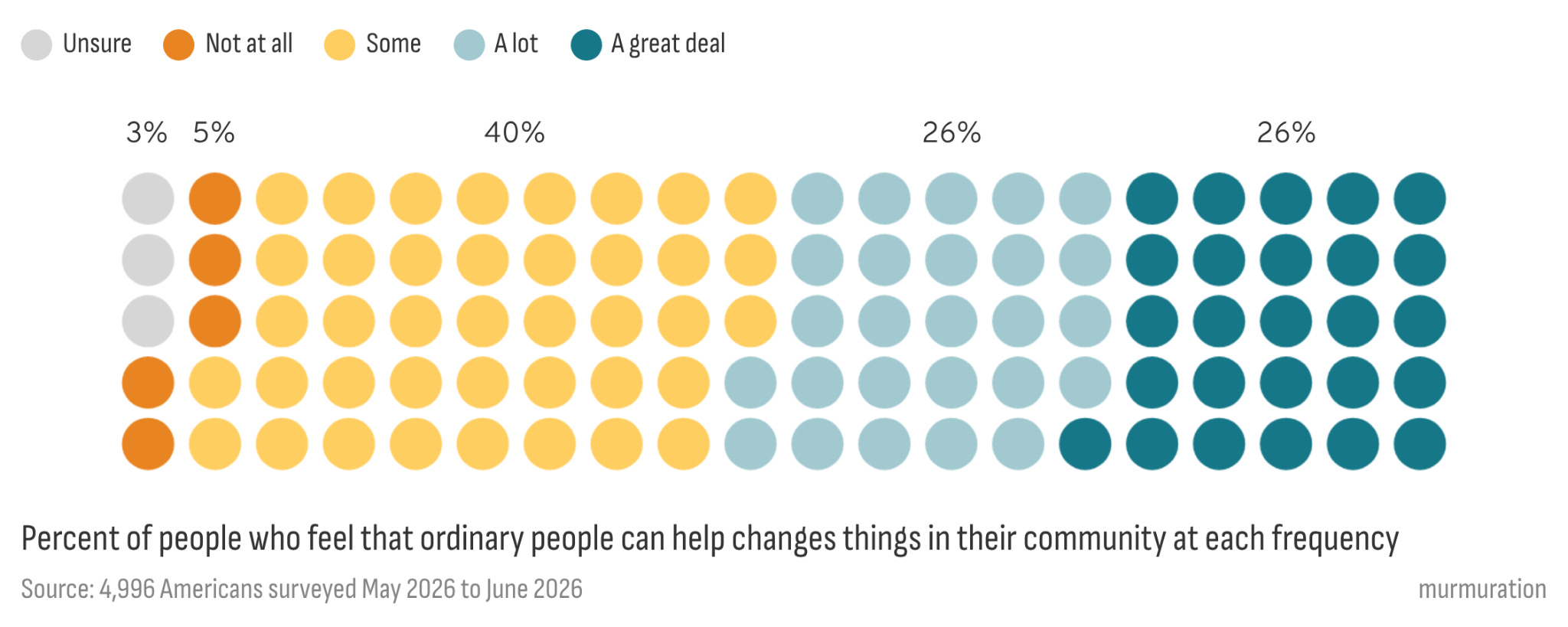
What makes this finding particularly striking is how little disagreement exists. Across age groups, educational backgrounds, races, and political affiliations, Americans are remarkably aligned in believing that ordinary people make a difference.
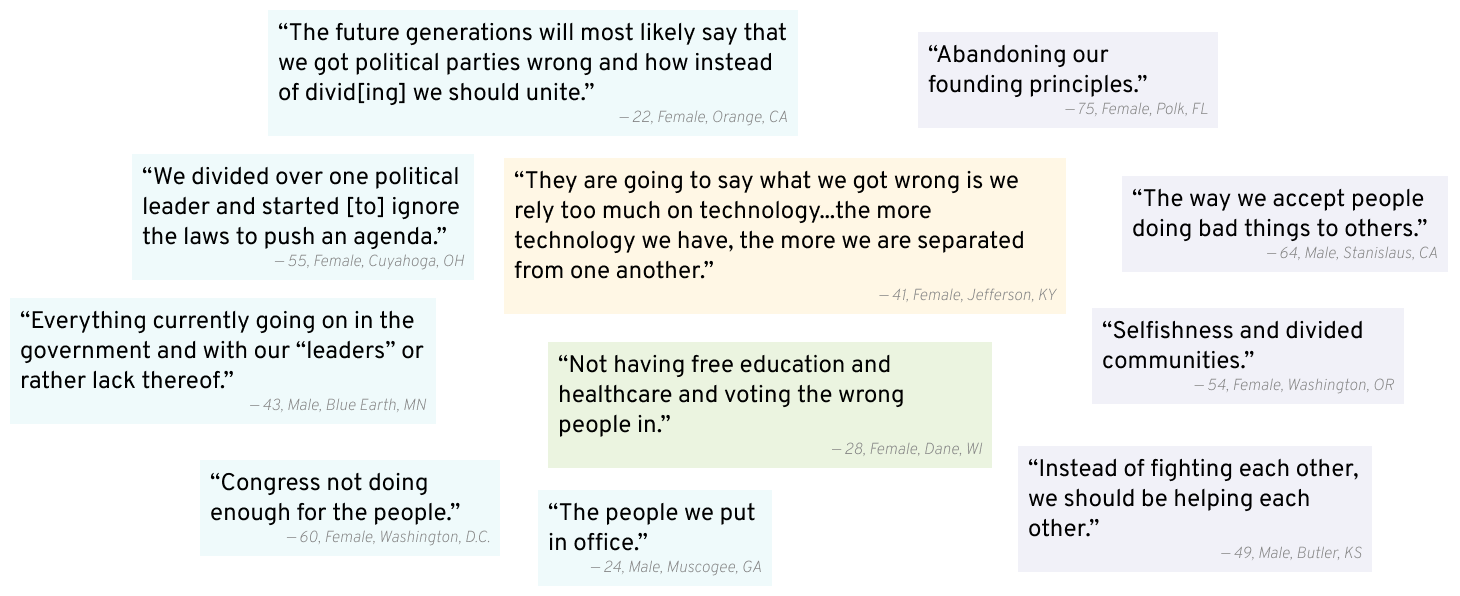
That faith stands in sharp contrast to how Americans view those currently in power. Asked what future generations are most likely to say we got wrong, the most common answer is political leadership (23%). Here, too, we see remarkable unanimity. Across age, education, parental status, race, income, and gender, Americans most often point to today’s political leaders, followed by lost values and connections (16%) and division and hatred (13%).
This frustration is mirrored when we ask people what they wish they had the ability to influence in America. A plurality point to politics and government (26%), the very area they expect to regret most, while another 12% name social division and civility.
The data also suggest Americans have not entirely lost faith in solving big problems. When asked which challenge seems most realistic to address, respondents pointed first to the cost of living (22%), followed by government accountability (14%), healthcare (12%), housing affordability (9%), and education (9%). Notably, relatively few selected political division (6%). The issues people believe can be solved are often the ones they can see, experience, and influence directly.
By now, this won’t surprise you: the strongest divide in the data is financial comfort. Americans who are financially comfortable are far more likely to feel they have a great deal of control over the direction of their own lives (52% of Prosperous vs. 13% of Struggling). They are also more likely to believe ordinary people can help change things a great deal in their communities (47% vs. 26%) and to have taken action locally in the past year (55% vs. 33%).
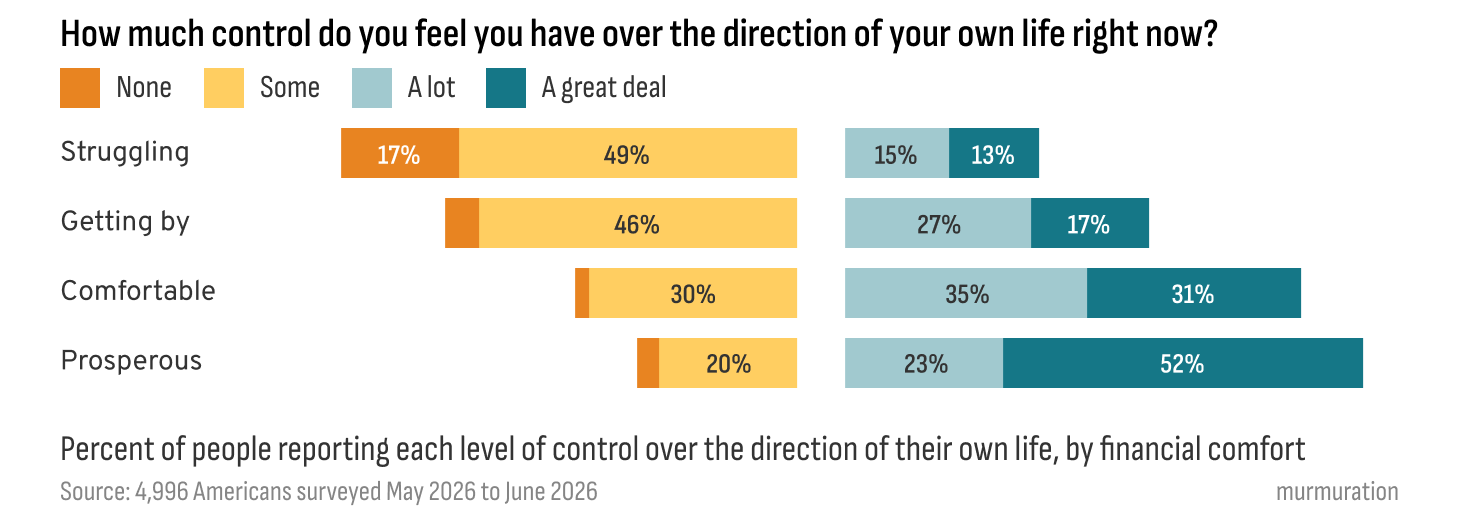
The opposite is also true. Americans who are struggling financially are more likely to feel little or no control over their own lives, less likely to have acted in their communities, and more likely to say they wanted to get involved but have not yet done so.
Making Change Local
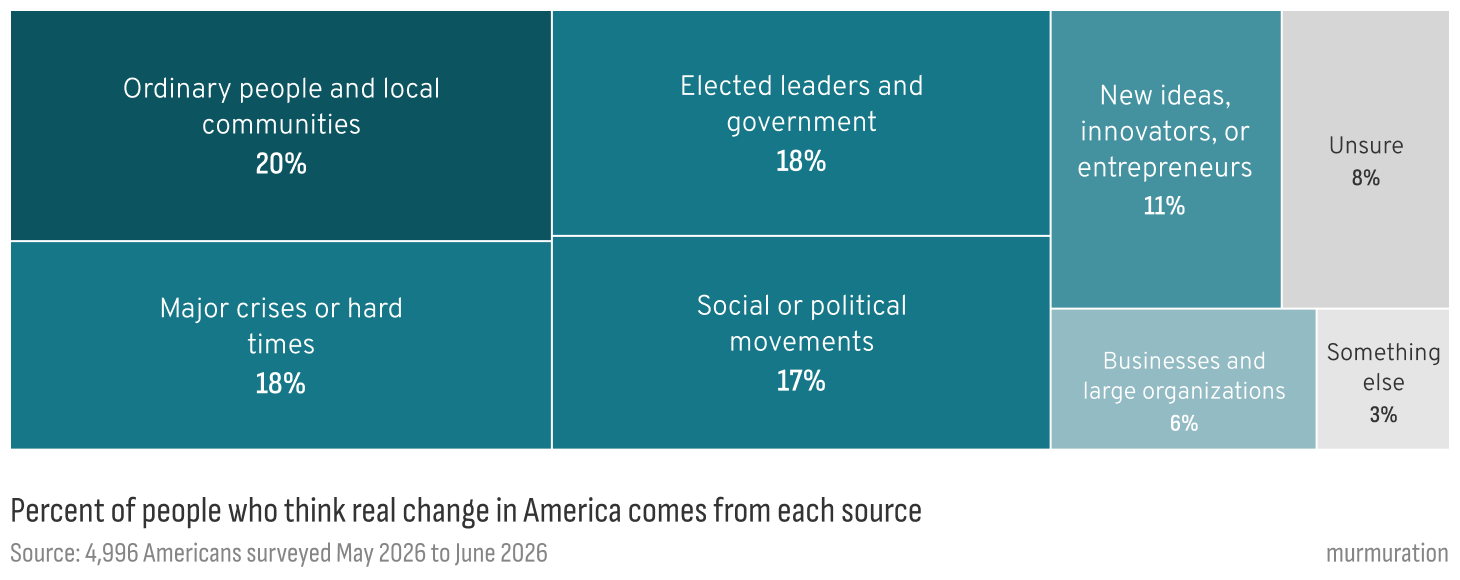
When asked where real change happens in America, no single institution dominates. Americans are divided among ordinary people and local communities (20%), elected leaders and government (18%), social movements (17%), and major crises or hard times (18%).
But when we look at how people personally define meaningful action, a much clearer picture emerges. The most meaningful action, according to Americans, is helping someone directly (33%). Volunteering (19%) and voting (19%) tie for second. Far fewer point to joining organizations, contacting elected officials, donating money, or speaking publicly.
When Americans think about change, they tend to imagine it at a human scale. A neighbor helping a neighbor. A volunteer showing up consistently. A community solving a local problem. A person deciding to get involved.
The behavioral data tell a similar story. More than four in ten Americans say they have taken action to improve something in their local community during the past year (41%). Another nearly three-in-ten say they have wanted to but have not yet taken action (29%). Belief in how much ordinary people can change things has an impact on how often Americans take action in their own communities. A majority (56%) of those who believe ordinary people can change things a great deal have taken action at least once in the past year, compared to those who don’t think people can change things at all (21%).
The data also reveal something encouraging about how Americans connect across differences. Most report having meaningful conversations with people from a different generation at least sometimes (77%), including a substantial share who do so very often (29%).
Final Thoughts
While trust in institutions may be strained, belief in people remains remarkably resilient. Americans still believe ordinary people can make a difference. They still see value in helping neighbors, volunteering, showing up for their communities, and investing in the places closest to them. For many, change feels less like something delivered from above and more like something built from the ground up.
The data have us wondering about what strengthens civic agency:
What helps people believe that change is possible in the first place?
What helps people move from wanting to make a difference to actually taking action?
How can communities create more opportunities for people to participate in meaningful ways close to home?
This data mirrors a pattern we’ve seen throughout this series. Whether we are talking about belonging, connection, joy, identity, or change, Americans consistently place their faith in things that are personal, local, and relational. The strongest forces in civic life often begin not with institutions, but with people.
Democracy starts close to home.
As America marks its 250th anniversary, this State of Us series looks beyond nostalgia and national myth toward the future we still have the chance to build—one grounded in belonging, connection, dignity, and the everyday realities of American life.
Murmuration is a non-profit that organizes a network of partners and equips them with the insights, tools, and services needed to help communities build and activate the power to transform America into a nation where everyone thrives. murmuration.org