


Previously in America 251. Thus far, we’ve found that people are more likely to feel rooted when they have stability, more connected when they have strong relationships, and more joyful when they have the time and freedom to pursue what matters to them. But thriving is not only about where we live or how we spend our time. It’s also about who we become. This week, we explore identity: what helps people feel seen, valued, and free to be themselves.
Identity has always shaped American life: who belongs, who is seen, who is valued, and who has access to power and opportunity. But identity is also deeply personal, shaped by family, community, culture, work, memory, and experience.
Most Americans are still in the process of becoming themselves.
In a culture that prizes certainty and self-definition, that may sound surprising. Yet our data suggest that identity is less a destination than an ongoing process. People are continually adapting, balancing different roles, and reconciling who they are with who they hope to become.
The result is a portrait of Americans that is both hopeful and complicated: people who are largely proud of who they are, yet still evolving; who often feel accepted, yet still feel pressure to fit in; and who are searching not just for belonging, but for the freedom to become themselves.
A Work in Progress
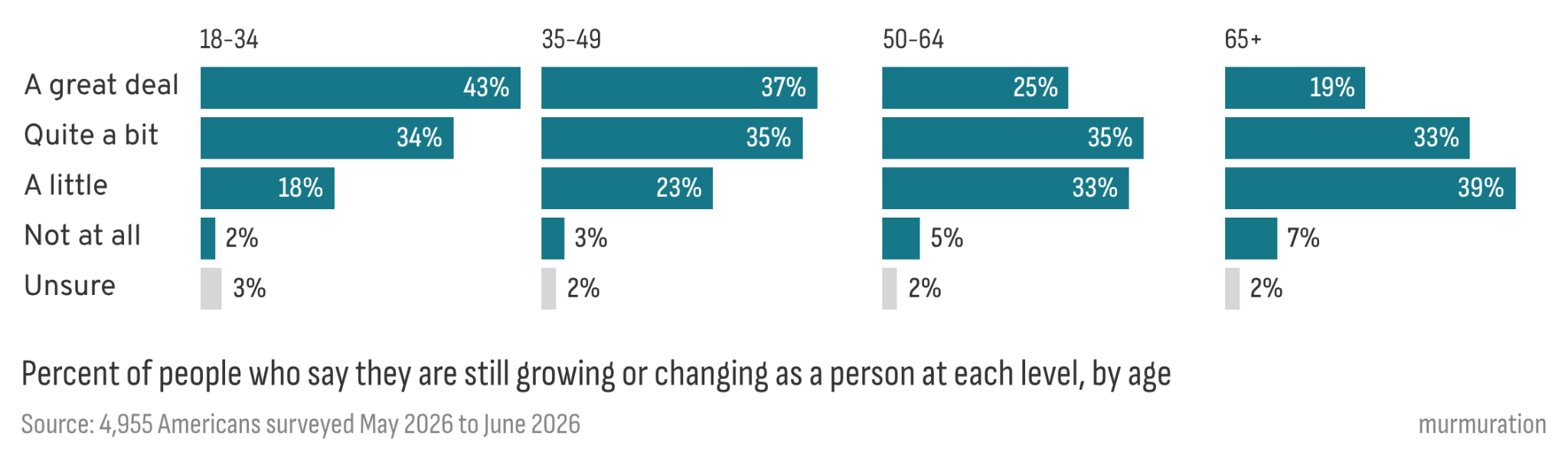
The first thing that stands out in the data is how few Americans believe they are finished becoming who they are. Two-thirds say they are still growing or changing as a person, either “a great deal” or “quite a bit” (66%). Only a small share says they are no longer changing at all (4%). Even among older Americans, many continue to describe themselves as evolving.
When people describe who they are today, they rarely offer fixed labels. Instead, they talk about themselves as people navigating life, balancing responsibilities, and continuing to become. As one 21-year-old woman from Texas put it, she is “an open-minded Hispanic woman trying to navigate the changes in this country.” A 38-year-old man from South Carolina described himself as “a motivated professional who values family and community.” Others defined themselves through everyday passions and aspirations: “I am a simple person. I love punk rock and beer. I love helping people,” wrote a 47-year-old man from Louisiana, while a 59-year-old woman from California summed herself up as “an American citizen just trying to live the American dream.”
At the same time, Americans see their identities as deeply rooted in the people and places that shaped them. Seven in ten say their upbringing influences who they are today either “a lot” or “almost entirely” (70%). When asked who had the biggest influence on who they became, the answers were remarkably grounded. Parents topped the list (27%), followed by spouses and partners (18%). Far fewer pointed to public figures, books, media, or cultural leaders. In an era often defined by influencers and algorithms, the strongest influences on identity remain the people closest to us. This finding also challenges the popular notion that identity is purely individual. Only about one in five Americans say they mostly figured out who they are on their own (21%).
The Many Selves We Carry
Most Americans report being able to be their true selves in daily life. Roughly two-thirds say they can do so always or often (67%). Most also say they feel respected and appreciated by the people around them (72%), and more than half say they often or always feel proud of who they are (56%).
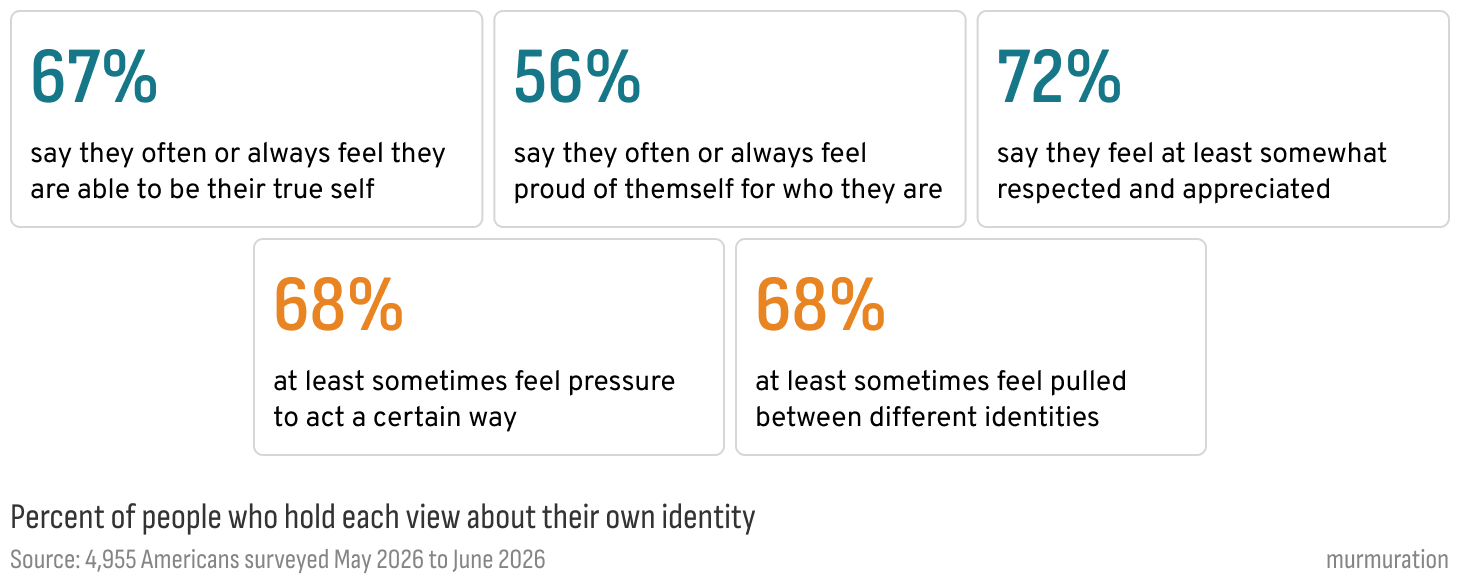
But another set of numbers tells a different story. Large majorities say they feel pressure to act a certain way because of what others expect, at least sometimes (68%). Similar numbers say they feel pulled between different parts of their identity—between different roles, values, obligations, or expectations (68%). These pressures don’t fall only on people who often struggle to be themselves. Even among people who say they are always able to be themselves, half (50%) still feel pulled between different parts of their identity at least sometimes, and 44% feel pressured to act in a certain way at least sometimes.
The data suggest that the challenge facing many Americans is not hiding who they are. It is reconciling the many versions of themselves they are asked to be. Parent and employee. Caregiver and individual. Neighbor and newcomer. Ambitious and exhausted. Independent and responsible to others.
At the same time, those experiences are not distributed equally. Compared to people who perceive themselves as more “normal” in their communities, people who perceive themselves as more “different” are far more likely to say they often or always feel pressure to act a certain way (40% vs 23%). They are also less likely to say they can always be themselves (24% vs 42%), and more likely to say they often or always feel pulled between different parts of their identity (41% vs 22%).
And, as we’ve seen many times now, financial comfort also seems to play a role. Americans who are financially comfortable are significantly more likely to say they can be their true selves. They are more likely to feel proud of who they are. More likely to feel respected and appreciated by the people around them. More likely to see a meaningful role for themselves in their communities.
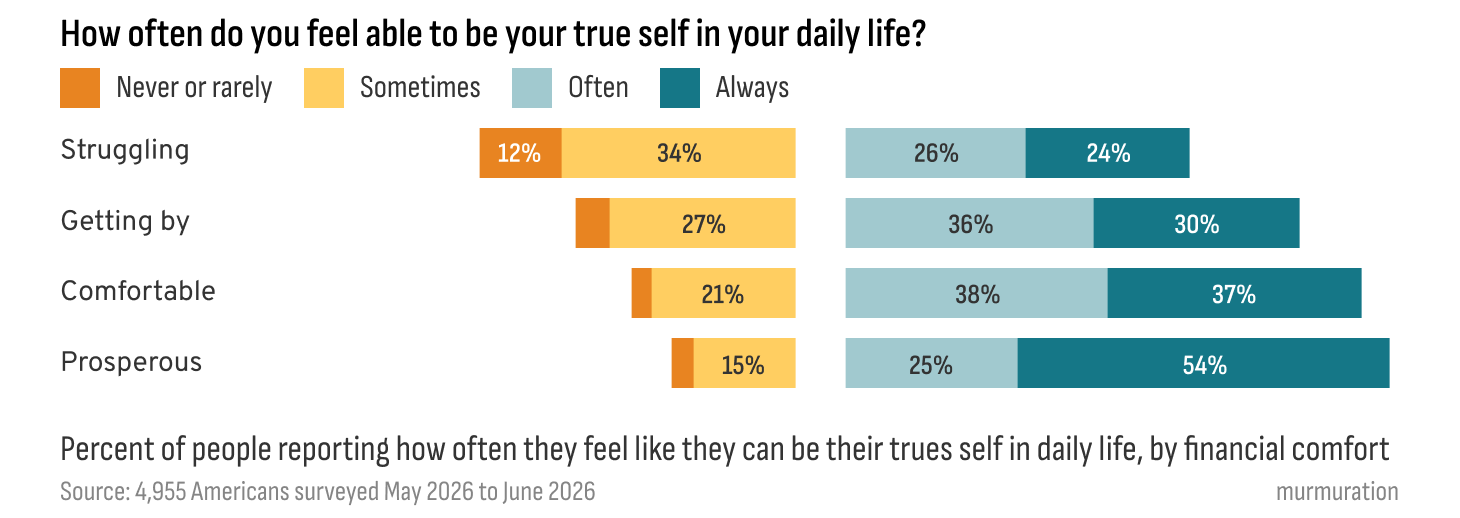
Those who are struggling financially report a very different experience. They are less likely to feel authentic, recognized, or valued, and more likely to feel different from the people around them.
That does not mean identity is reducible to economics. It isn’t. But it does suggest that authenticity may be easier when people have enough stability to take social, professional, and personal risks. The conditions of daily life shape more than material well-being. They shape whether people feel free enough to fully be themselves.
Final Thoughts
Most Americans are still growing into themselves, navigating the competing roles and expectations of modern life. That may be truer than ever in a world where people move between communities and identities at increasing speed.
At the same time, most want something remarkably simple: to feel seen, respected, and accepted for who they are. The findings leave us with a set of deeper questions about identity and self-expression:
Why do so many Americans feel different from the people around them?
What helps people navigate the competing roles and expectations they carry?
What conditions allow people not only to belong, but to fully and confidently become themselves?
Becoming yourself is not something people do alone. It depends, in part, on whether the people and communities around them create space to be seen, accepted, and valued for who they are.
We are all still becoming.
As America marks its 250th anniversary, this State of Us series looks beyond nostalgia and national myth toward the future we still have the chance to build—one grounded in belonging, connection, dignity, and the everyday realities of American life.
Murmuration is a non-profit that organizes a network of partners and equips them with the insights, tools, and services needed to help communities build and activate the power to transform America into a nation where everyone thrives. murmuration.org