


Previously in America 251. This series began with questions about everyday life: Where do I belong? Who do I rely on? Do I have room for joy? Can I be myself? Can I make a difference? This week, we ask what happens when those same questions are applied to the nation itself. Do people feel included in America's story?
America has always been an unfinished project.
From the beginning, the country’s ideals have existed alongside exclusion, inequality, and ongoing arguments about who counts, who belongs, and who the nation is ultimately built for. As debates around immigration, citizenship, identity, and democracy intensify, many Americans are asking deeper questions about the identity of the nation itself.
For some, America represents freedom and opportunity. For others, it evokes disappointment, exclusion, or a promise that has never been fully realized. Many Americans feel pride in the country’s diversity, creativity, and democratic ideals while simultaneously feeling disconnected from the national story America tells about itself.
What we found in this data is more complicated than either patriotism or cynicism. Americans remain deeply attached to the idea of America. But many are less certain that America is living up to its promise or that people like them are fully included in its future.
American, But Not Uncritical
Nearly eight in ten Americans identify strongly or completely as American (79%), including a majority who say they identify completely (52%). At first glance, that finding might seem surprising. Public discourse often suggests that national identity itself is becoming fractured. But the data tell a different story. The real divide is not whether people identify as American. It is whether they believe America is living up to its ideals.
Only about half of Americans believe the country is close to being a place where everyone has a fair chance to live freely and with dignity (53%). Many believe America remains far from that aspiration. A plurality believe America is currently mostly built to serve politicians and people in power (28%), and another 26% say it is built to serve wealthy people. Merely 7% say it is built to serve working people, and only 14% say it serves everyone equally.
At the same time, Americans continue to find reasons for pride. When asked what makes them most proud of the country, they point first to freedoms and rights (27%). Others cite America’s diversity (16%) and communities helping one another (14%). What stands out is what people do not mention. Few point to military power, global dominance, or economic strength. And when asked what disappoints them most about America, government dysfunction emerges as the clear leader (37%), far ahead of any other response.
When asked what being an American means to them, people demonstrated a surprising level of agreement, with more than half (51%) writing about freedom and liberty. Another 23% wrote simply about pride and patriotism, and 13% wrote about having responsibility to their communities. We also continue to see that some Americans are more concerned about the country’s current state, with 13% choosing to write in either “nothing” or explicitly describing a challenge the country is facing.
The Nation Americans Want
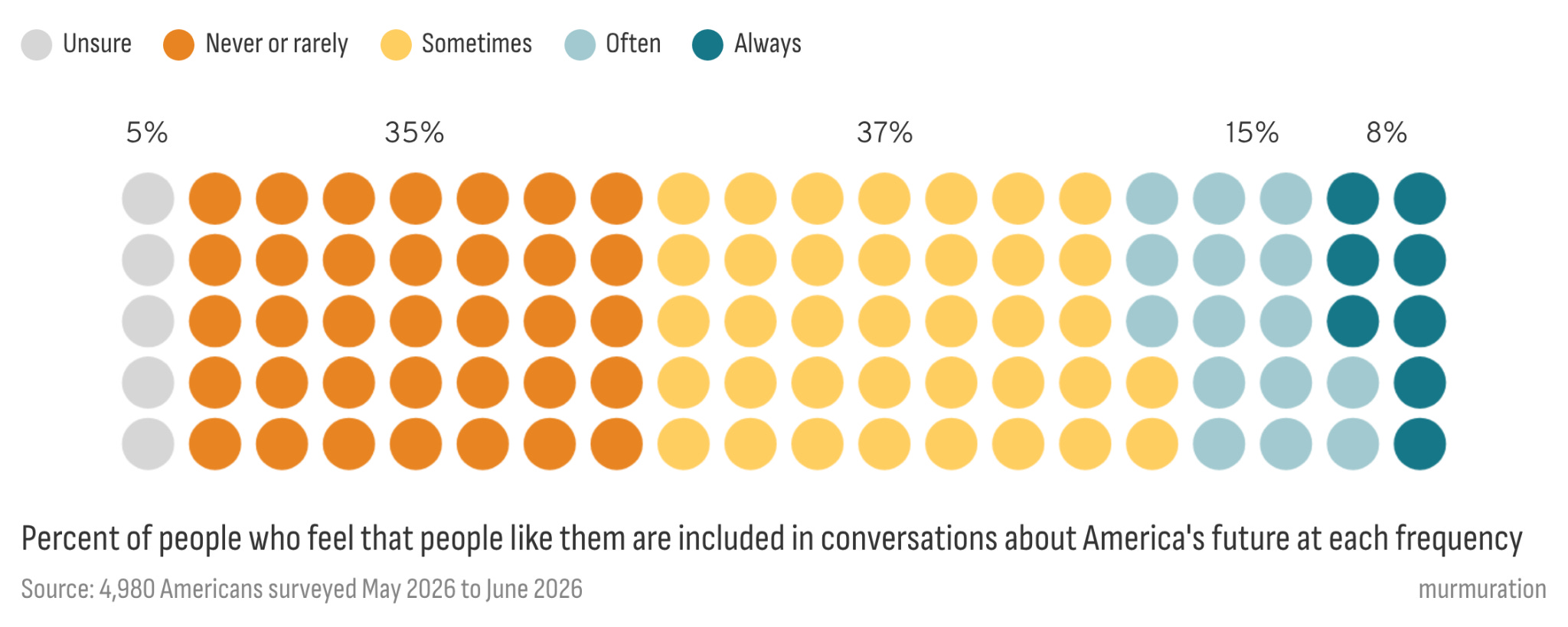
Despite most people having a strong sense of American identity, far fewer feel included in the story America tells about itself. Only about a quarter say people like them are often or always included in conversations about America’s future (23%). Roughly a third say people like them are rarely or never included (35%).
A similar result is found when people are asked whether their own life fits the American story. Only about a third say their life fits that story very well (31%). The rest say it fits only somewhat, a little, or not at all.
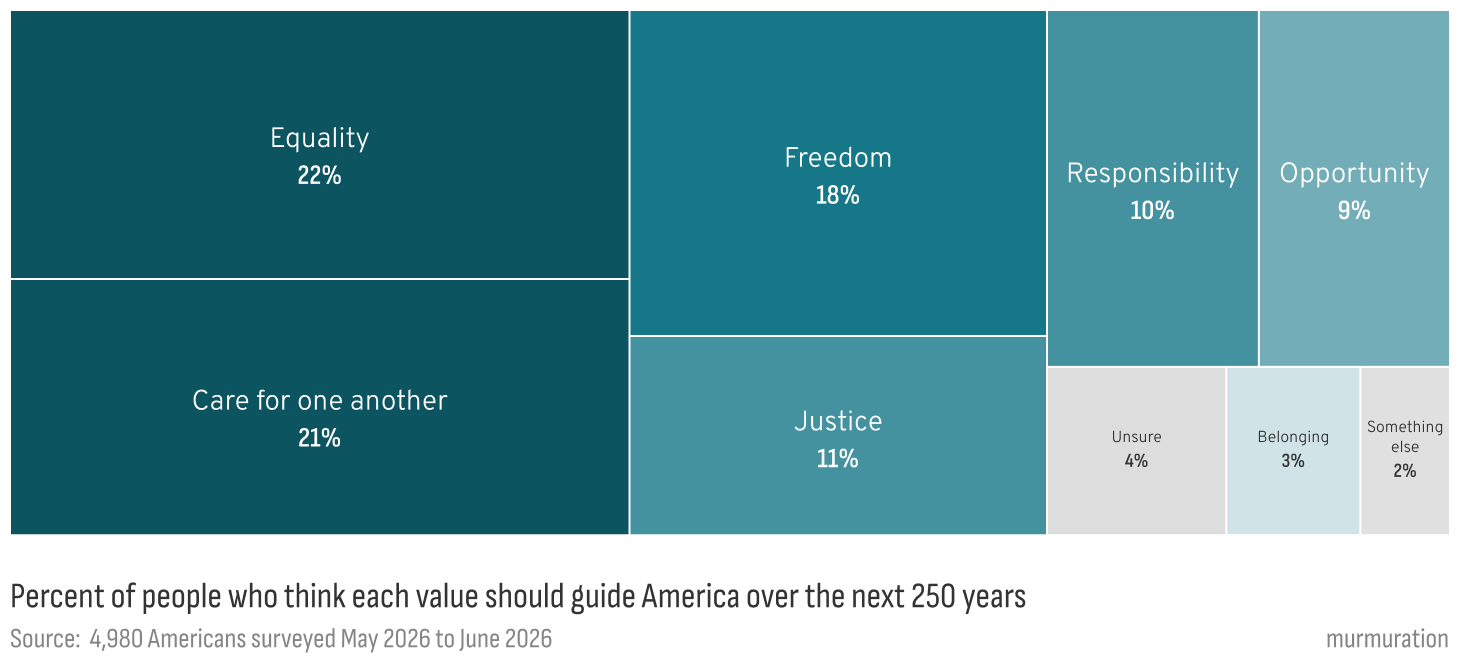
Despite widespread frustration, Americans remain fairly aligned on the values they want the country to embrace moving forward. When asked which value should guide America over the next 250 years, three themes rise to the top: equality (22%), caring for one another (21%), and freedom (18%). Identity has an impact: among those who identify completely as American, 22% chose freedom as the value to guide America moving forward. This compares to 11% of those who somewhat identify as American, or 9% of those who do not identify that way at all.
In fact, when we asked what today’s kids should be taught about America, the most common answer (25%) was about character and values, followed by what can be achieved with hard work (17%). Again, mentions of freedom and sacrifice (17%) were common, as was the importance of kindness and respect (15%). Five percent mentioned civic participation. But here too, people voice concern about the country, with 11% saying we should warn kids of a potential America in decline, or that the country used to be better.
That said, the data also point to more optimism than headlines might suggest. Most Americans express at least some confidence that the country can build a better future for the next generation (76%). While relatively few are very confident, outright pessimism remains a minority view.
Who Feels Included?
Across this series, financial comfort has repeatedly emerged as one of the strongest predictors of how Americans experience their lives. But the differences in this data on nationhood are among the largest we’ve seen.
Americans who are financially comfortable are dramatically more likely to feel that people like them are included in conversations about America’s future (25% of Prosperous vs. 4% of Struggling). They are more likely to say their life fits the American story (56% vs. 18%). They are more likely to believe everyone can live freely and with dignity (43% vs. 15%). And they are substantially more confident that America can build a better future for the next generation (84% vs. 57%).
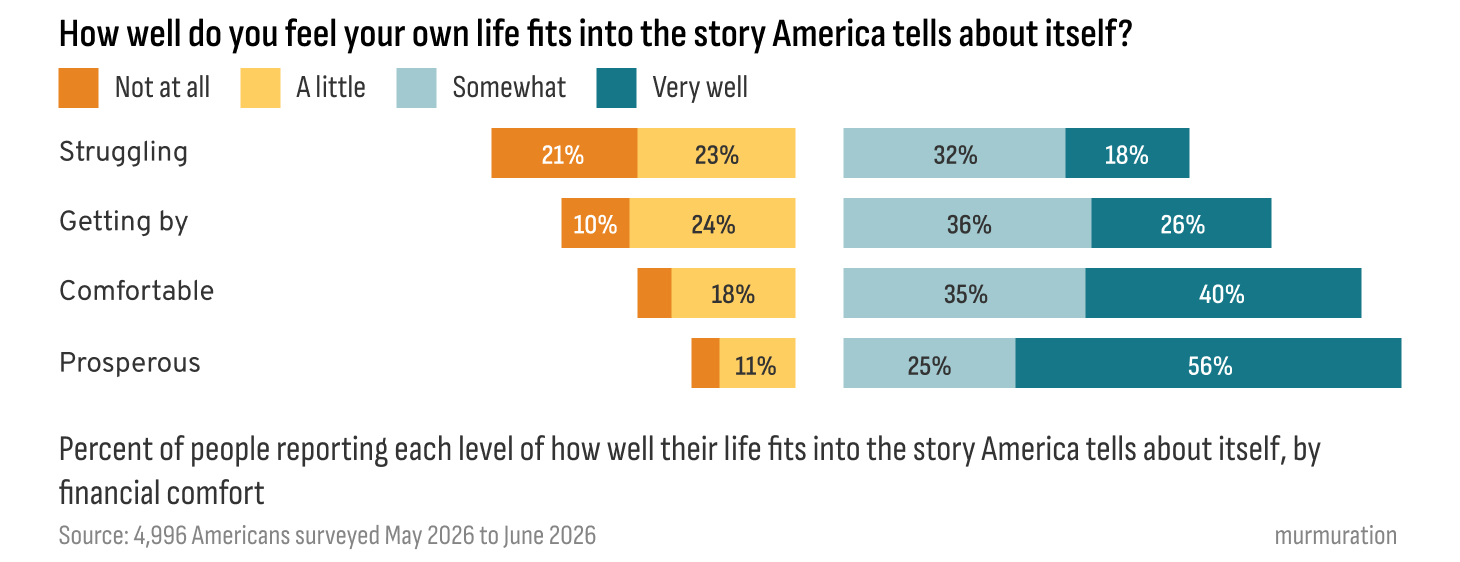
Those who are struggling financially tell a different story. Many are less likely to see themselves reflected in the nation’s future, less likely to believe the American promise applies equally to everyone, and less confident that the next generation will inherit something better.
Final Thoughts
One of the most striking findings in this survey is that Americans have not abandoned the idea of America. Most still identify strongly as American. Most still find reasons for pride. Americans remain deeply attached to the country’s ideals. What many are questioning is whether those ideals are being realized in practice and whether people like them are fully included in the future being built.
Beneath these findings lies a deeper set of questions:
What helps people feel represented in conversations about the country’s future?
Why do so many Americans identify strongly as American while simultaneously feeling disconnected from the national story?
And what does it take for people to believe that the promise of America applies to them too?
Six posts into this series, here is what we know: People need roots, relationships, room to pursue what matters, recognition, agency, and a sense that they belong not only in their communities, but in the broader story of the country itself.
For all of our disagreements about politics, policy, and culture, most Americans still seem to share a common aspiration: a country where people are free, treated fairly, cared for by one another, and able to contribute to something larger than themselves.
America is still being written.
As America marks its 250th anniversary, this State of Us series looks beyond nostalgia and national myth toward the future we still have the chance to build—one grounded in belonging, connection, dignity, and the everyday realities of American life.
Murmuration is a non-profit that organizes a network of partners and equips them with the insights, tools, and services needed to help communities build and activate the power to transform America into a nation where everyone thrives. murmuration.org