


For the last several months, headlines about the Iran war, instability in the Strait of Hormuz, and rising oil prices have dominated economic news coverage. National gas prices have climbed sharply since February, with analysts warning that the effects could linger—or even worsen—into the summer and possibly the midterm elections.
Americans are noticing. A recent Pew survey found that nearly seven-in-ten Americans are worried about higher gas prices tied to the Iran conflict. But what’s particularly striking is how differently Americans across the political divide are responding to the sudden, sharp increases in gas prices nationwide.
Murmuration has been tracking public satisfaction (and dissatisfaction) with gas prices over time, and the data reveals two things happening simultaneously: rising dissatisfaction across the country, and stark partisan differences in how Americans make sense of the same, shared economic reality.
About More Than Gas
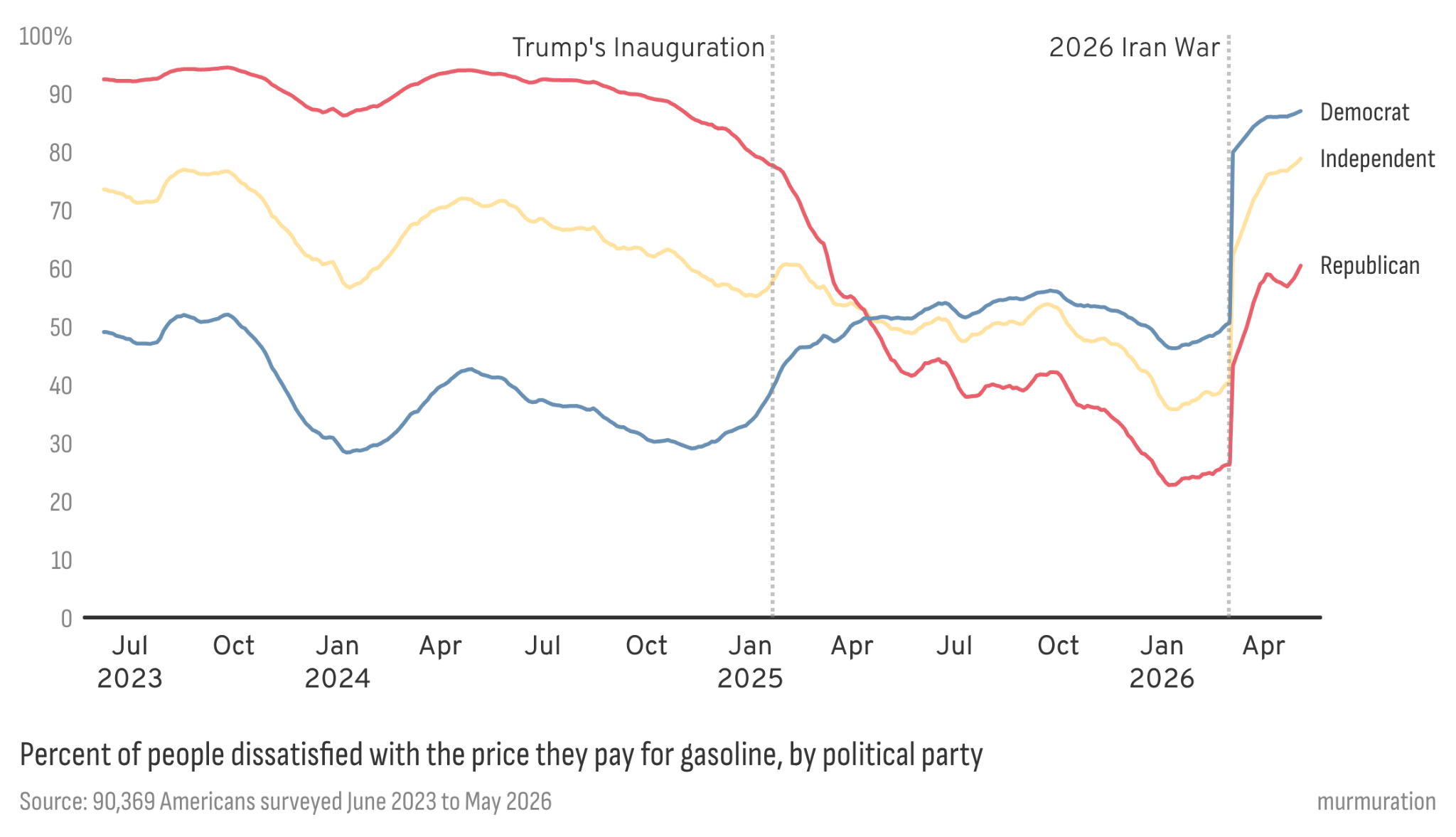
The chart above shows Americans’ level of dissatisfaction with gas prices starting in 2023. Overall, dissatisfaction now sits at 76% with just 6% of Americans saying they are satisfied with current prices. The start of the Iran conflict caused an immediate spike in dissatisfaction among all political groups, followed by continued, more gradual increases. Democrats report the highest dissatisfaction levels at 87%, followed by independents at 79%.
Republicans tell a more complicated story. In 2025, Republican dissatisfaction with gas prices fell dramatically when President Trump returned to office, despite relatively modest changes in actual prices. Since February, Republican dissatisfaction has returned to earlier levels, now reaching 60%.
The gap between Democrats, Independents, and Republicans is revealing.
The data suggest Americans are not simply reacting to prices themselves. They are also reacting through political identity, media narratives, and beliefs about who or what is responsible. For some Americans, rising prices appear to register first as a political interpretation before becoming an economic judgment.
And yet, material conditions still seem to matter. Even among Republicans, dissatisfaction still increased substantially alongside the latest price spike. The result is a public that is polarized in interpretation, but still responsive to real-world economic strain.
Final Thoughts
These findings matter because gas prices occupy a unique psychological space in American life. While most economic indicators are abstract—inflation is complicated, GDP is distant, interest rates can be invisible until they hit your mortgage—increases in gas prices are felt immediately.
People see them every morning on giant signs at the corner of their street. They become a running calculation in family budgets. They shape commute decisions, vacation plans, grocery costs, and perceptions of whether the country feels stable or unstable.
There are many ways to interpret this moment, but one question continues to sit at the center of it:
If Americans experience economic stress most viscerally through immediate, visible costs like gas and groceries, how should leaders think differently about trust, stability, and public confidence?
Voters may disagree about the causes. They may blame different leaders or policies. But the emotional reaction is remarkably similar: rising fuel costs make people feel anxious, constrained, and pessimistic about the future.
Filling Up, Feeling Down
Murmuration is a non-profit that organizes a network of partners and equips them with the insights, tools, and services needed to help communities build and activate the power to transform America into a nation where everyone thrives. murmuration.org