


On April 1, we did what any serious research team does when the country feels tense, exhausted, and one issue away from a national meltdown: we went straight to the experts.
Introducing…
25 young kids, with sticky fingers, strong opinions, and absolutely no interest in pretending things are fine if they are not.
The results were surprisingly coherent. Also, kinda funny. And, at times, a little devastating in the way only a five-year-old can be when they look you dead in the eye and say something like, “[If I were in charge] I would say you can’t have any candy. And no TV.”
Let’s begin.
The Diagnosis
Kids do not have a theory of polarization. They do not know what a filibuster is. Most have never heard the phrase “civic decline.” But they are extremely clear on one thing: things start to go wrong when people are not nice.
To them, “not nice” behavior is concrete. It is something you can see. “A mean face,” one four-year-old explained, squinting and tightening his fists to demonstrate. Others described it as yelling, complaining, touching things that are not yours, or calling someone stupid. Some talked about it more directly: “When another friend bit me.” “[When] they don’t treat people how they want to be treated.” “[When] they’re grumpy like Grumpy Monkey.” In their world, these moments disrupt the group quickly. When they happen, kids expect the grownups in the room to step in. One child proposed a clear enforcement mechanism: “The teacher should take them home and their mommy can put them on their bed for time out.”
But the bigger problem is often exclusion. A bad day at school is rarely about academics—it is about belonging. Even small moments carry weight: someone touching your desk without permission, someone throwing away your pencil, someone insisting you are a ninja if you are not.

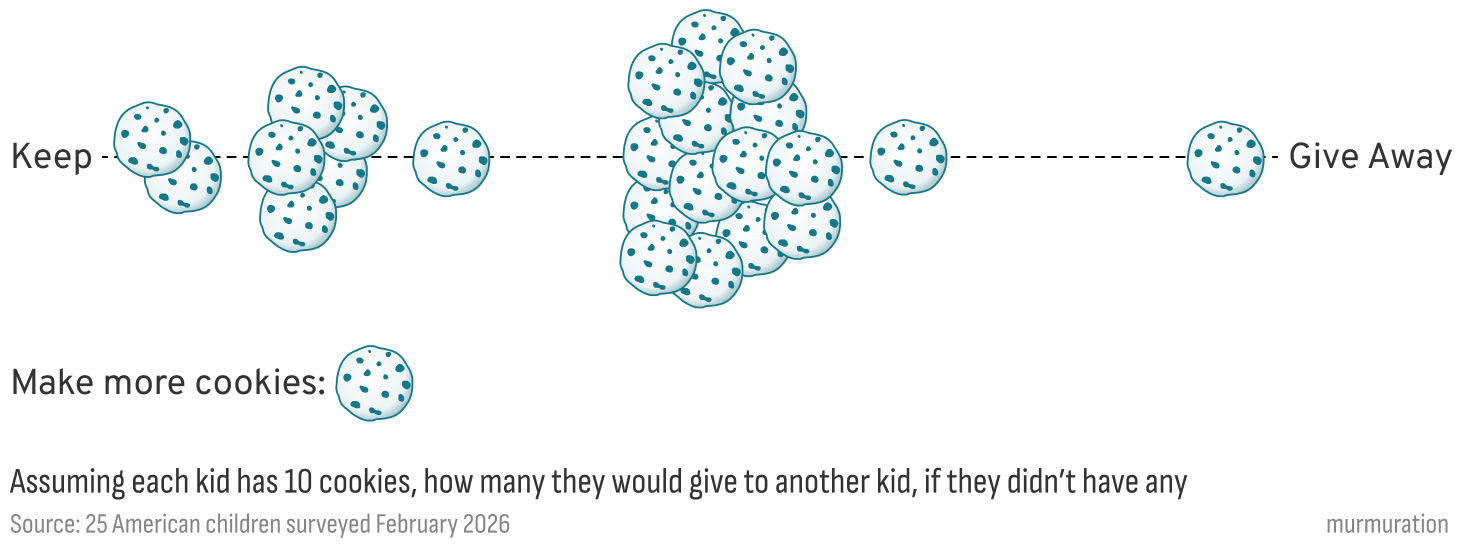
Fairness is another fault line kids notice quickly. When asked what they would do if they had ten cookies and another child had none, most favored balance. “I would give them some of my cookies” or “Give them five so we would have an even number.” Others proposed partial sharing: “I’d give one so I would have nine.” “If I have extra cookies, they can have my extra cookies.” Only two children suggested keeping everything: “I would just eat them myself” (though we were told he was very hungry at the time) and “I would keep them all in my hand.” But the dominant instinct was visible fairness. Or, in one particularly elegant solution: “Make more cookies. And then he can have 10 cookies too.” That same instinct showed up again later—when asked what they would do if they were in charge of the country for a day, one child simply said, “Give them my cookies.”
Kids also notice when effort does not lead to success. One child described the feeling simply: “Building a high building but it keeps falling down.” Frustration, in their view, often builds from there. When asked why someone might feel grumpy or sad, many traced it back to something that happened earlier: “Because something bad happened to them.” and again, “Because their friends are not nice.” In their framework, problems are connected. Hurt people often become the ones acting unkind.
Finally, they notice when the rules themselves feel unstable. One child described bringing a favorite toy to school and being allowed to have it briefly—but not later. “I could only have him for snack time.” The frustration was not just the rule itself. It was the rule changing. For kids, predictability matters. When expectations shift without explanation, trust starts to erode.
Taken together, their diagnosis is surprisingly clear. Things deteriorate when people are unkind, when someone is excluded, when fairness feels off, when effort does not lead to progress, and when the people in charge seem inconsistent or absent.
The Repair Agenda
Most kids are not drafting ten-point policy plans. They are not talking about “systems change.” Their solutions are much more practical. Much more immediate. If you ask them how to make things better, the answers cluster around a few simple conditions.
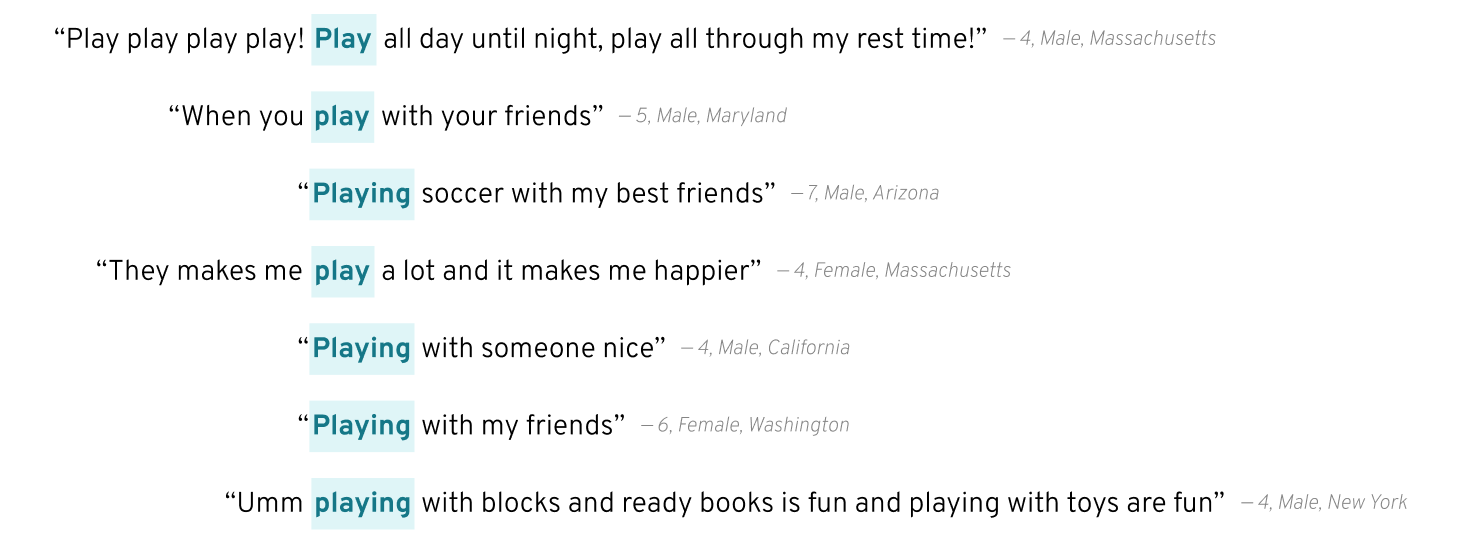
Start with playing. A lot of kids seemed to believe the country’s problems might ease up considerably if everyone just had somewhere to climb and run around. “I would tell them to all go to Hawaii and go on a waterslide,” one child told us. Even when it came to school, the same logic applied: learning works best when it still feels like play—“when we get to do the lab stations where you get to play.” Finally, one respondent offered what may be the simplest theory of social cohesion we’ve heard all year: “Playing with someone nice.” In their world, togetherness is preventative care.
Then there is food. Snacks are not a side note. They are infrastructure. “Adults should know snack time is at 3:00 and they can pick any snack they want,” one child said, with the calm authority of someone who has thought this through. Another explained, very emphatically, “I like Chick-fil-A.” And when asked what to do if someone didn’t have food, the answer was immediate. “Give away some.” In their world, hunger is solvable, sharing is obvious, and fairness is something you can see.
Rest follows naturally. They may resist naps themselves, but they understand the pattern. When someone is unkind, something else is usually going on. “They need to rest a little bit more,” one respondent said. Another offered the simplest reset available. “Take a break.” or spoken from true personal experience they might just need “Water and bandaid.”
And finally, repair. For kindergartners, apologies are not ceremonial. They are functional. It starts with stopping the behavior. “I’ll say, ‘Stop! I don’t like that. Don’t do it ANY day!’” one child explained. Then comes care. “A hug.” “A smooch.” Or, as one child put it, “a hug, or a kiss and respect.” Another suggested a slightly more advanced approach:
“Say something nice to them, give them a compliment or ask them what made them upset.” - 7 year old girl, Virginia
The goal is not punishment. The goal is to help someone feel better so everyone can return to playing together.
Final Thoughts
It is hard not to hear, beneath the humor, a serious civic vision.

A country with more kindness, places to gather, and fewer barriers to belonging. A country that takes fairness seriously in ways people can see and feel. A country that intervenes early, apologizes often, and understands that sometimes conflict is what happens when people are overwhelmed.
Rather than our tradition of leaving you with more questions, we’re passing along a few things these experts thought all adults should know:
“Share with everybody.” - 4 year old boy, New York
“Learn to be kind.” - 4 year old boy, Texas
“Don’t be naughty.” - 4 year old boy, California
“People need to be treated good… make everyone feel included.” - 6 year old girl, Washington
And finally, one child offered a gentle reminder:
“Grown ups do not know everything. Kids are sometimes smarter than grown ups.” - 4 year old boy, Vermont
Honestly, that feels about right.
It may be April Fools…But the quotes are real.
This is beautifully written, Sarah. A invitation for us all to return to the simplicity of purpose in extending humanity.
These kids are refreshing. Thanks.