


Across politics, culture, and public life, there is a growing sense that the people in government making decisions are increasingly disconnected from the people living with the consequences.
Many Americans look at political leaders, corporate executives, media figures, and other visible decision-makers and see people whose lives bear little resemblance to their own. That distance helps explain the rise of outsider candidates, frustration with political elites, and growing demands for institutions that feel more reflective of and responsive to ordinary people.
Beneath many of these debates is a fundamental question: who speaks for us?
In partnership with RepresentWomen, Murmuration surveyed more than 5,000 Americans about political leadership, representation, and the future of democracy. What emerged was a public that remains deeply dissatisfied with the current political system, but still believes that we have the ability to improve our representation, elections, and ultimately our democracy.
Americans have not stopped believing representation matters. If anything, they appear to be searching for leaders and institutions that feel closer to the people they are meant to serve. And perhaps most notably, Americans seem less interested in preserving the political system exactly as it exists today than in finding ways to make it feel more representative, more responsive, and more reflective of the communities it governs.
The People and the Powerful
For years, Americans have been told that polarization is the defining problem facing democracy. Yet when given the opportunity to identify the biggest challenge themselves, people were far more likely to focus on who holds power and whose interests are being served.
More than one-quarter of Americans (26%) identified corruption as the biggest challenge facing politics today, making it the most common response in the survey. Another 17% pointed to the influence of special interests. By comparison, just 9% cited political division, 5% pointed to ineffective government, and 4% identified political violence.
That concern also shows up elsewhere in the data. More than two-thirds of Americans (68%) say they are dissatisfied with the current political system, including 43% who are very dissatisfied. Yet this frustration does not appear to reflect a wide-spread rejection of democracy itself. A majority (53%) still believe elections give citizens a meaningful say in how the country is governed, and nearly two-thirds (64%) believe the rules governing elections can be changed to make elections fairer.
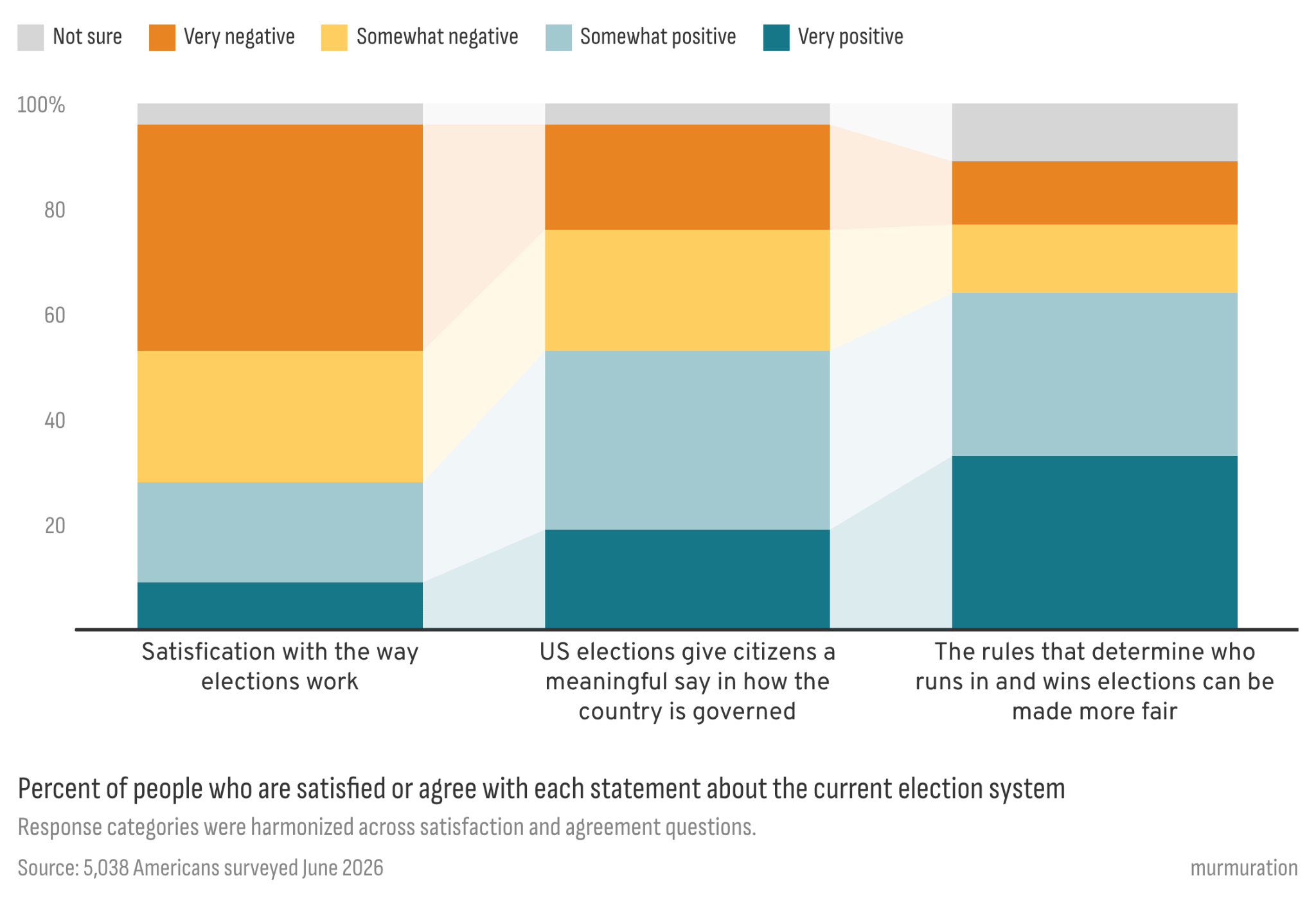
In fact, Americans seem remarkably open to change. Nearly six in ten (58%) say the country needs major changes to the way elections and representation work, while only 8% believe no changes are necessary. Similarly, 59% say making important changes to improve representation and fairness is more important than preserving stability and trust in existing democratic institutions. That appetite for reform extends across regions and community types, suggesting that concerns about representation and responsiveness are not confined to any one part of the country.
New Voices, New Perspectives
Across the survey, one answer appeared again and again: more choice, more independence, and more perspectives.
Nearly eight in ten Americans (78%) said it is more important to have an election system that gives voters greater flexibility to support their preferred candidates than one that gives political parties more control over who appears on the ballot. Similarly, nearly three-quarters (73%) said they prefer politicians who make decisions based on the issue and circumstances rather than those who reliably support their party’s agenda.
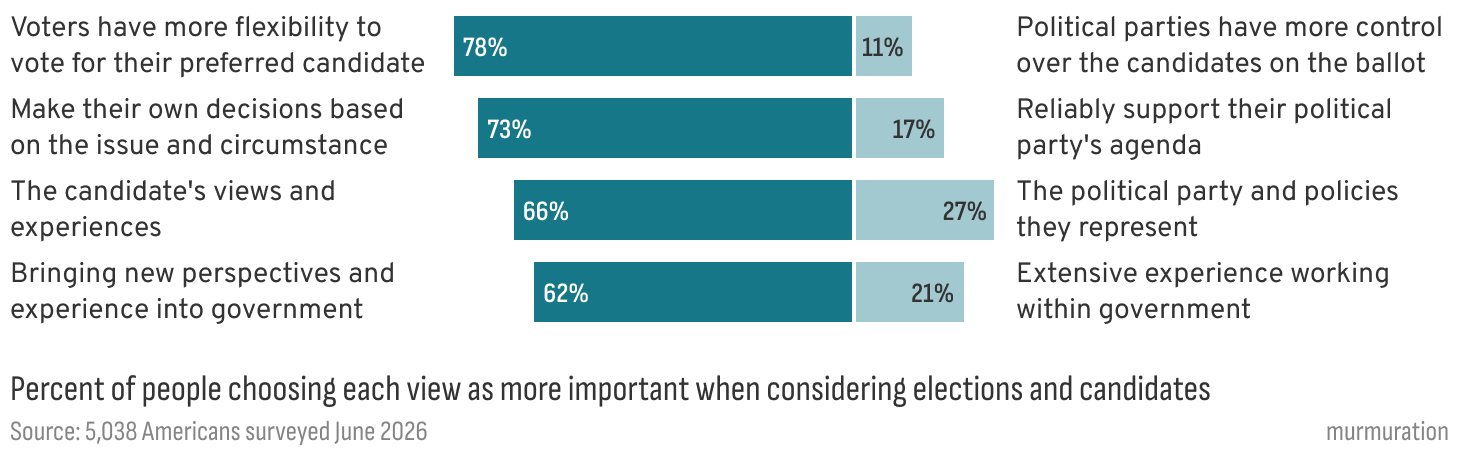
Even when evaluating candidates, Americans appear far more interested in individuals than institutions. Two-thirds (66%) say a candidate’s views and experiences are more important than the political party they represent, while just 27% prioritize party affiliation. That desire is not limited to any particular political camp. Across partisan groups, Americans consistently place greater value on candidates’ experiences and independent judgment than on party loyalty alone.
That desire for proximity extends beyond politics itself.
By nearly three to one, Americans say bringing new perspectives and experiences into government (62%) is more important than having extensive experience working within government (21%). At a moment when many institutions are struggling to earn credibility, voters appear to be placing a premium on lived experience and fresh perspectives over traditional credentials.
This may also help explain why many Americans see value in expanding who holds office. Nearly half (46%) say increasing the number of women in elected office is important, while only 21% say it is unimportant. When asked what would happen if more women were elected, Americans most often pointed to outcomes tied directly to representation: 39% believe different issues would receive more attention, 36% believe more people would feel represented, and 33% believe government would better reflect the population.
Underlying these findings is a broader belief that leadership is shaped by experience. Americans appear to recognize that people who bring different perspectives, priorities, and lived realities into public office. A government that draws from a wider range of experiences is often seen as better equipped to understand the communities it serves.
Final Thoughts
For much of the last decade, Americans have been consumed by questions of polarization, misinformation, and political division. But these findings suggest another question may be just as important: do people feel like the institutions governing them understand them?
That is ultimately a question about belonging.
People are more likely to trust institutions when they feel seen by them. More likely to participate when they believe their voices matter. More likely to accept decisions—even ones they disagree with—when they feel represented in the process.
Americans do not appear to be giving up on representation. They are asking whether the institutions around them are still capable of providing it. Which means the future of democracy may depend on answering a few difficult questions:
When do people feel like government is truly listening?
What would it take to narrow the distance between institutions and the communities they serve?
And how do we rebuild trust when so many people feel disconnected from the people making decisions on their behalf?
Representation, after all, is about more than elections. It is about whether people can see their communities, experiences, and priorities reflected in public life. It is about whether institutions feel distant or familiar, responsive or disconnected, accountable or insulated.
The floor is ours.
Murmuration is a non-profit that organizes a network of partners and equips them with the insights, tools, and services needed to help communities build and activate the power to transform America into a nation where everyone thrives. murmuration.org
RepresentWomen is a nonpartisan research and action hub that promotes evidence-based solutions to improve women’s political representation and leadership in the United States. representwomen.org