


“Democracy”
There’s a heaviness to the word now.
Not long ago, “democracy” evoked something abstract but sturdy—an institution, a set of rules, a promise. These days, it sounds more like a diagnosis. People (spoiler: only certain people) aren’t just worried about democracy. They’re naming it as a source of personal stress, something broken or breaking down in real time. But the word “democracy” often functions more as a contested symbol than a shared definition, shaped by identity, ideology, and lived experience.
In Civic Pulse, we ask open-ended questions about what’s stressing people out, what gives them hope, and how they feel about the direction of the country. Since November 2024, “democracy” has surfaced in 850 comments across almost 2% of respondents.
That alone tells us something.
It wasn’t prompted. No question asked about democracy directly. But it still surfaced, occasionally, as both the problem and the thing people are clinging to. What they meant by it—and how they talked about it—offers a glimpse into the emotional state of the electorate heading into the second half of 2025.
Democracy by Demographic
The people invoking “democracy” aren’t a random sample of the country. They’re older, more educated, disproportionately female, and overwhelmingly white.
61% were women, suggesting that the emotional weight of this moment may be landing differently—or more heavily—on them.
Almost half (45%) were 65 or older, and another 28% were between 50 and 64. Just 9% were under 35. This is a generational story: for most respondents, democracy isn’t abstract but is something they have lived with long enough to watch shift, fade, or erode.
77% were white, with Black (9%), Hispanic (8%), and Asian (4%) respondents underrepresented. It may be that some communities have long been skeptical of democracy’s promises or have different words for what they’re trying to protect.
5 in 10 had a college degree or higher, and most fell into middle or upper-middle income brackets, with over 40% reporting household incomes over $100K. The idea that democracy is failing seems to be particularly resonant among people who once believed the system worked for them or at least expected it to.
75% were parents, which could explain the urgency and anxiety in many responses as a future-oriented fear.
Politically, 60% identified as Democrats, 20% as Independents, and just 4% as Republicans. That’s important. It doesn’t mean Republicans aren’t worried about democracy. But it does suggest that, in this sample, using the word “democracy” as a lens for stress is more common among people on the left.
But perhaps even more telling is who isn’t saying it.
Young people, people of color, and lower-income respondents were far less likely to use the word at all. That doesn’t mean they’re unbothered by the state of the country. But it might mean that “democracy” isn’t the frame that resonates. Maybe it never delivered on its promise for them in the first place. Or maybe the word feels too theoretical, too fragile, or too co-opted to capture their lived experience.
That absence is as important as the presence.
Because if democracy is becoming a litmus test for distress, it’s not a universal one. And if we want to rebuild it—or protect it—we need to start by understanding who sees it as theirs to lose.
Democracy as a Stressor
When this subset of people talk about democracy today, it’s not with reverence. It’s with alarm.
Consider this representation of the words that typically come before or after people mention democracy. Here’s what rises to the top:
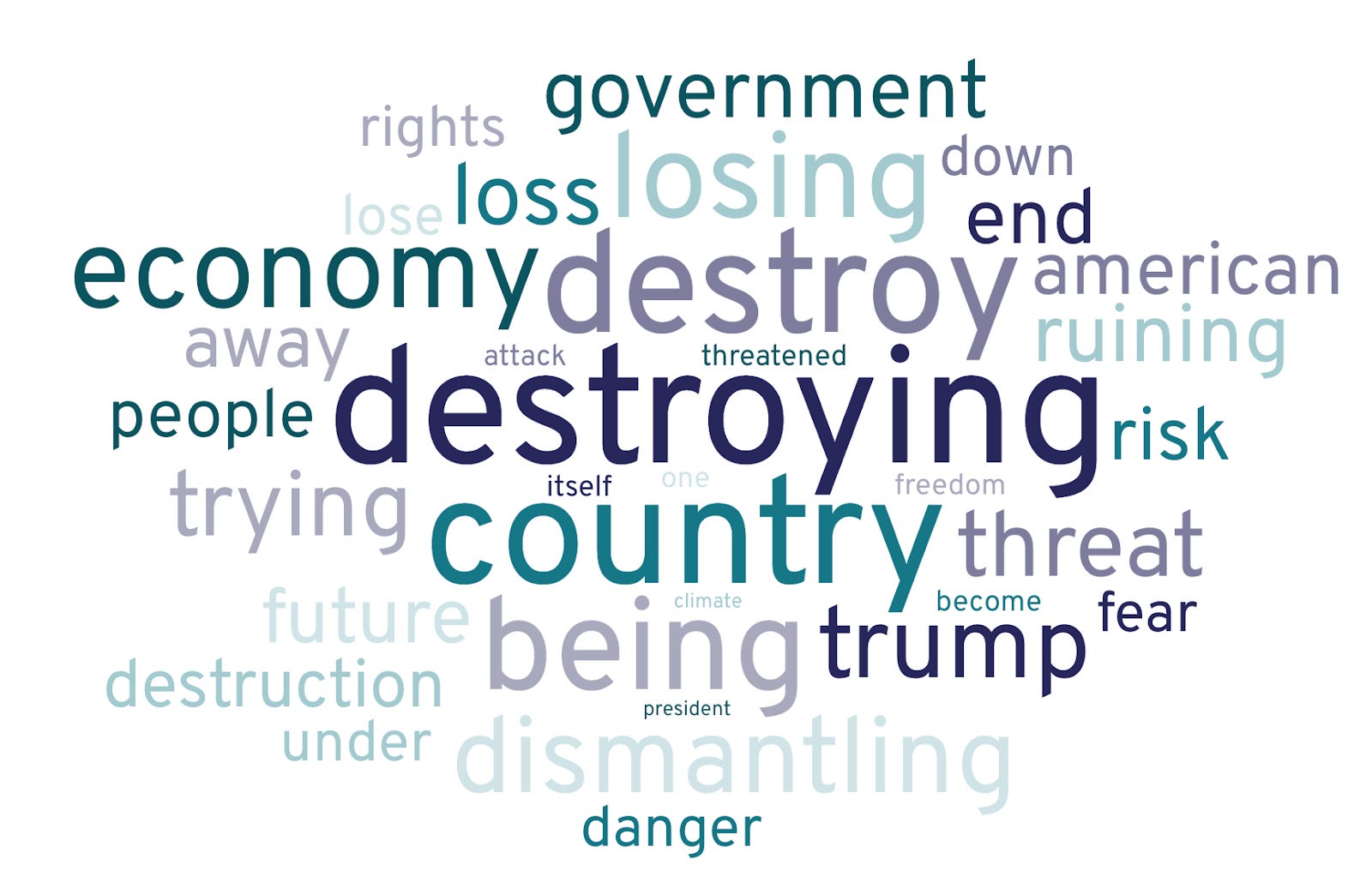
More than three times as many respondents mentioned democracy when describing what’s stressing them out compared to what’s giving them hope. And the emotional tone is overwhelmingly dark. Here is a sample of how folks talked about it:
"The main stress/anxiety I have is due to the return of the 45th and what will happen to our democracy, our country, our freedoms & our rights." 71, Democrat, Female, Columbia Falls, Montana
"The darned doom of democracy and feeling like the US has become a hopeless, horrible playground for rich idiots and the utterly unexplainable reasons that voters brought this.", 72, Democrat, Female, Arlington, Virginia
"The state of American politics and the fact that our Democracy is under threat of Dictatorship while tens of millions of people voted for this", 54, Unknown, Female, Louisville, Kentucky
"I would say the tariffs and the government being dysfunctional and in turmoil. Democracy is at risk.", 36, Democrat, Male, West New York, New Jersey
In fact, among all respondents who mentioned democracy in the stress question, 91% described it as under threat. Nearly 9 in 10 expressed dissatisfaction with the direction of the country. And nearly one-third used terms that implied destruction, not just decline.
When Democracy Inspires Hope
And yet, some still reach for it as a source of optimism.
Among the 52 people who mentioned democracy in response to the question about hope, the tone shifts. Here are another few examples:
"I am hopeful there are people fighting for democracy.", 68, Democrat, Female, Inglewood, California
"That democracy in this country has survived difficult situations before", 75, Democrat, Female, Burton, Michigan
"I am hopeful that democracy will prevail.", 71, Independent, Female, Grand Rapids, Michigan
"People still believing in democracy and having empathy for others.", 40, Unknown, Male, Memphis, Tennessee
But still, the optimism is conditional. Hopeful responses often hinge on a change in leadership or a political course correction. The survival of democracy is not assumed—it’s aspirational.
What Satisfaction Looks Like
When we asked people how they feel about the direction of the country, the people who mentioned democracy overwhelmingly reported dissatisfaction. Only about 23% said they were satisfied, but even then the comments were hedged:
"I have hope that our democracy is stronger than any one person who would ruin it.", 75, Democrat, Male, Alva, Oklahoma
"We are still a democratic country and there are some good leaders and strong voices for our democracy and well-being.", 79, Democrat, Female, Encinitas, California
"Already to see positive change and hope to save our Country and democracy but lots of damage and division fostered past 8 years", 65, Republican, Female, Phoenix, Arizona
These aren’t victory laps. They’re cautious endorsements or more like “still standing” rather than “thriving.”
And those who are dissatisfied? The language is blunt:
“There is officially no democracy in the U.S. anymore. We have a complete oligarchy.” 41, Democrat, Female, Berkeley, California
"We are on the verge of losing Democracy", 76, Democrat, Male, Palm Coast, Florida
"I mean democracy is crumbling in front of our eyes. We are grabbing people off the street and deporting them without due cause. Eggs are $10.", 28, Unknown, Female, Culver City, California
Final Thoughts
When a word as foundational as “democracy” shows up in people’s emotional lives—not as an ideal, but as a source of stress, fear, or fragile hope—it’s worth paying attention. Especially when it surfaces unprompted, from people who feel like they have something to lose.
And that’s the key: the people invoking democracy most often are older, whiter, more educated, and more likely to have grown up believing the system could work. For them, democracy isn’t an abstract promise. It’s a structure they’ve watched falter in real time. Their grief, anxiety, and frustration are deeply personal because they once trusted that democracy meant stability, fairness, or control.
But just as telling is the silence from others. Younger people. People of color. Lower-income respondents. That doesn’t mean they’re less worried about the country. It means “democracy” might not be the framework they reach for. Maybe they never fully saw themselves in it. Maybe they’ve always known its promises were partial. Or maybe the word itself has become too politicized, too fragile, or too hollow to carry their hopes.
That absence matters.
Because if “democracy” is becoming a litmus test for distress, it’s not a universal one. It’s a story of who still believes this system is worth saving and who never really saw it working in the first place.
So what do we do with that?
That suggests an opening. Not for platitudes or generic civics education, but for real conversation. For clarity. For reimagining what democracy means in practice, and for whom. Because when people say “democracy,” they’re often telling us what they value most and what they’re afraid is slipping away.
And if we’re serious about understanding democracy as more than voting but as a lived experience then protest has to be part of that story. It’s not just a right; it’s a feature of democratic life. What’s happening right now in LA, with the criminalization of student protest, and coordinated crackdowns on dissent, isn’t some abstract policy dispute—it’s the real-time unraveling of democratic norms. The line between civic engagement and criminal behavior is being redrawn by power, and not in the people’s favor. If we’re writing about who gets included in democracy, we can’t ignore who gets punished for trying to participate.
So here’s what we’re left wondering:
Can democracy become a unifying concept again, or is it now too fractured by history and ideology?
What might it take to make democracy feel worth claiming, especially for those who have never really seen it deliver?
What other words are people using when they’re talking about democracy without saying the word?
If democracy has never fully included you, what exactly are you being asked to fight for?
The system’s under strain. So are the people in it. Coincidence? Probably not.