


Yesterday, Murmuration released Life in the Digital Age, a new national study, with support from the Walton Family Foundation, examining how technology is changing everyday life, connection, and what people increasingly want to reclaim. The findings point to something we call “digital saturation”: Americans aren’t rejecting technology, but they are increasingly trying to make more room for the physical world around it.
For years, more of our lives have been moving online: how we work, shop, bank, find information, entertain ourselves, and stay in touch. And then the pandemic accelerated that shift, disrupting many of the places, routines, and interactions that had long brought people together in person.
Many of these changes made life more convenient. They also made it possible to stay connected across distances in ways that are genuinely valuable. But convenience and connection are not the same thing. (Aside: We highly recommend watching Cord Jefferson speak on this at America 251; video here.)
So as part of our research on digital life, we wanted to understand the other side of that shift: not just how people feel about technology today, but what else they feel may have been lost as more of our lives and relationships moved online. And because the pandemic accelerated so many of those changes at once, we used it as a natural point of comparison, asking a new open-ended question: Is there anything about how people connected, communicated, or spent time together before the COVID pandemic that you miss today?
What We Miss
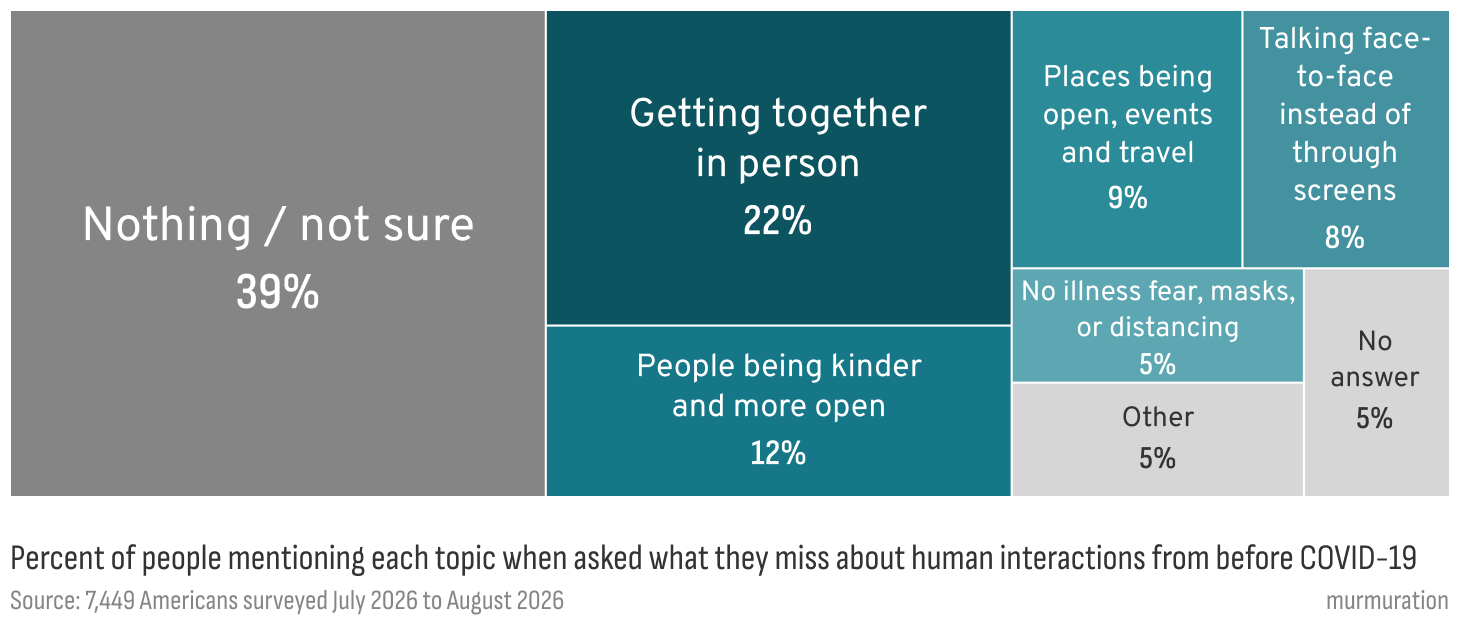
More than seven thousand people answered this question, and the first thing worth noting is that not everyone feels something has been lost. Thirty-nine percent said there was nothing in particular they missed or they weren’t sure, with responses ranging from a simple “no” to people saying life had largely returned to normal. Another 5% did not answer the question. One respondent saw the changes positively:
“No. It is pretty much like before covid with the added benefit of online options to stay connected.” - 68, Male, Democrat, Black Diamond, WA
But among those who did identify something they miss, the most common answer was also the simplest: being together in person. Twenty-two percent of all respondents talked about missing gatherings, family and friends, parties, physical closeness, or simply spending more time together. Put differently, among respondents who named a substantive thing they missed, nearly four in ten mentioned getting together in person.
The examples ranged from the significant to the wonderfully ordinary. People missed “social gatherings,” “getting together and having a BBQ,” “being closer to family,” “crowded concerts”, and “seeing friends more regularly”. One person wrote, “The desire to want to be around people.” Another said, “I miss how people used to plan time to physically meet up with people.”
That distinction—the desire to see people—is interesting. Respondents weren’t only saying there are fewer opportunities to gather. Some felt that the social expectation itself had changed. Here are two young adults on opposite sides of the country, in cities that are thought of as quite different, sharing this experience:
“The efforts and desire people had to see each other in general. It seems that it has diminished significantly.” - 24, Female, Los Angeles, CA
“It got quieter after Covid. No more family reunion and no more laughing and talking.” - 24, Male, Springdale, AR
The second major theme was not about where people interacted, but how they treated one another. Twelve percent described missing greater kindness, patience, openness, trust, or a general sense that people used to be friendlier and less guarded. “We were kinder to each other,” one person wrote. Another missed “the kindness and empathy of other people and the interactions with them.” Others simply said “trusting others,” “there was more kindness and compassion,” or “people were nicer and civil.”
Some of these responses went beyond manners. They described a change in people’s willingness to engage with one another at all. One respondent remembered “how open people were to talk to one another,” adding that now “it’s like no one talks or speaks up and would rather just not talk.” Others wrote:
“People didn’t hesitate to chat with you when out in public. Now everyone is on their phones and nobody wants to bother with strangers.” - 64, Female, Kenosha, WI
“It seemed before Covid people connected and weren’t hostile to each other. Post-Covid people don’t connect and nearly everyone is hostile about someone or something.” - 85, Male, Quincy, IL
That is a subtly different kind of loss. It isn’t the absence of close relationships. It is the disappearance of the weak ties and casual encounters that make a place feel social: talking to a stranger, chatting with a neighbor, recognizing someone at a store, making small talk without having planned to do so.
Technology was its own recurring theme. Eight percent explicitly said they miss talking face-to-face rather than through screens, including less reliance on phones, social media, texting, Zoom, and other forms of digital interaction. One person wrote, “I miss that a lot more of people interactions were in person, rather than online.” Another said simply: “Less phones, more face to face connection.”
Here, younger Americans stood out. Eleven percent of Gen Z adults mentioned face-to-face interaction rather than screens, compared with 7% among adults 46 and older. Among the youngest Gen Z adults, ages 18–23, that rose to 14%. In other words, the generation most associated with digital life was also among the most likely to explicitly say it missed communication that happened off-screen.
The responses were not uniformly anti-technology. What people seemed to object to was substitution. As one respondent explained, before COVID, people might connect online and then make plans to see one another; afterward, they felt “connection and communication primarily online” had increasingly replaced “daily interactions within the community.”
Another put the tradeoff particularly well:
“With technology we can just call each other, shoot a quick text or FaceTime but we don’t receive the same connection and bond we once did when we were connecting in person.” - 23, Female, Gainesville, FL
The physical places where connection happened mattered too. Younger adults again stood out: 12% of Gen Z mentioned this category, compared with just 6% of adults 61 and older. Among Gen Z ages 24–30, it was 13%. Across all generations, nine percent mentioned places being open, events, and travel—including restaurants, stores, malls, concerts, clubs, movies, and sporting events. Plus, one answer I did not expect to encounter quite so often: 24-hour stores with 365 people (3% of our data)—but extrapolates to roughly 8 million nationally—missing longer store hours, including 263 folks, specifically lamenting the loss of 24-hour or all-night businesses, and 151 respondents calling out Walmart by name.
“I definitely feel people connected easier in person before the pandemic. Restaurants/shopping centers still haven’t opened back up to previous hours. I miss 1am Walmart runs,” one person wrote. Another remembered, “24/7 Walmart lol I used to meet some cool people late at night.” Others missed late-night shopping with family or “midnight snack runs with friends.”
It sounds trivial until you think about what those places provided. A store open at 1 a.m., a mall, a diner, a neighborhood event, or somewhere inexpensive to wander isn’t just a business. It is somewhere people can be around other people without formally arranging to be around other people.
Smaller shares talked about no longer having the same freedom from illness fears, masks, or distancing (5%); spontaneity and a slower pace (4%); community and neighbors (2%); and school or work happening in person (2%).
These categories overlap, but people aren’t describing one missing behavior. They’re describing an ecosystem of connection: the desire to get together, places where gathering happens, spontaneous encounters, face-to-face conversation, trust between strangers, and enough openness to turn an interaction into a relationship.
One response captured almost all of it:
“Being able to spend time with friends and family, going out often, attend special occasions, go shopping, traveling. In truth, there are a lot of things I miss before that COVID pandemic, but I could never truly sum it up in a few words.” - 38, Female, Red Bluff, CA
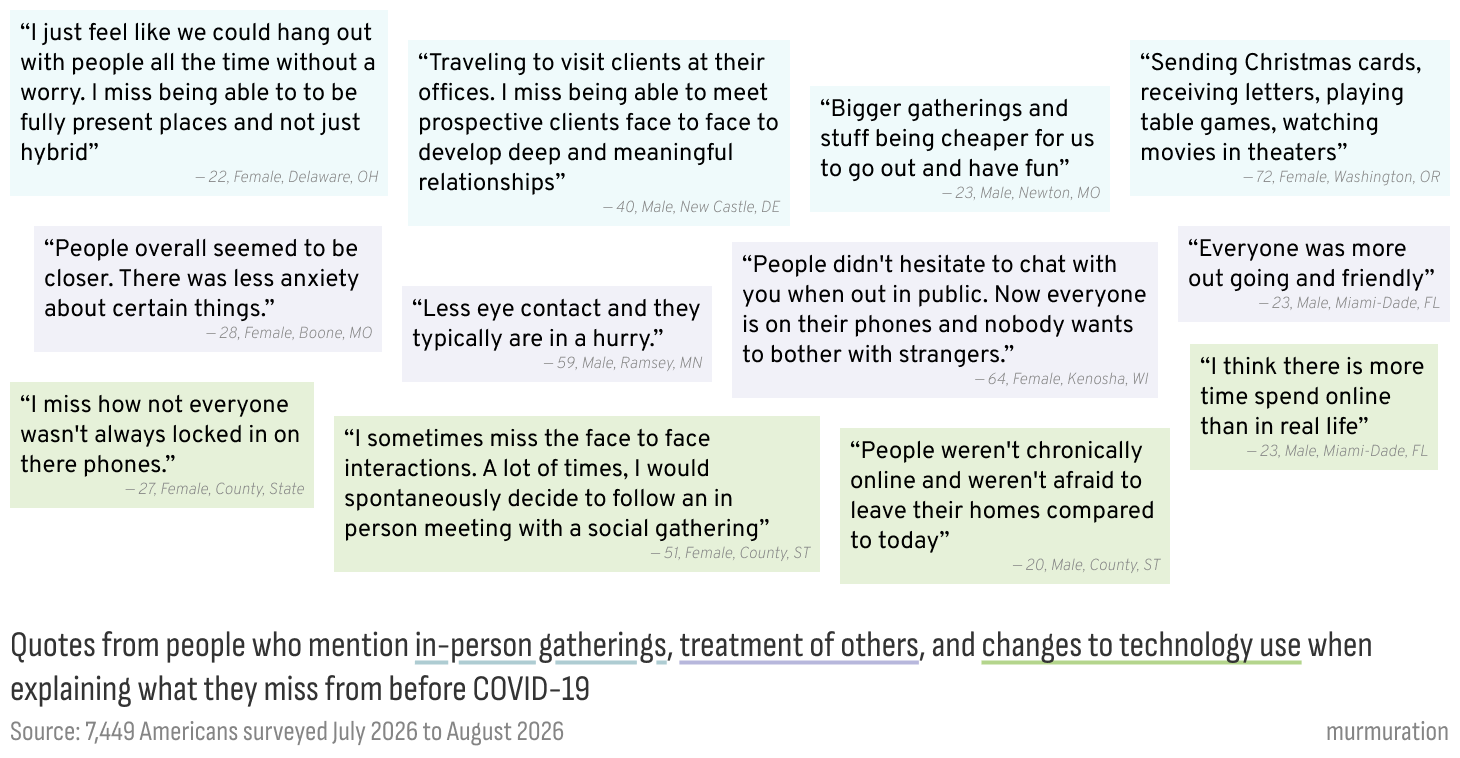
And a few more quotes for good measure:
Final Thoughts
It would be easy to read these responses as simple nostalgia for life before 2020. I don’t think that is quite what they are telling us. Nearly four in ten respondents said there was nothing in particular they missed or they weren’t sure, and many of the changes that accelerated during COVID—from remote work to online communication—have made life easier and connection more accessible for millions of people.
But among those who do feel something has been lost, the answers extend well beyond screens. People miss seeing friends and family. They miss conversations that happen face-to-face. They miss strangers being more willing to talk to one another and people seeming kinder, more patient, and less guarded. They even miss the malls, restaurants, neighborhood events, late-night stores, and other ordinary places where social life happened without anyone explicitly planning for it.
Connection is not only a relationship between two people. It also depends on the conditions around them: places to gather, time to linger, opportunities to encounter strangers, norms that make conversation feel welcome, and enough trust to engage with someone you don’t already know. If people are missing the conditions that made being together easier, that raises a set of questions:
What kinds of places and routines make casual connection possible, and are we losing too many of them?
If people perceive one another as less open, trusting, or friendly, how does that change the way communities function?
What would it mean to design neighborhoods, institutions, and civic life not simply around access and convenience, but around making it easier for people to be together?
We often talk about connection as though it is something individuals either have or don’t have. But these responses suggest that connection also has an infrastructure. It is built through people, certainly, but also through places, habits, expectations, and countless small encounters that make us feel part of the world around us.
Make room for each other.
This research was supported by the Walton Family Foundation, which has funded Murmuration’s Gen Z research efforts since 2021. Learn more about our ongoing research partnership and findings on the youngest generation of voters here.
Murmuration is a non-profit that organizes a network of partners and equips them with the insights, tools, and services needed to help communities build and activate the power to transform America into a nation where everyone thrives. murmuration.org