


Americans want the truth, and they don’t think they’re getting it. Across issues, events, and institutions where Americans think there should be settled facts, they are instead divided over what to believe. But underlying this clash of viewpoints, there is one belief that Americans increasingly share: they are not being told the whole story.
To better understand that instinct, we asked Americans a simple question: How often are the government’s official explanations accurate? The answers reveal a profound shift in how people approach information. Nearly seven in ten Americans begin from the assumption that any official account is either incomplete or intentionally withholding something.
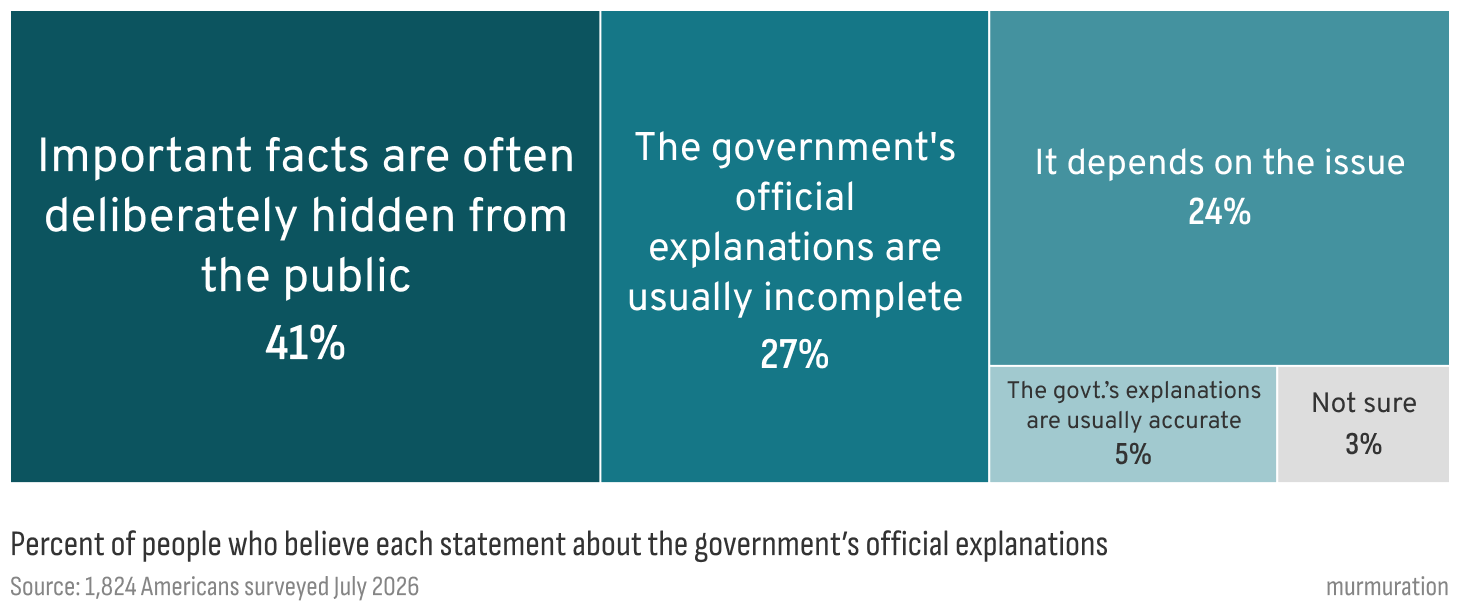
This is not simply a story about conspiracy theories or fringe beliefs. It is a story about what happens when public trust in shared sources of information erodes.. Increasingly, Americans are questioning the motives of anyone claiming to give an authoritative account of reality. They are starting from the assumption that every account is incomplete, and that the truth, if it exists, must be pieced together from somewhere else.
More to the Story
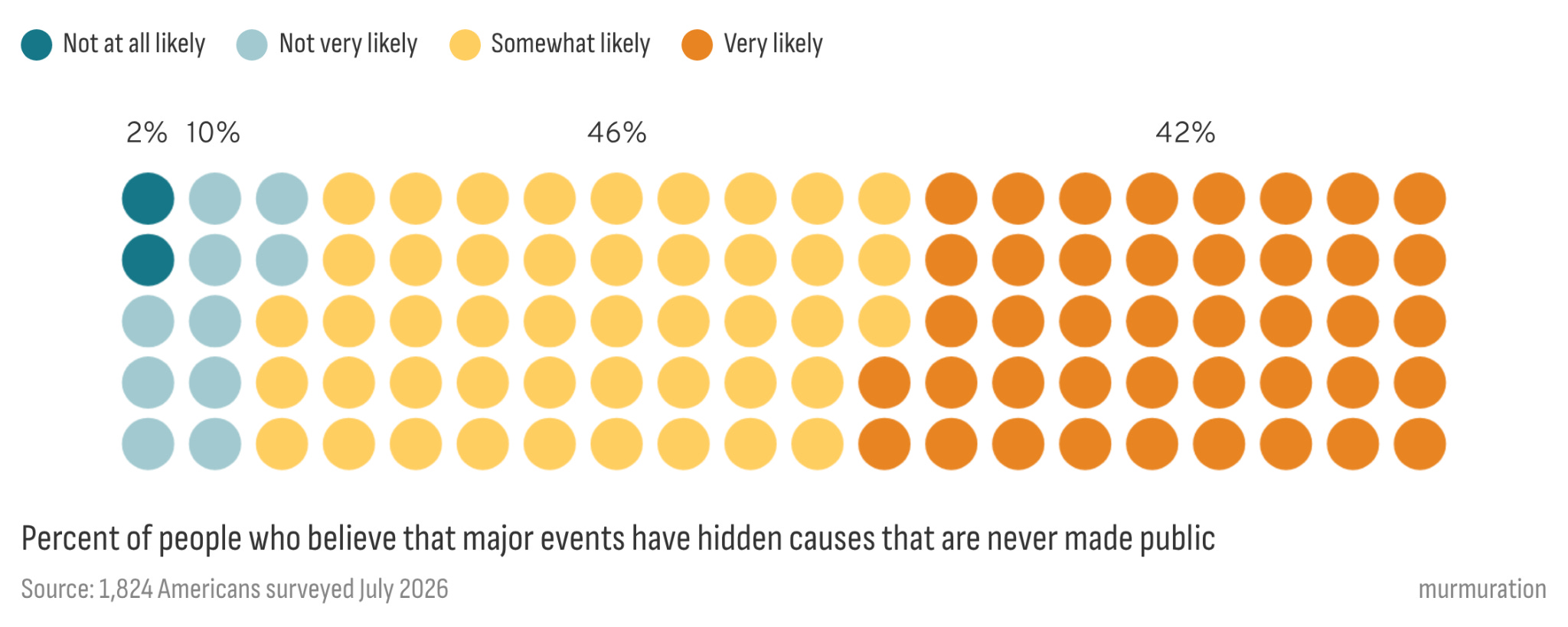
But questions about trust in government are only one part of the story. People’s skepticism extends well beyond the government itself. Nearly nine in ten Americans (88%) believe major events are at least somewhat likely to have hidden causes that are never made public, including 42% who say hidden causes are very likely. Perhaps surprisingly, this worldview is almost identical across political parties. Just under half of Democrats (42%), Independents (42%), and Republicans (43%) all say hidden causes are very likely. Another 46% say hidden causes are at least somewhat likely. At a moment when nearly every issue appears polarized, Americans begin from remarkably similar assumptions about whether the public is receiving the complete story.
At the same time, Americans no longer appear to have a shared authority they turn to for answers. Asked whom they would trust most to know what really happened during a major national event, no source was named by even one in five respondents. Mainstream news organizations led at just 18%, followed by “no one” (15%), eyewitnesses (10%), and themselves (8%).
But that does not mean Americans have stopped looking for help. When they are unsure whether a claim about politics or current events is true, they draw from a much wider network of sources to try and verify what happened. Twenty-nine percent say they turn to friends or family who know about the topic, 26% to subject-matter experts or academics, 23% to national news organizations, and 22% to local news. Another 18% look to someone they trust on social media.
Even the definition of healthy skepticism appears to be changing. While 35% of Americans say skepticism means questioning claims until there is good evidence, 20% define it as assuming there is usually more happening behind the scenes. Another 40% say both definitions describe healthy skepticism equally well.
History, Controversy, and Conspiracy
Over a range of questions, Americans vary from broad consensus on certain documented historical facts to division over more controversial or contested events.
The strongest agreement appears around events that have since become historically established. Eighty-seven percent believe tobacco companies knew smoking was harmful before publicly admitting it, while 69% believe the FBI monitored Martin Luther King Jr. More than two-thirds also believe climate change is primarily caused by human activity.
Other claims occupy a much less settled middle ground. Fifty-nine percent believe the U.S. government is hiding evidence of extraterrestrial life. Fifty-eight percent believe Jeffrey Epstein did not die by suicide. Fifty-four percent believe COVID-19 was intentionally engineered and released. About half believe that the assassination attempts on Donald Trump were staged, and a similar number believe that the CIA was involved in John F. Kennedy’s assassination.
At the opposite end of the spectrum, Americans overwhelmingly reject claims such as the Earth being flat (79% do not believe), members of the British royal family secretly being reptiles (72% do not believe), or birds actually being surveillance devices (70% do not believe).
Just as revealing as what Americans believe is who is most likely to believe it.
The largest differences in the survey are between generations. Younger adults are consistently more willing to entertain contested explanations. More than half of adults under 35 believe the U.S. government was involved in the September 11 attacks, compared with just 16% of adults over 65. Seventy percent of younger adults believe the government is hiding evidence of extraterrestrial life, compared with fewer than half of older Americans. Younger adults are also substantially more likely to believe that Jeffrey Epstein did not die by suicide, that the CIA was involved in John F. Kennedy’s assassination, and that the 2020 election was “stolen” through widespread voter fraud.
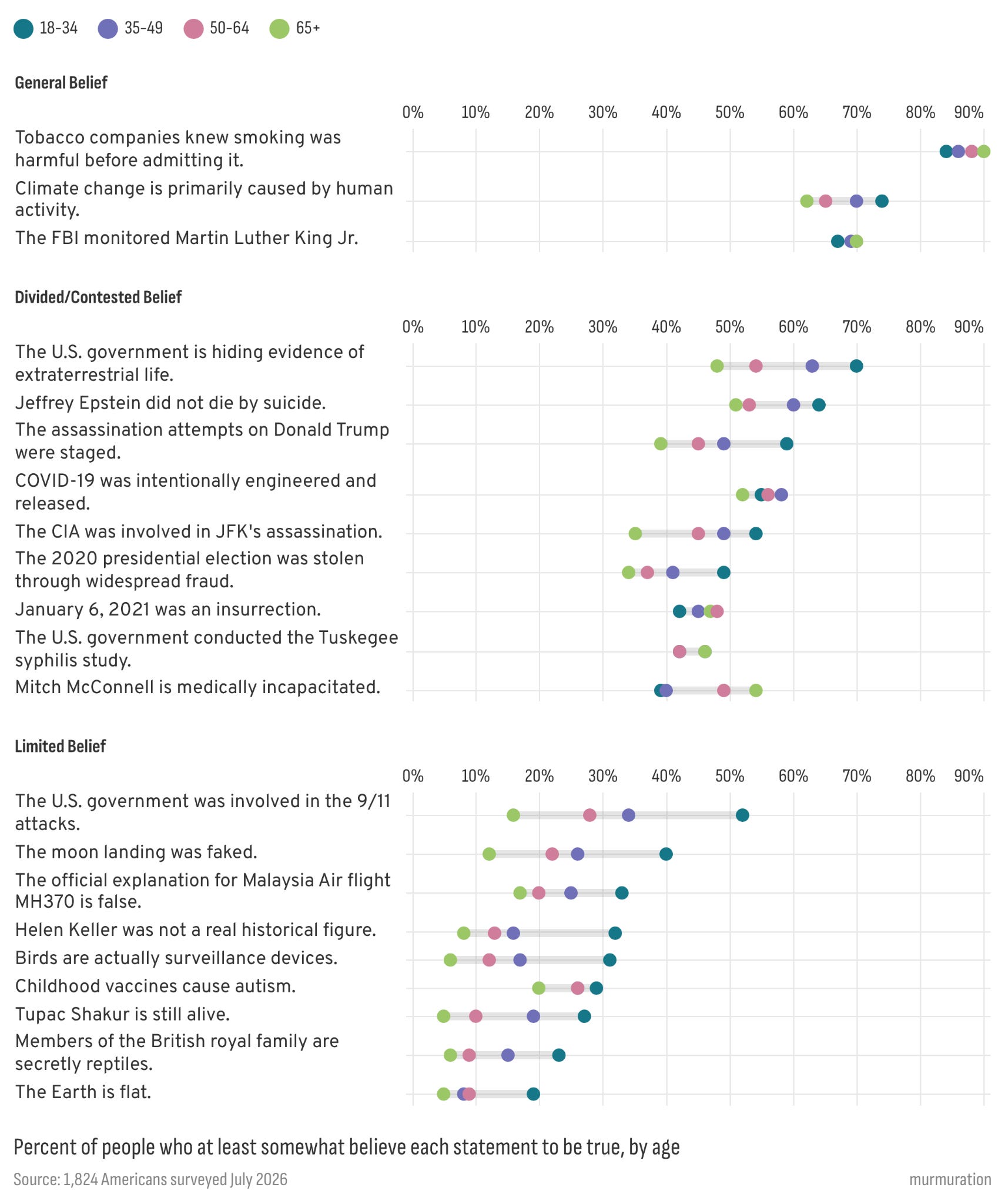
Partisanship matters as well, but often in predictable ways. Republicans are considerably more likely to believe the 2020 election was stolen and that COVID-19 was intentionally engineered and released. Democrats are much more likely to believe January 6 was an insurrection and are also more likely to believe the assassination attempts on Donald Trump were staged. Yet despite these differences, there are surprisingly few partisan divides on some of the survey’s most recognizable claims. Belief that the government is hiding evidence of extraterrestrial life is virtually identical across Democrats, Independents, and Republicans, and belief that Jeffrey Epstein did not die by suicide varies little by party as well.
Finally, uncertainty itself has become one of the defining characteristics of public opinion. Fifty-eight percent of Americans say they are unsure whether the official explanation for Malaysia Airlines Flight MH370 is false. Nearly half are unsure whether the U.S. government conducted the Tuskegee syphilis study, and 44% are unsure whether Mitch McConnell is medically incapacitated.
That uncertainty may be the most important finding in the survey. Americans have not abandoned the idea that truth exists. Rather, many appear to be navigating a world in which they no longer feel confident that any single institution, expert, or official explanation can fully provide it.
Final Thoughts
Trust has always been part of how societies establish truth. We rely on journalists to investigate, scientists to test evidence, courts to evaluate facts, and public institutions to explain what happened. None of those systems has ever been perfect. But they have traditionally provided a common starting point from which disagreement could occur.
Today, that common starting point appears to be eroding. The result is not simply a decline in trust in any one institution, but a fragmentation of public trust across the many sources Americans rely on to understand what is true. That leaves us with difficult questions for the future:
If Americans increasingly believe there is “more to the story,” what would institutions need to do to earn back the public trust ?
When does skepticism strengthen democracy, and when does it begin to undermine it?
How do we create shared confidence in evidence without expecting everyone to reach the same conclusions?
The challenge ahead is not simply helping Americans agree more often. It is rebuilding enough shared confidence that disagreement can still begin from a common understanding of truth and how truth is pursued.
The truth is still out there.
Murmuration is a non-profit that organizes a network of partners and equips them with the insights, tools, and services needed to help communities build and activate the power to transform America into a nation where everyone thrives. murmuration.org
Great article, the three closing questions get to the heart of “The State of Truth”.
Rebuilding trust starts with institutions being more transparent and showing more of their process. Healthy skepticism strengthens democracy when it comes from curiosity rather than cynicism. Shared confidence may be more about agreeing on process, rather than agreeing on conclusions.