


Last week, I had the chance to guest edit the newsletter FWIW by Courier. I used that opportunity to write about something deceptively simple: the disappearance of “third spaces.” It is something that so many of us have felt in our neighborhoods, daily routines, and in the quiet erosion of places that once invited us to sit, linger, and belong.
These third spaces are so woven into the fabric of daily life that we often don’t always notice them until they’re gone. But when they vanish, the loss echoes far beyond convenience. It chips away at belonging, narrows our sense of who we know, who we trust, and where we fit.
Here’s what we shared...
What the Data Shows
Murmuration’s Civic Pulse shows just how fragile third spaces have become. When asked, “Excluding home or work, how many places in your neighborhood can you go without spending much money” almost two-thirds of people say few or none.
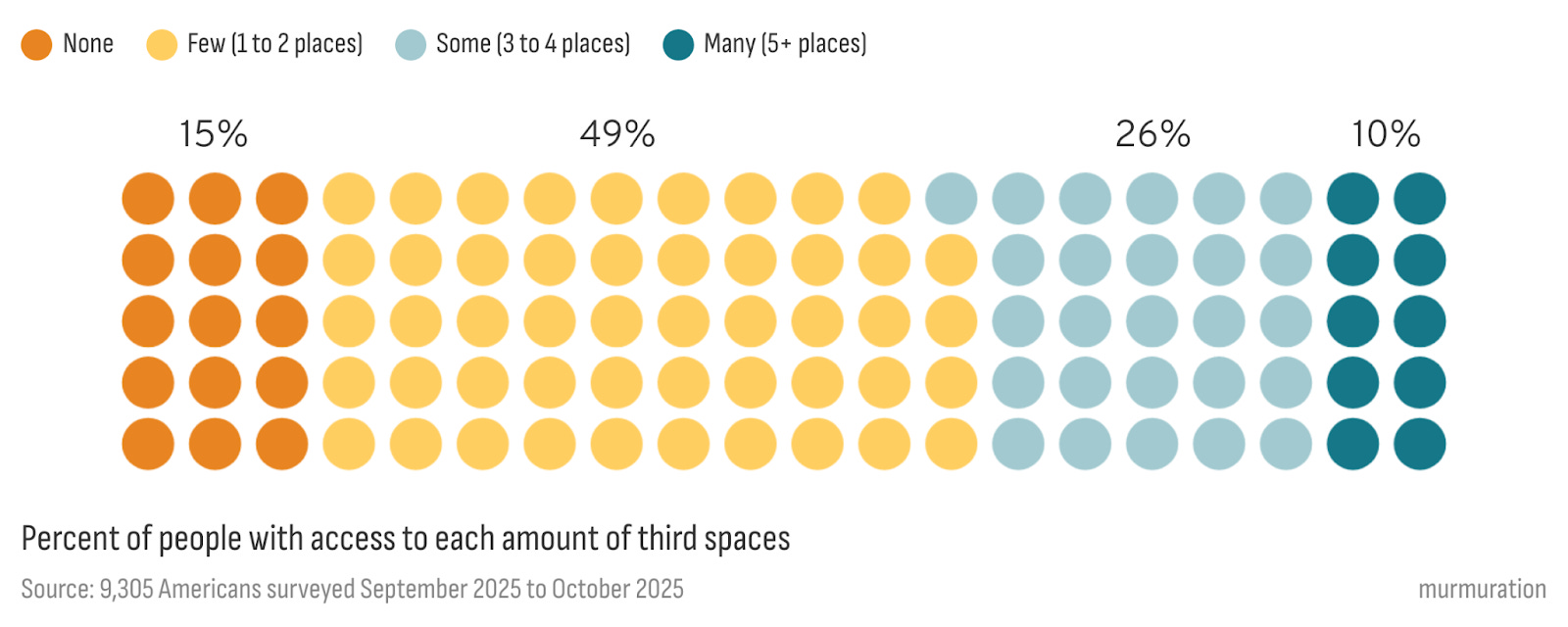
That absence matters. People with no third place are more likely to say:
they are “not at all” part of a caring community (+26pp).
their local community’s wellbeing is “poor” (+17pp).
their community is “not at all” designed for people like them (+14pp).
they are “not at all hopeful” about their future (+7pp).
From Belonging to Ballots
What’s striking is when those third spaces are absent, the cracks show up not only in how people feel about belonging and wellbeing, but extend into civic life itself: even after accounting for partisanship, income, education, geography, and broader national mood, the presence—or absence—of third places is strongly tied to civic participation.
People without access to third places are less likely to say they always vote in local elections (-7pp) or have participated in civic life in the past month (-20pp). By contrast, in neighborhoods with third places, people report being more likely to:
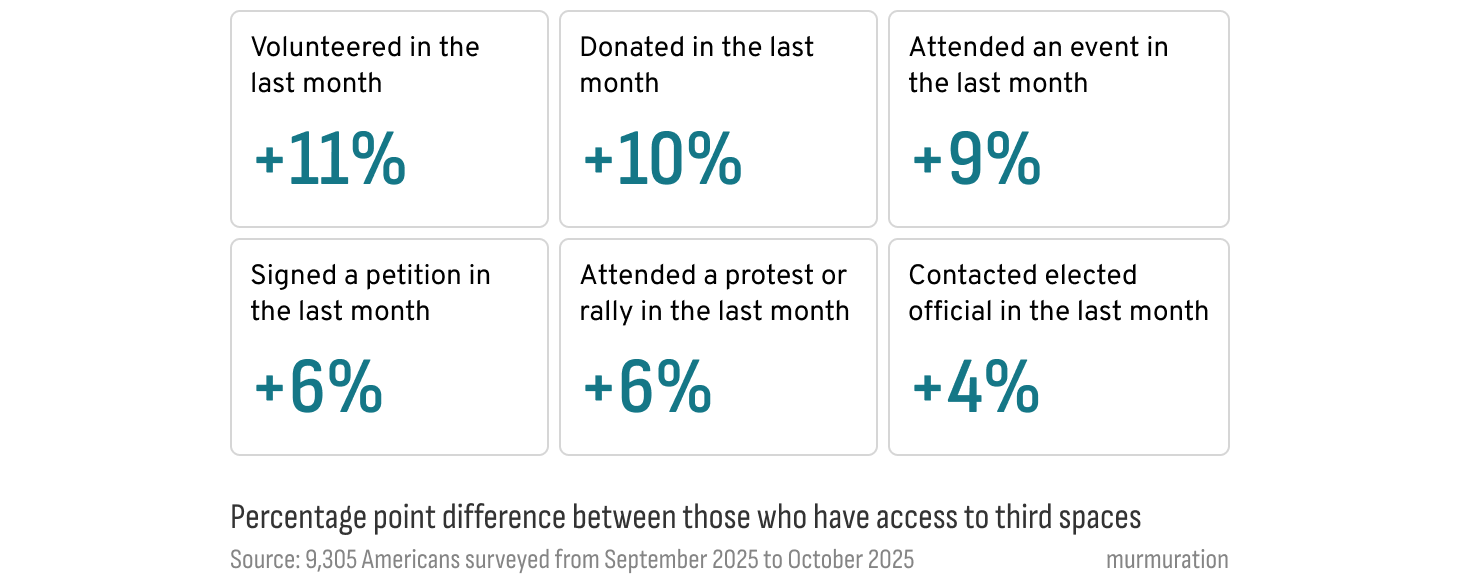
It’s not just civic activity that suffers when people lack access to third spaces. It’s the everyday encounters that build bridges across differences. People without third places are less likely to interact with those who hold different political views at least “some days” (-11pp). And with fewer interactions comes less trust, as people without third places are also less likely (-11pp) to believe that those on the “other side” act in good faith at least “a little”.
Rebuilding What We’ve Lost
People talk about third spaces not only as something nice to have, but as something missing and that their communities need to function. When we ask what communities need to make daily life easier, answers pile up around third places: “a community center for gatherings,” “more green space,” “more things to do that [don’t] cost money”. Similarly, when we ask what communities need that would help bring people together, respondents mention “festivals,” “free concerts in the park,” or simply “a coffee shop I could walk to with comfy seats.”

So who should be responsible for creating or maintaining third places? Civic Pulse finds no consensus: some say local government (37%), others say nonprofits and community organizations (26%), and many say the neighbors themselves (23%). Everyone agrees they matter; no one feels fully in charge.
Final Thoughts
Communities depend on shared spaces to hold the weight of daily life. When those places vanish, we don’t just lose somewhere to sit—we lose the gentle collisions that make civic life possible. The erosion of third spaces is more than an aesthetic change; it’s a quiet rearranging of trust, belonging, and connection.
The good news is that people still want these places. Across differences, Americans are asking for the same things: somewhere to gather, to rest, to feel part of something larger than themselves. That desire is a blueprint waiting to be built on.
The questions we’re left with are pressing:
How do we rebuild shared spaces when time, cost, and safety all work against lingering?
Who is responsible for maintaining the commons when everyone values them but no one feels accountable?
And perhaps most urgently, what happens to democracy when there’s nowhere left to meet?
If a community depends on connection, then rebuilding the third places may be where it begins.
Third’s the word.
Murmuration is a non-profit that strengthens community-driven change at the local level. By equipping local organizations with powerful data, technology, and insights, Murmuration helps them amplify community voices, build collective power, and drive solutions that reflect the lived realities of the people they serve. murmuration.org