


“I feel a strong sense of belonging in my community. Everyone is kind, caring and helpful.” – 62, Female, Fairfield, Connecticut
That’s what belonging sounds like. Or at least, what it’s supposed to. For many Americans, it still is. They find it in the warmth of a church circle, a trusted group of friends, or a book club where nobody judges your wine choice or your hot takes.
Belonging plays a critical role in personal well-being. People who feel connected to others consistently report higher life satisfaction. Our findings confirm this:
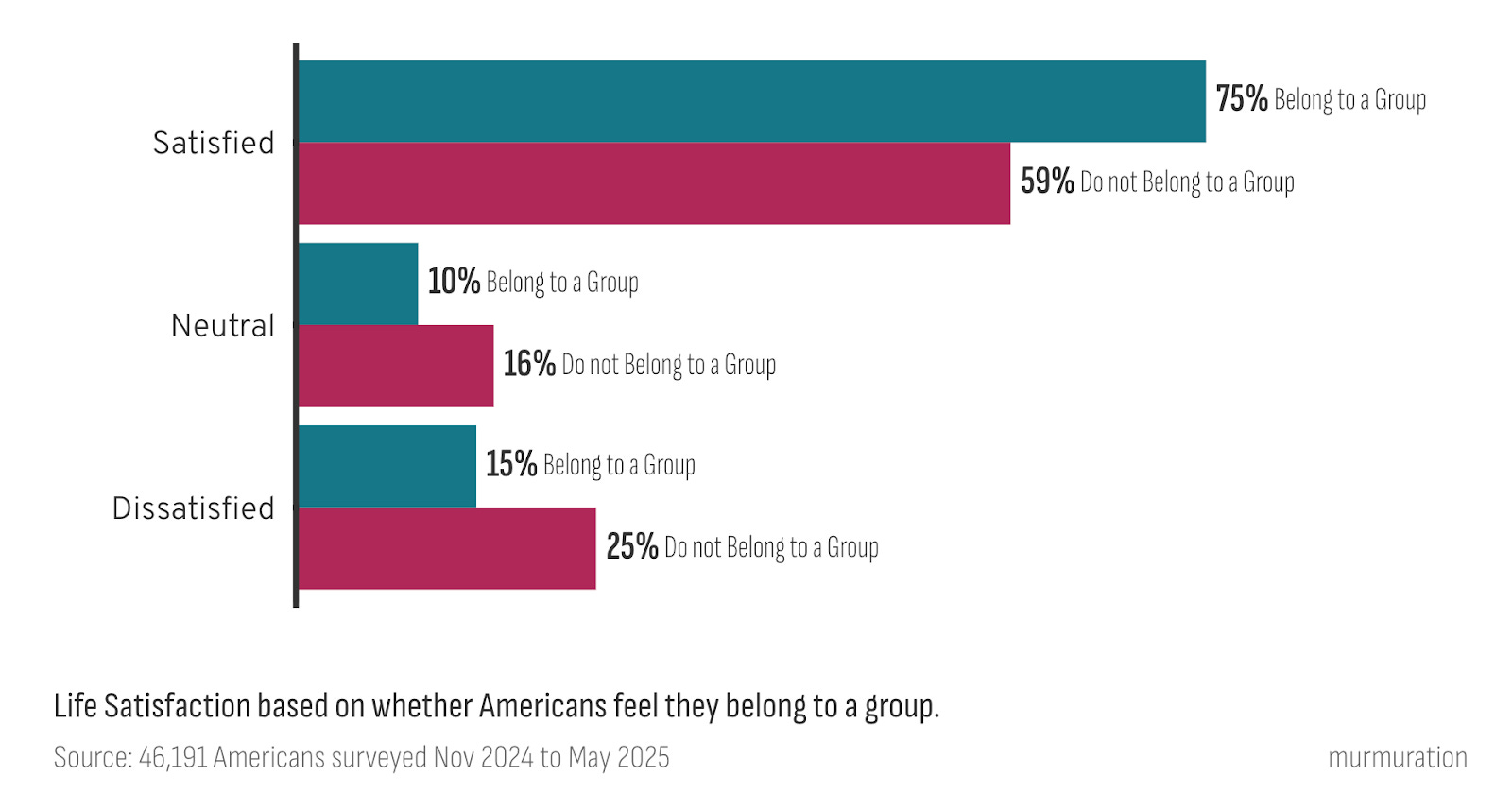
But to understand more, in Civic Pulse, we asked folks: “Think about groups, organizations, or networks you’re a part of. Which ones give you a strong sense of belonging, and why?”
The answers we received reveal not just how people connect, but how these connections shape emotional well-being.
Who Belongs Where?
We dug into tens of thousands of open-ended responses to identify where people feel the strongest sense of belonging. The answers ranged from the heartfelt to the hilarious, but clustered into eight broad categories:
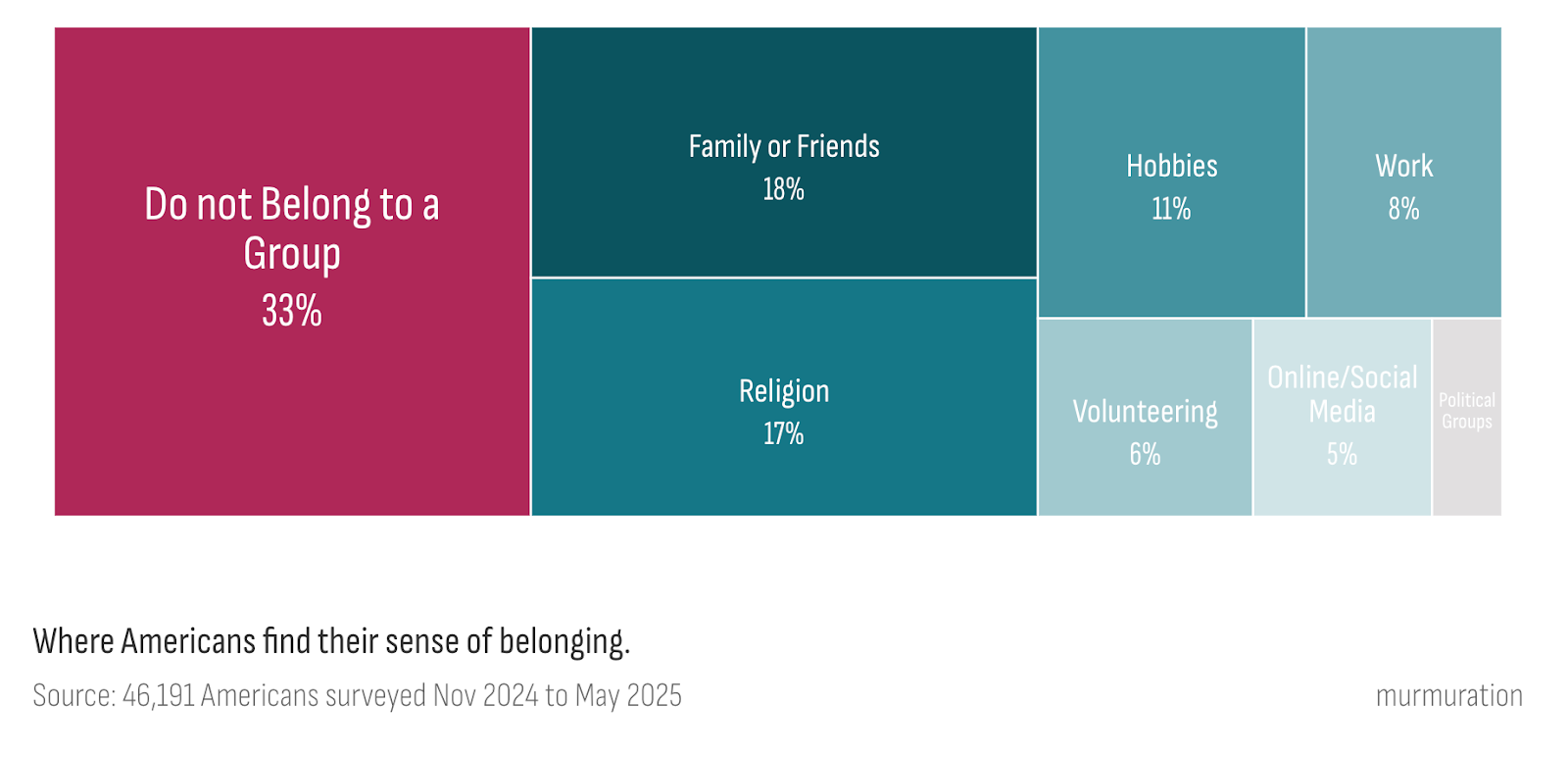
Many people pointed to the timeless anchors of family, friends, and faith:
“My friends and family give me a sense of great belonging.” – 45, Female, Williamsville, New York
“My book group and my church group both give me a strong sense of belonging due to active participation and acceptance.” – 64, Male, Powell, Ohio
Others spoke to the power of shared purpose, from volunteer service to support groups:
“Rotary is very good. It allows me to give back to my community. I am able to participate in international projects. I have made some very good friends.” – 70, Male, Nevada City, California
“The biggest sense of belonging is my UHPW group. It is other women supporting each other and being honest and open. Gives you a feeling you are not alone.” – 57, Female, Lagrange, Georgia
For some, similar feelings of belonging came through hobbies or online communities:
“My gym has a really friendly, nice community of people I like. It's very supportive and always perks me up on a bad day.” – 32, Female, Monument, Colorado
“Reddit, I enjoy the various subreddits, I learn a lot through them about almost every subject.” – 36, Male, Denver, Colorado
And then there were the unexpected gems—those delightfully honest answers that remind us belonging can take many forms. One respondent shared: “Jimmy Kimmel on YouTube helps keep a strong sense of belonging.” Another, perhaps our most memorable, declared: “Costco membership. You may laugh, but there is no bullshit, no pretending, no playing games. It is a relationship of convenience.”
These answers might seem unexpected, but they underscore something enduring: even as the world changes, people continue to seek out spaces—however unconventional—that offer clarity, connection, and a sense of purpose.
Belonging as Nourishment
But while people find connection in all kinds of places, not all forms of connection offer the same sense of fulfillment. We found striking differences in life satisfaction across the various types of group connections:
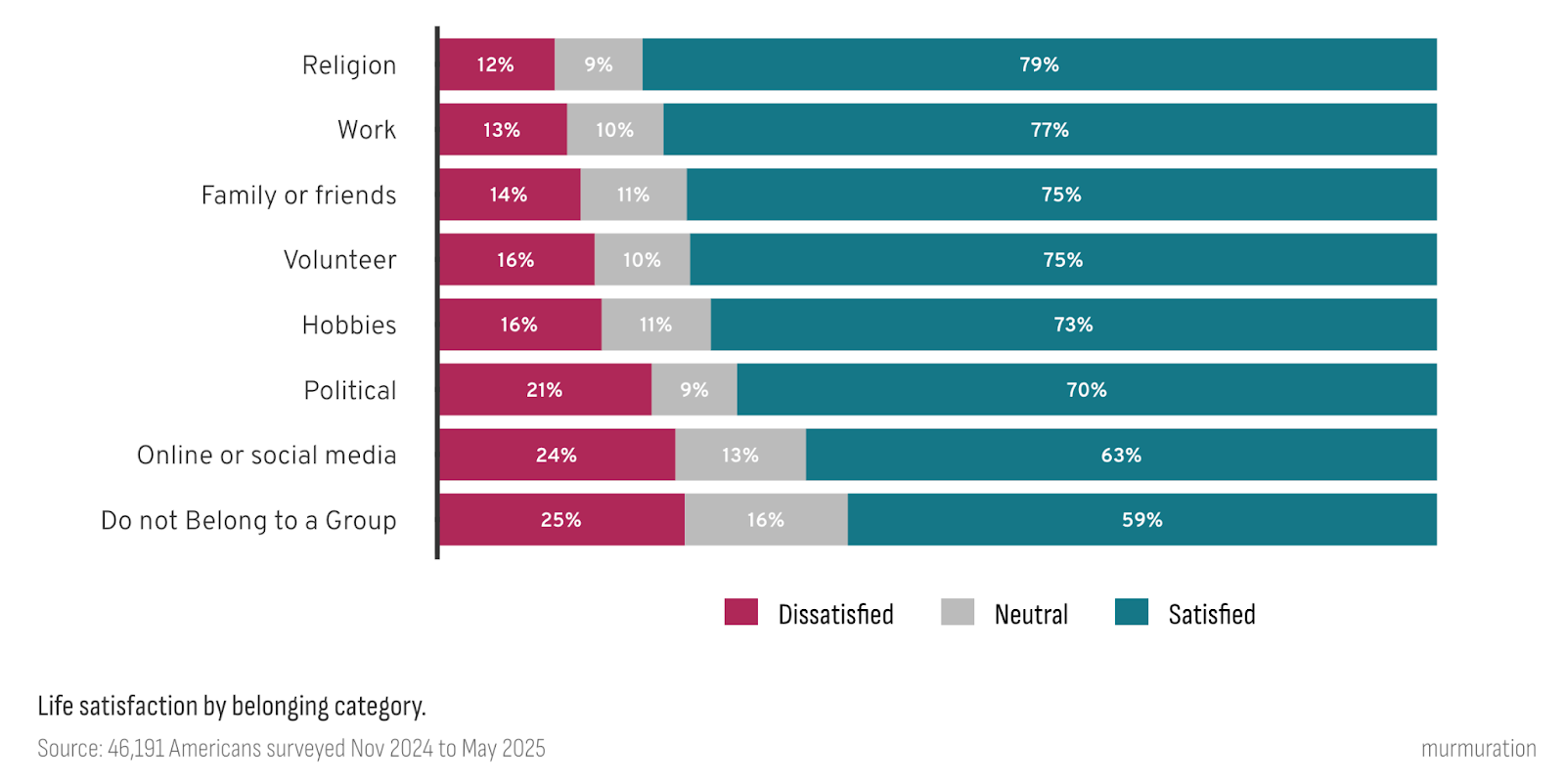
That’s right: people who say they belong via social media are unhappy at nearly the same rate as those who don’t belong anywhere. A sense of belonging filtered through screens and algorithms just doesn’t seem to hold up in the emotional durability department.
Even people who find belonging in political groups, a cohort you’d think might feel fired up and engaged, rank near the bottom of the satisfaction ladder. And in some cases appears to belong via ideology more than community. For example:
“The Republican Party gives me a strong sense of belonging because they don't want me to apologize for being a white man that *checks notes* EXISTS” — 33, male, Norfolk, MA
Why might this be? Many of the groups with higher satisfaction seem to foster connection rooted through mutual care, shared effort, and emotional sustenance. Others rely on something stickier but far more brittle: fear, resentment, and a sense of embattled identity. The glue that holds these communities together is often negative and tribal in the most primitive sense: useful for surviving, but rarely for thriving.
The Lost Ones
Critically, a staggering 33% of Americans say they don’t belong to a group or organization in their community.
“I'm not really a part of any groups or organizations. I don't feel like I belong where I work and I don't do much outside of work” – 22, Female, Whitefield, Maine
This absence is surprisingly consistent. There’s no clear divide by gender, urbanicity, or even race. However, a few patterns do emerge:
Non-college graduates are much more likely to lack group affiliation (38%) than college graduates (24%).
Lower-income Americans are the most likely to report not belonging to any group (42%), compared to those (25%) earning $100K or more.
Middle-aged adults are the most likely to say they don’t belong to any group (35%), followed by younger adults (32%), while retired individuals are the least likely to say this (31%).
Political Independents are less likely to belong to a group (37%) than both Democrats (33%) and Republicans (29%).
Non-parents are more likely to say they don’t belong to a group (35%) than parents (31%) with the greatest gap (+10) during peak child-raising years.
Belonging, Built by Volunteers
Only about 6% of Americans say they find a strong sense of belonging through volunteering. That may sound like a small number, but for organizers, advocates, and anyone working on campaigns, this group punches far above its weight. Volunteers are part of the often invisible infrastructure of community life.
So, who are these people? If you’ve spent time around a volunteer phone bank or community garden, this likely won’t surprise you:
They skew older. Belonging through volunteering is most common among those 65 and up (7%) and those who are retired (8%). Younger people who are 18-29 come in lower (4%).
They’re slightly more likely to be women. Women clock in at 6% vs. 5% for men.
They lean blue. Democrats are more likely (6%) to cite volunteering than Republicans (5%) or Independents (5.5%).
They trend higher-income. Those earning $100k+ are slightly more likely to say volunteering (6%) compared to those who earn under $50K (5%).
They’re everywhere. Volunteering shows up with less than 1% difference across urban, rural, and suburban communities.
The takeaway? If you’re trying to build community or move people to action, don’t underestimate the power of this modest slice of Americans.
Final Thoughts
We’re social creatures, but not all social connections carry the same weight. Belonging isn’t just about being part of something. It’s about being part of something meaningful, reciprocal, and real.
If we're being honest, there's something foreboding about a third of Americans walking around without a sense of belonging at all. That loneliness isn't just sad. It is also dangerous. It shows up in health outcomes, voting patterns, even democratic resilience.
The connection is measurable. People who feel a strong sense of belonging are far more likely to engage in civic life. About 20% of people who belong to a political group reported doing four or more civic activities (e.g. volunteer, donate, attend an event, sign a petition, etc.) in the last month. That number is 13% for those involved in a volunteer community, and hovers around 6 to 7% for those connected through other forms of belonging. But for people who say they don’t belong anywhere? That number drops to less than 3%.
So we’re left asking some big questions:
What would it take for the one-third of Americans who feel like they don’t belong anywhere to find a place that feels like home?
What kinds of groups actually build real community and which ones just give the illusion of it?
How can we re-think digital spaces so they come closer to fostering the sense of satisfaction from in-person connection? Or conversely how are digital spaces driving isolation?
The data tells us that when people feel connected, they show up. They contribute. They care. Especially when the belonging fosters a shared sense of interdependence. And where that connection is missing, participation falters and disconnection deepens.
The challenge ahead isn’t just to measure belonging but to build it. Not performatively, not transactionally, but intentionally. In neighborhoods and online, in institutions and informal spaces, we have an opportunity to create places where people don’t just show up but where they stay, because they feel seen.
Keep building the world you want to belong to.
Belonging is such an important feature of life and it’s interesting to see where and how people find that belonging. So appreciative of these insights!