


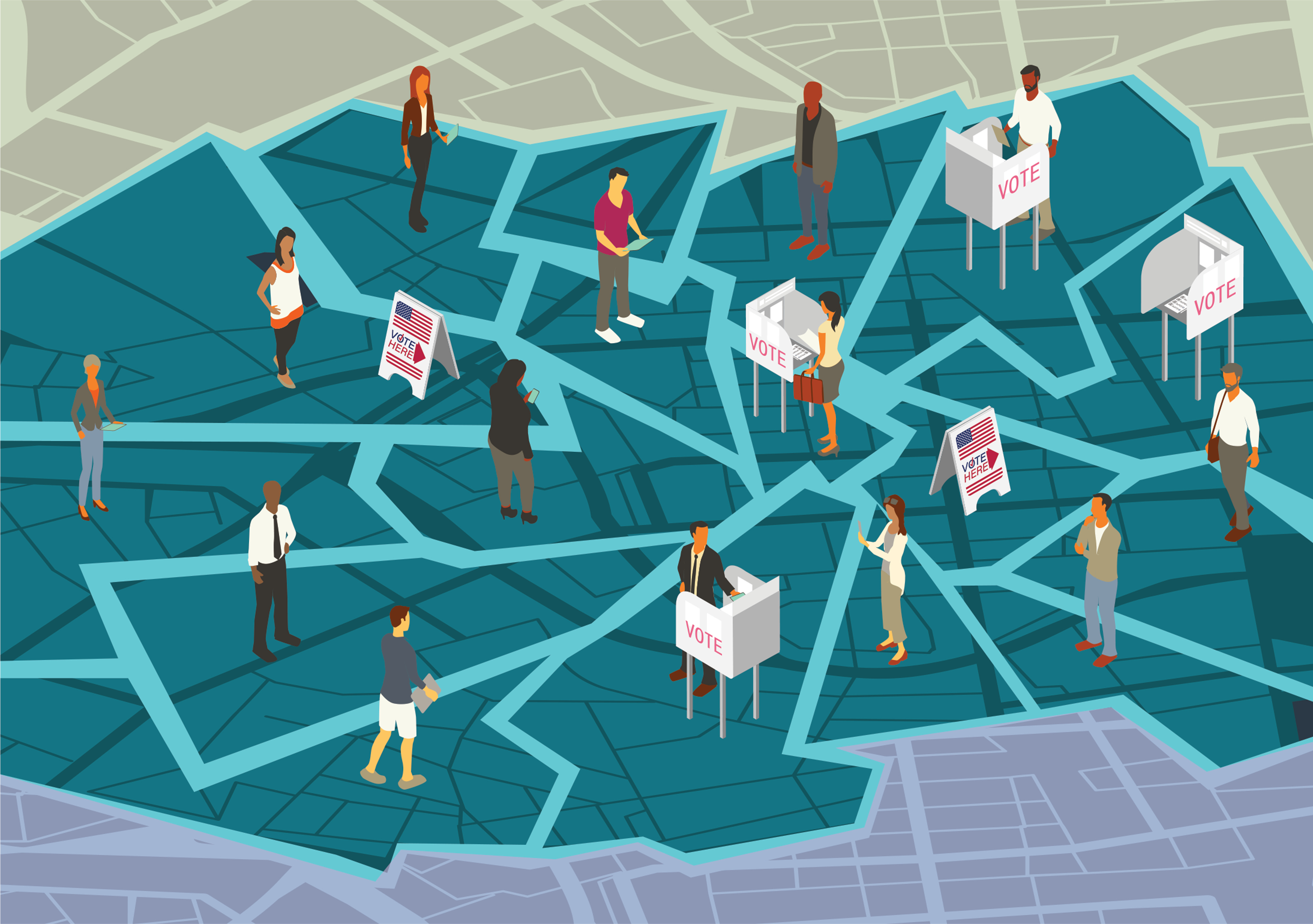
Murmuration’s Chief Marketing and Operating Officer, Michael Slaby, sat down with Spencer Overton, Law Professor at George Washington University Law School, for The Exchange, our interview series featuring influential thought leaders, organizers, advocates, and others who are shaping the future of civic life.
This interview has been edited for length and clarity.
Michael Slaby: Thanks so much for joining today and taking the time to talk to us about your work, especially at this incredibly complex moment around the idea of political power and enfranchisement in this country. Can you tell me a bit more about how you came to focus on race and democracy?
Spencer Overton: I initially came to democracy work through concerns about money and politics. Early in my career, I was focused on campaign finance and the ways concentrated wealth distorted democratic accountability. Some of that was about the unequal distribution of resources in terms of race, but it was broadly an issue of fairness.
In the aftermath of Bush v. Gore in 2000, it really became impossible to ignore how rules about voting itself, voter identification laws, felony disenfranchisement, and purges were shaping who had political power in America. That led to my book Stealing Democracy, which examined how politicians manipulate electoral rules to maintain power. What struck me over time is that these tactics were rarely isolated. Redistricting, access to the ballot—all these different mechanisms served the same objective, basically deciding in advance whose voices will matter politically.
In about 2014, I stepped away for about five years and ran a Black think tank. We focused on economic issues, but I came back to the issue of politicians manipulating electoral rules to maintain power through a technological lens around 2019. Between 2019 and now, a lot of my work has focused on democracy and technology.
Michael Slaby: You’ve talked about the expressions of political power in the context of the Callais decision and the undermining of section two of the Voting Rights Act. The Voting Rights Act was really about ensuring that communities that had been actively oppressed and denied political rights could actually build and exercise political power and ultimately access institutional power in the form of representation in our government. I think we lose sight of the role that drawing maps played in ensuring communities had power.
We’re in a world now where, apparently, redistricting is becoming more common, and I don’t expect that to be a political tool that anybody is willing to set down readily. If we’re constantly remapping, the relationship between political power and place is challenged, complicated, or even distorted.
Spencer Overton: When I started my book Stealing Democracy, the first chapter dealt with democratic gerrymandering in California. I wanted to say the broader issue is politicians manipulating rules to predetermine outcomes here, and that’s a fundamental issue. When race becomes intertwined with these systems, the harms are especially durable because they can lock communities out of meaningful political power for generations. We think about the best political systems being ones where different factions can form, but they can also reshape, and they can create new coalitions in the future to respond to new problems. But when things are fixed because of racial polarization, that’s an issue. I think that’s a problem here that is unique.
We’re seeing all of these different cases coming together—the Callais decision gutting the Voting Rights Act, the Brnovich case, and Rucho putting a green light on partisan gerrymandering. And as a result, we’re in a fundamentally different place. But the fact that we’re in this different place can hopefully open us up to some completely different systems that transcend our existing systems.
Michael Slaby: I think the Callais decision is rooted in a misunderstanding of the purpose of the Voting Rights Act. It was not just enfranchisement, but actually empowerment, literally the ability to exercise political and sustain institutional power for communities. But because that was not clear in the legislation, it’s easy to say things like colorblindness and wave away the injustice and inequity of failing to share power more effectively with communities. What emerging innovations do you see that may allow us to re-engage this question of sharing power?
Spencer Overton: A representative democracy means that people who share interests and experiences can translate their political participation into meaningful representation and meaningful governing power. In our current system of winner-take-all elections, large portions of the electorate routinely end up with no representation that reflects their views. Gerrymandering intensifies that problem, and as a result, there are millions of people who feel like their ballot doesn’t count.
That’s one of the reasons I’ve become increasingly interested in proportional representation. Under proportional systems, groups receive representation roughly proportional to their share of the vote. If a group makes up 30% of the votes and they vote cohesively, they should be able to elect roughly 30% of the legislative body. It helps communities of color secure representation without requiring race-conscious district lines, which are viewed skeptically after Callais, but it’s not just about race. It can improve ideological diversity when we think about a place like Massachusetts, which is about a third Republican, but has no Republican congressional members. The reverse is true in Tennessee, particularly after the recent gerrymander there.
In our current system of winner-take-all elections, large portions of the electorate routinely end up with no representation that reflects their views. Gerrymandering intensifies that problem, and as a result, there are millions of people who feel like their ballot doesn't count.
Michael Slaby: At the time of recording this, in the last forty-eight hours, there have been other maps challenged—Alabama and South Carolina, for example. The idea that maps are no longer stable representations of our political landscape is becoming a destabilizing fact for people.
Spencer Overton: I think about how we can develop a system where voters choose the groupings and the outcomes rather than politicians. I also think that people do not have the same confidence in the U.S. Supreme Court that they once did. Instead of a system that’s based on judicial intervention, we need to set up systems where voters select the groups—and then those groups might change from election to election. And then obviously, we’ve got some other issues like money in politics, which is significant. And then there’s our system of primaries, where basically 8% of the population selects 82% of the U.S. House, because of a combination of gerrymandering and low turnout primaries. And the Senate just has so much power in terms of its confirmation power, and it doesn’t reflect the diversity of our country. There are many different structural issues that we have to acknowledge and address.
Michael Slaby: Naming that there is a multiplicity of challenges is important. I think there are moments when we think about democracy reform and innovation, and we get precious about a particular answer, rather than recognizing the multiplicity of solutions that might exist. There are many different dysfunctions. It’s not one dysfunction. So we probably need more than one answer.
Spencer Overton: I think that’s right. There’s not just one silver bullet here that’s going to solve everything. This is a complex system, and there are a variety of things we’ve got to deal with.
Michael Slaby: I’m curious about how you see reform also as an engine of rebuilding trust. That at some level, democracy is a system of faith, and if we don’t believe that our power is being shared, if we don’t believe that our agency has value, we’re not likely to use it, and then we’re unlikely to participate. And then we’re unlikely to trust it, and then the results become questionable. Today, the rule of law is under pressure because we don’t feel like there are any stable or consistent rules. Where do you see opportunities to address this?
Spencer Overton: I think the first step is recognizing that much of the distrust is rational. Americans are responding to real structural problems, such as gerrymandering and politicians who are insulated from accountability. We talked about the Senate. We talked about the Supreme Court. Obviously, campaign spending creates some understandable perceptions that wealthy interests dominate here. So, rebuilding trust cannot rely exclusively on messaging, right? It really requires substantive institutional reform. We talked about how to manage gerrymandering with things like proportional representation. Concerning our Senate piece, that’s really complex because some interpretations of Article V suggest that the U.S. Constitution cannot be amended to base the voting power of U.S. Senators on population, but there could be some intermediate steps, like DC statehood, that give more influence to historically underrepresented communities. And there are some other things that one could possibly do, like Supreme Court ethics reform, shadow docket reform, and obviously campaign finance reform. A lot of the distrust comes when people feel like their participation doesn’t matter.
The book The Turnout Gap by Bernard Fraga proposes that a lot of the racial gaps in participation aren’t due to socioeconomic issues, but due to gerrymandering and people feeling like their vote doesn’t really make a difference. Feeling like you’re making a difference is important. I also think that sometimes reformers ignore deep-seated cultural issues. People feel cultural anxiety. The country is changing from a demographic standpoint, and that creates tension because people are not necessarily ready to share power or feel a threat to their status. How do we recognize that and address it as opposed to simply calling it racist or simply pretending that it doesn’t exist? How do we acknowledge that and make a space that’s respected for people and figure out a way for some of those folks to have trust in a very diverse democracy here?
I think the first step is recognizing that much of the distrust is rational. Americans are responding to real structural problems, such as gerrymandering and politicians who are insulated from accountability… I also think that sometimes reformers ignore deep-seated cultural issues. People feel cultural anxiety. The country is changing from a demographic standpoint, and that creates tension because people are not necessarily ready to share power or feel a threat to their status.
Michael Slaby: I think at times a failure of imagination keeps allied groups around democracy reform and the voting rights space from cooperating and co-organizing to build collective power. But when we look at younger people, I feel a sense of hope that new justice movements or new reforms might be possible.
Spencer Overton: I’m excited about the fact that younger reformers, and I think younger generations generally, are not just focused on the status quo. Many young people want something that is truly transformative rather than simply kind of nibbling around the edges. The fact that people don’t want to just rely on what has existed before, and are open to and willing to do some different things, gives me hope.
One of the things that concerns me is the evolution of technology and its role in terms of expression, speech, the economy, displacement in terms of jobs, and our ability to govern. I don’t know that we’re going to be able to effectively allow government to ensure that technology works for human beings if we don’t get our democratic institutions right. I don’t know that the government can effectively, for example, regulate technology in light of our current campaign finance rules, gerrymandering, and some of the other incentives. I really feel like we’ve got to get these basic democracy issues together to collectively confront some of these larger challenges of our time.
Michael Slaby: We never proactively laid out what we wanted social media tools to make possible for the community, for engagement, for civic life. I think we’re similarly missing an opportunity to talk about what we want from AI and talking about them too much as a set of things that are happening to us with an inevitability that implies we have no agency. We need to create a powerful public conversation to get what we want explicitly from tools that are meant to elevate humanity and elevate the way society thinks and functions, to create bridges and creativity that don’t exist, but our current systems don’t lend themselves to that type of activity.
Spencer Overton: I think that the first challenge that we have there is that so often we’re reactive in terms of here’s what the problems are, as opposed to proactively describing a vision. Many different people are going to have different visions, but that’s part of the work in terms of having that conversation and working through it. If you haven’t been talking about it and you haven’t kind of worked it through, you’re not going to be able to advance a new vision in the finite window that we have to implement that change.
I think that it is important to have those conversations now and not feel vulnerable, “like it’s inevitable, the machines are definitely going to take over,” or the opposite, right? Like the abundance culture of it’s all just going to get better because AI is great and is going to save us. Recognizing that we have agency both in terms of the technologies as well as laws, and that we have to exercise that agency and figure out what it is that we really want.
Michael Slaby: Do you see places where you would guide people to using that agency, either in that conversation or in the voting rights conversation right now?
Spencer Overton: I have gotten a lot out of looking overseas. For example, in Northern Ireland, the Good Friday Agreement allowed almost warring factions, in terms of the British settlers who are largely Protestant and the native Irish who are largely Catholic, to have an agreement, to share power and work together using proportional representation there. These are tools that have allowed people to share power and make decisions together in times of cultural conflict.
Michael Slaby: I appreciate that focus on looking to relationship and community and the ability to share power in ways that feel just and creative as the driver—not cleverness. In democracy reform conversations, sometimes there are moments where we lose contact with a moral and ethical orientation toward healthy, vibrant relationships and community. And I think to our detriment, because we come off as technocratic and clever in a way that is misleading for what’s really at stake.
Spencer Overton: Some people would say, “let’s just be colorblind,” or “let’s tone it down” in terms of concerns about justice and policing, because we see the backlash that comes from it, so we just all need to be in the middle, and that’s the solution to making everything better.
My concern with that is that it doesn’t account for the pluralism of who we are as a country. I think that some marginalized folks experience that sentiment as similar to the mandated assimilation that we saw in terms of Indian boarding schools, or Black women having to straighten their hair to keep their job, or schoolchildren being prohibited from speaking Spanish at recess. It feeds into a kind of conquest. I think we should reject that and recognize some of the value of pluralism is that we can all share power, and we all can win.
Michael Slaby: More diverse groups are more creative. More diverse groups are more adaptive and adaptable. We flatten the engine of creativity in society if we choose safety or similarity, or assimilation instead of real integration. It’s an incredible missed opportunity in addition to being unjust. On another note, what’s giving you hope for the future right now?
Spencer Overton: I am a law professor, and it’s so neat to work with young minds and their excitement about the future. Younger folks give me hope. History also gives me hope. Many of the periods we now romanticize were experienced at that time as moments of profound crisis. When we think about Bloody Sunday and Selma, many people thought American democracy was and would be fundamentally broken. But that period produced the Voting Rights Act. Watergate exposed serious corruption and abuse of power, but it also generated major campaign finance and ethics reform. Democratic progress in the United States often emerges from periods of intense conflict and institutional failure. And for me, the question is, when the window opens up after this crisis, will we be prepared to kind of usher in a new and better system where different groups are able to share power, and we can move forward?
Democratic progress in the United States often emerges from periods of intense conflict and institutional failure. And for me, the question is, when the window opens up after this crisis, will we be prepared to kind of usher in a new and better system where different groups are able to share power, and we can move forward?
Michael Slaby: We have to confront and take care of people who are under threat, but we also have to be prepared for the moment when change is possible. We have to do both.
Spencer Overton: We have an opportunity, and we can’t lose hope. We can’t get pessimistic about each other. The founders were not perfect, and there were a lot of flaws. But what we have inherited in terms of a superpower of a nation—there’s so much good we can do in the world if we really focus right now in terms of getting these systems right so that we can share power. Don’t get discouraged. Go out and vote. Be engaged. All those things are really critical at this moment. The future of the nation, and I would say that the future of the world, hangs in the balance in terms of our engagement around democracy issues over the course of the next decade.
About Spencer Overton
Spencer Overton is a tenured professor and the founder and faculty director of the Multiracial Democracy Project at GW Law School. The Project is currently working on proportional representation and other alternatives to our current electoral system as a strategy to preserve representation for communities of color in light of the U.S. Supreme Court’s gutting of Section 2 of the Voting Rights Act. Spencer is the author of the book Stealing Democracy: The New Politics of Voter Suppression and numerous law review articles on democracy, race, and technology. He has also worked on race and democracy issues as a senior policy official in the Obama Administration and as president of the Joint Center for Political and Economic Studies—America’s Black think tank.
About Michael Slaby
Michael Slaby is a leader in how values, systems, strategy, and technology drive movements and organizations. At Murmuration, he leads marketing, fundraising, network engagement, and culture. Before joining Murmuration, he was a senior strategist and head of community at Harmony Labs where he worked on accelerating media reform and transformation. He founded and was head of mission of Timshel, a social impact technology company, and was a fellow at the Shorenstein Center at the Harvard Kennedy School of Government. Michael helped lead the Obama for America campaign as chief integration and innovation officer in 2012 where he oversaw all technology and analytics and as deputy digital director and chief technology officer in 2008.
Murmuration is a nonprofit working to transform America into a nation where everyone can thrive. We organize a network of community-focused partners and equip them with the insights, tools, and services they need to help communities build and activate power more effectively. murmuration.org