


If you spend even a few minutes with the news it’s easy to walk away with a very particular impression of American life right now: that people are more divided, more self-interested, less willing to show up for one another than they used to be. That whatever held communities together has frayed, or at least weakened.
But most of us aren’t forming our views of “the country” in the abstract. We’re forming them through accumulation and algorithms…through what we see, the content we engage with, and what we assume about everyone else.
So this week, we stepped away from the big narratives and asked something more grounded: what are people actually seeing in their day-to-day lives? What moments make them feel like people are capable of goodness? How often are they showing up for others themselves? And what do they believe everyone else is doing?
Because if our sense of each other is built in small moments, that’s where we need to look to understand what’s really holding and what isn’t.
Experiencing Goodness
Even in a moment where broader narratives emphasize division and distrust, most people are still moving through life filled with everyday interactions where they regularly encounter others in unscripted ways. Many of these settings aren’t designed to produce connection or generosity, but they often do.
When we asked what they had seen recently that made them think, “people are actually pretty good,” the answers were often ordinary and close to home: someone returning a lost wallet, a neighbor checking in during a storm, a stranger stepping in to help carry groceries. But, the most common response was simply kindness to strangers (29%) followed by a more general sense of everyday positivity (20%).
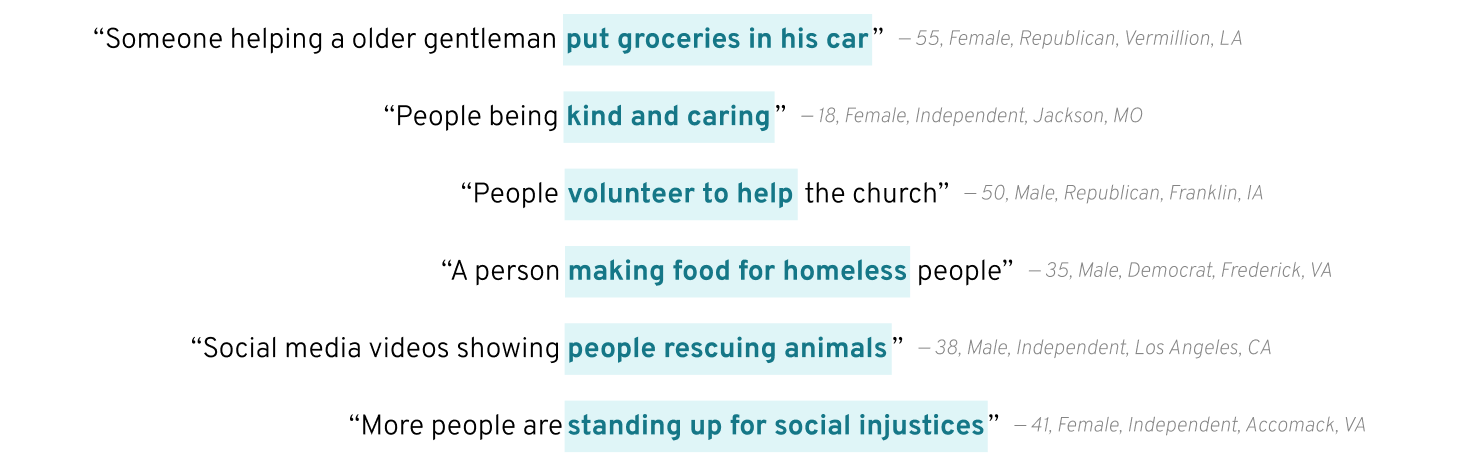
These moments aren’t rare, but they aren’t always noticed, either. Some people say they see them often (33% say a few times a week), others say almost daily (19%), while another third describe them as occasional (32% say a few times a month). And where they happen matters. Most of these encounters take place in familiar spaces—neighborhoods (19%), public spaces (29%), or online (16%)—places where people cross paths without expectation.
What’s striking is the weight these moments carry. Eight-in-ten Americans say moments of “goodness” influence how they see others (30% a lot, 50% some). Even brief interactions can shift how people see others, softening assumptions and interrupting more negative narratives.
One of the clearest divides isn’t just in what people do but in what they notice. People who feel connected to their communities are dramatically more likely to say they regularly see moments of goodness, while those with weaker community ties are far more likely to say they rarely see them or can’t think of any at all. The gap here is staggering, with differences of 30 points or more between groups. Financial comfort plays a role, but it’s smaller. What stands out is how strongly a sense of community shapes not just experience, but perception itself.
Being the Goodness
If the first part of the story is about what people see, the second is about what they do. Because alongside these observed moments of kindness is a quieter, more personal question: how often are people showing up for others in their own lives?
We started by asking what defines a “good neighbor,” and the answers pointed to something simple but consistent: showing up, being considerate, and offering help without being asked. Not grand gestures—just a baseline of care that makes shared life feel possible.
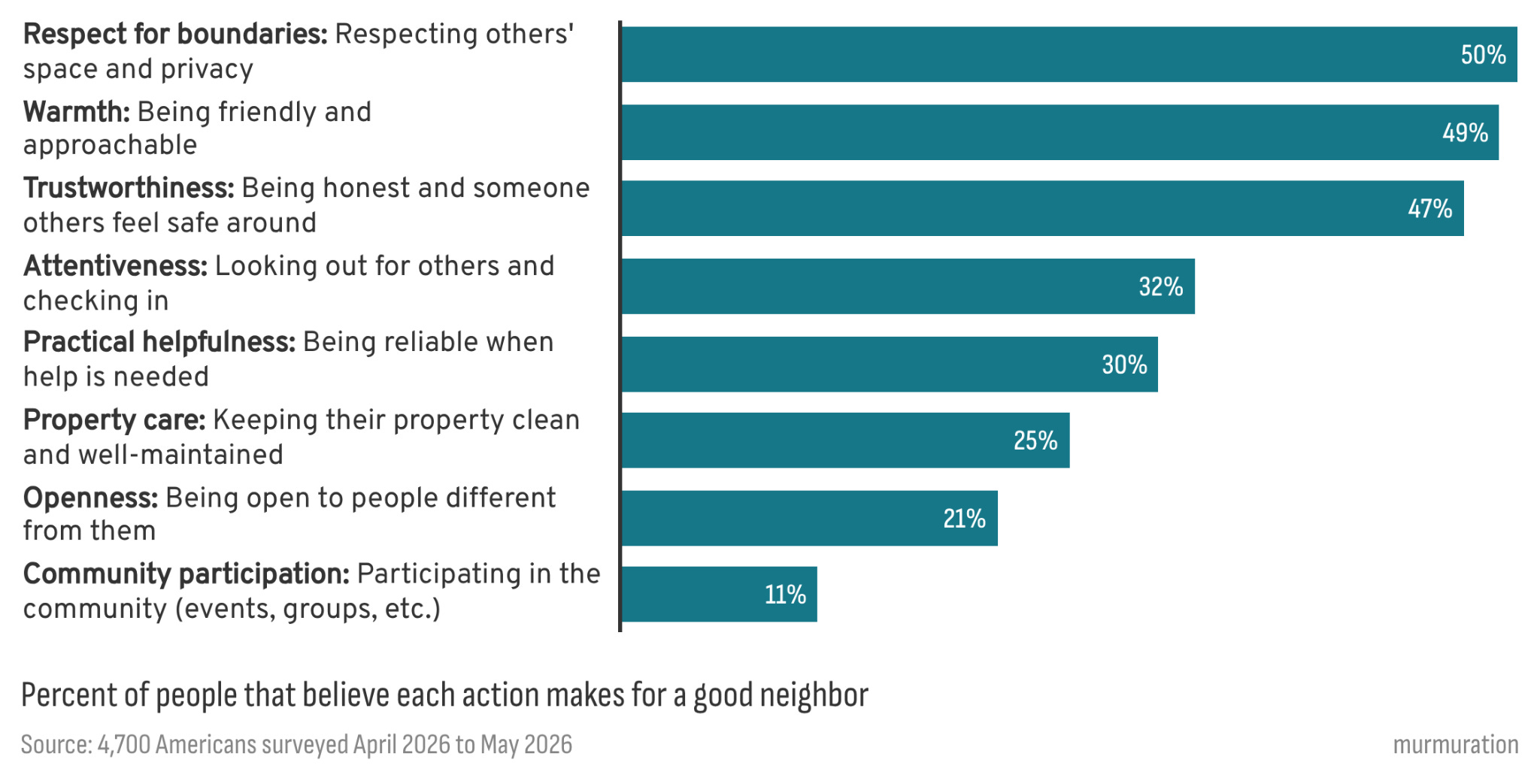
Next, we asked people to reflect on their own behavior; most described helping others with some regularity (34% said daily, and another 31% said a few times a week). The majority of support flows through close ties (66%)—family, friends, and people within immediate networks like neighbors and classmates—rather than strangers (21%). That doesn’t mean broader generosity isn’t happening, but it suggests that much of what holds communities together is rooted in repeated, familiar interactions rather than isolated acts. Yet, as we showed above, kindness toward strangers is the most common example people point to when they think of examples of people showing goodness. Helping strangers may be more visible, more interpretable, and more likely to shape how we see people beyond our own circles.
When we ask people to compare their own behavior to others, another gap emerges. Many believe they are helping more often than those around them (29%)—that while they are showing up, others are doing so less frequently. This perception gap matters. Because even if people are consistently supporting those around them, believing that others aren’t doing the same can erode trust and obscure just how much quiet, everyday effort is already happening.
Final Thoughts
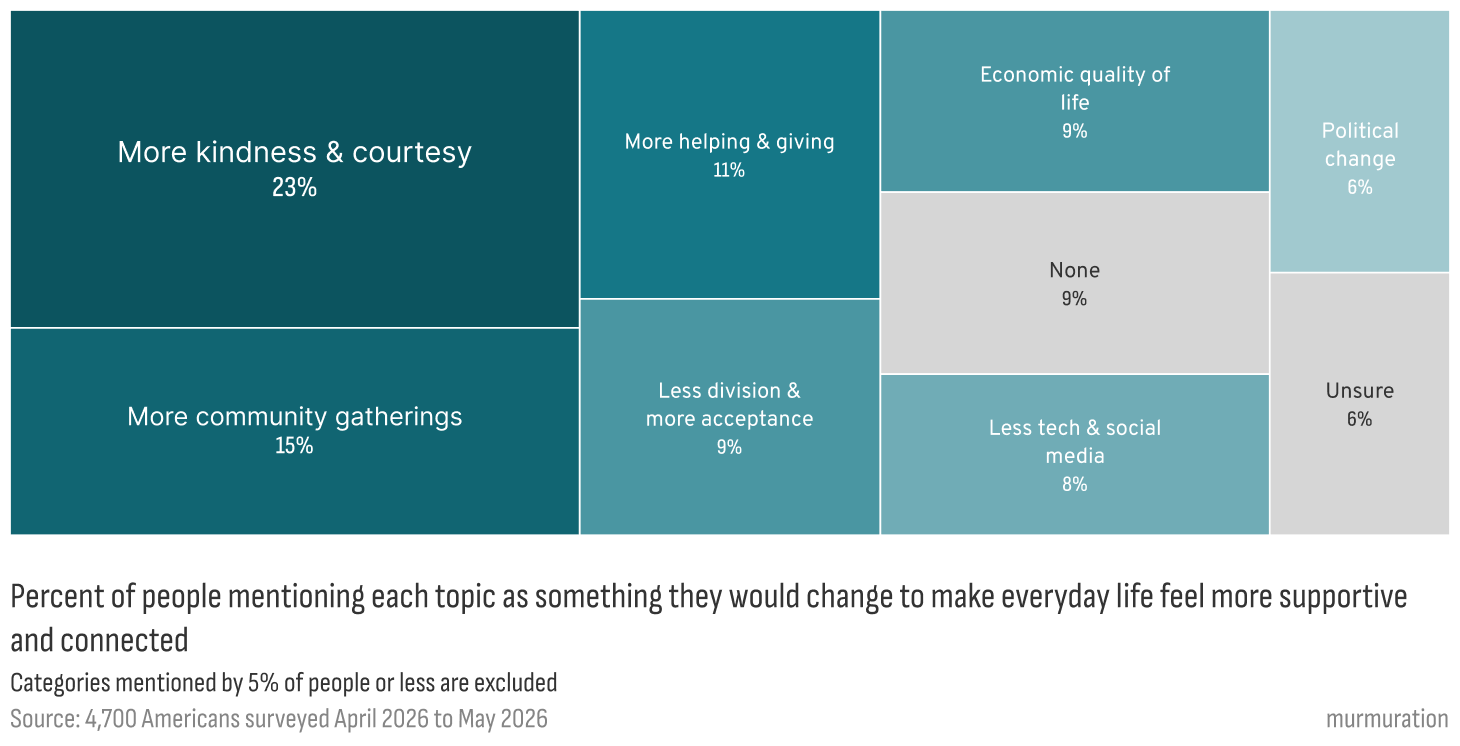
If everyday life feels disconnected, people don’t necessarily point to a lack of kindness—they point to a lack of consistency, visibility, and shared expectation. When we asked what would make life feel more supportive or connected, the answers were practical: more kindness and courtesy (23%), more spaces to interact (15%), and more helping / giving (11%). The most surprising was the 8% of folks who unprompted said using less technology or social media.
So we’re left with lingering questions we’re continuing to explore:
How can we build community so that our perceptions of kindness grow?
What could close the perception gap between what people do and what they believe others are doing?
Is there something about small acts of kindness toward strangers that are uniquely contagious?
The answers may not be dramatic. They may look a lot like the moments people are already describing—just more visible, more frequent, and more evenly shared.
Every neighbor was once a stranger.
Murmuration is a non-profit that organizes a network of partners and equips them with the insights, tools, and services needed to help communities build and activate the power to transform America into a nation where everyone thrives. murmuration.org