


Few institutions carry as much emotional weight in American life right now as schools. Part of that is because the world young people are entering feels increasingly unstable and difficult to predict. Artificial intelligence is reshaping work in real time. Career paths feel less linear. Social media has transformed how young people form identity, relationships, and political understanding. And many Americans no longer feel convinced that the systems that prepared previous generations are equipped to prepare this one.
That uncertainty puts enormous pressure on schools. People aren’t just asking what children should learn. They’re asking what young people will need to survive—economically, socially, emotionally, and civically—in a world that feels like it keeps changing faster than institutions can keep up.
So this month, we asked Americans a series of forced-choice questions about what K-12 schools should prioritize. What emerged was not a simple preference for career preparation or civic education, individual growth or collective responsibility. Instead, Americans seem to want schools to do something much harder: prepare young people to navigate instability without losing their capacity to shape the world around them.
Schools and the Future
When Americans are forced to choose what schools should prioritize most, the results reveal both broad consensus and deep tension about what young people need from education today:
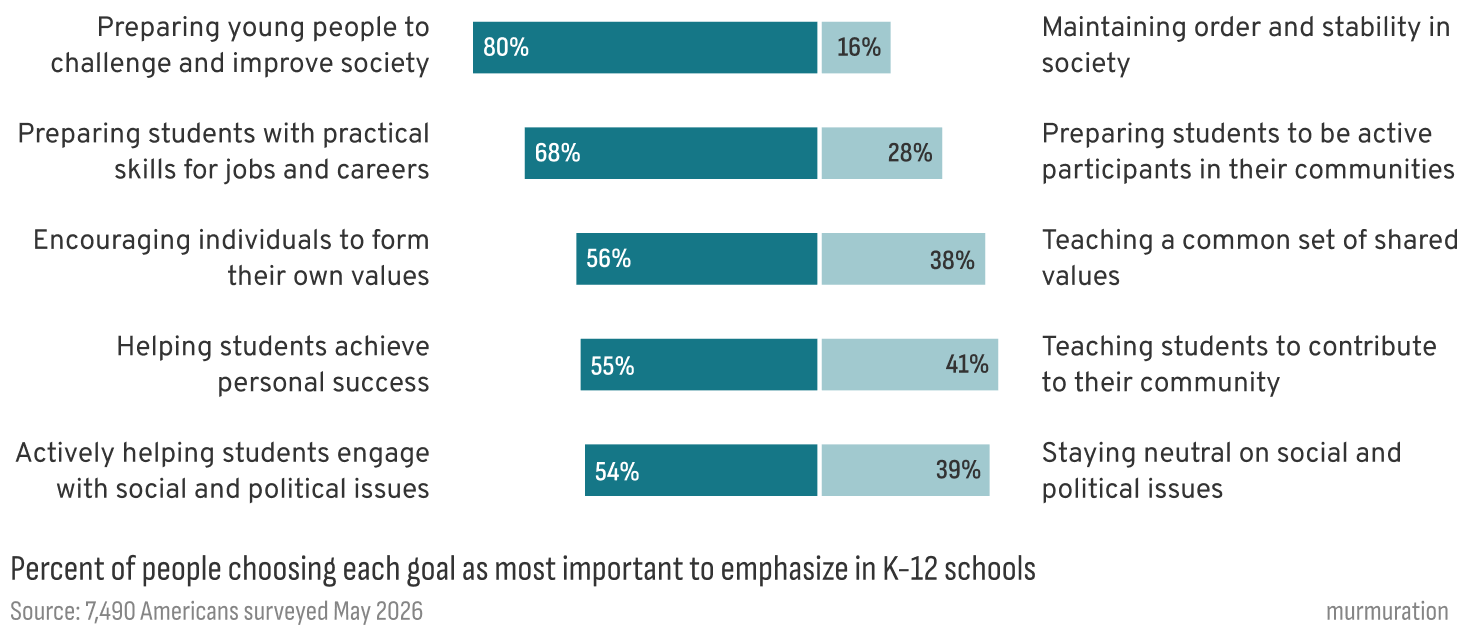
Challenge vs. stability. When forced to choose between preparing young people to challenge and improve society or maintaining order and stability, Americans overwhelmingly favored improvement. Eight in ten (80%) said schools should prepare young people to challenge and improve society, while just 16% prioritized stability.
Jobs vs. community participation. At the same time, Americans remain highly pragmatic about economic survival. More than two-thirds (68%) said schools should prioritize practical skills for jobs and careers over preparing students to be active participants in their communities (28%).
Individual values vs. shared values. The data also suggests Americans are deeply conflicted about values themselves. A slight majority (56%) said schools should encourage students to form their own values, while 38% preferred teaching a common set of shared values.
Personal success vs. community contribution. When asked whether schools should prioritize helping students achieve personal success or teaching them to contribute to their communities, Americans leaned toward personal success (55%), though community contribution remained strong (41%).
Political engagement vs. neutrality. Finally, Americans were more divided on whether schools should stay neutral on social and political issues or actively help students engage with them. A narrow majority (54%) supported schools helping students engage with social and political issues, while 39% preferred neutrality. But this question has the largest partisan split of the five: 69% of Democrats want engagement, while 50% of Republicans prefer neutrality.
Taken together, the five tradeoffs reveal a shared civic aspiration. Americans want schools to prepare young people to improve the world around them, but agreement begins to break down when it comes to how that should happen. While there is broad support for helping students challenge and improve society, there is far less consensus around the civic capacities, shared values, and political engagement that might make that possible.
Gen Z’s Tradeoffs
The clearest generational divide in the data emerged around what schools are for in the first place. Younger Americans are not asking schools to simply educate students. They are asking schools to function as a kind of civic and emotional infrastructure: a place where young people can develop their own values, learn how to engage with difficult social and political realities, and still build practical skills for an uncertain future.
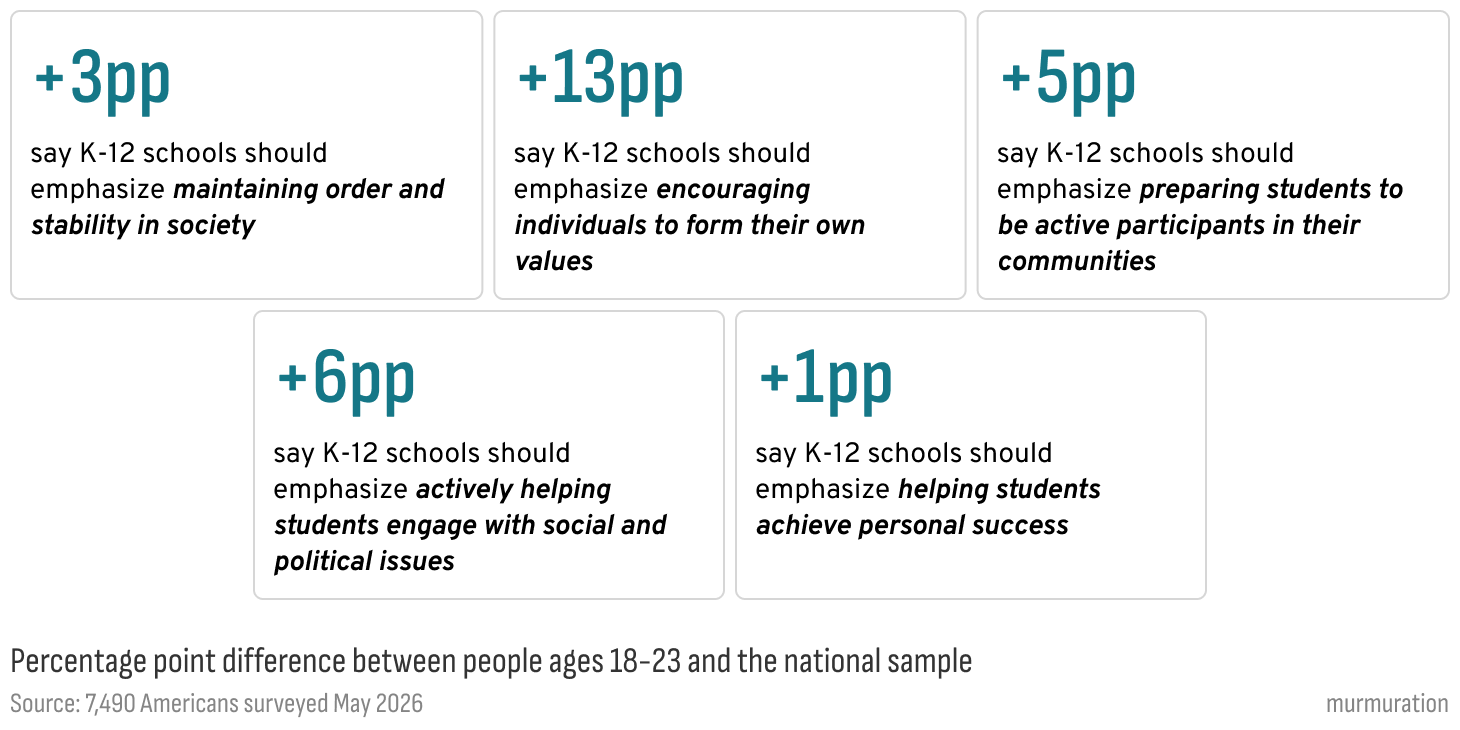
The sharpest generational divide is on values. Nationally, 56% of Americans say schools should encourage individuals to form their own values rather than teach a common set of shared ones. Among Gen Z, that number jumps to 66%. Among adults aged 61 or older, it falls to 49%. And within Gen Z, the youngest cohort (those 18 to 23) lands at 69%.
That could read as individualism, and in one sense it is. But pair it with this: Gen Z is also more likely than any other generation to want schools to actively help students engage with social and political issues. Sixty percent of 18-to-30-year-olds want that engagement, compared to 53% of 31-to-45-year-olds and 52% of those 61 and older.
So the Gen Z picture isn’t disengagement or apathy. It’s something more specific: Let me form my own values, and help me learn how to engage with the world aligned with my beliefs.
There’s one more place where Gen Z differs slightly from older Americans. On the jobs versus community participation question—where the national number is 68% jobs, 28% community—Gen Z shifts to 64% jobs, 33% community. Older generations skew even harder toward job skills: 73% of those 61 and older chose career preparation. Gen Z is the group most willing to say that preparing students to be active community participants is part of what schools should do.
What does this add up to? Gen Z has a distinct civic orientation that doesn’t fit cleanly into older frameworks of either engagement or disengagement. They want schools to help them engage with political and social reality. They want to form their own values in the process. And they’re somewhat more willing than older generations to say that becoming an active community participant is itself a legitimate goal of education and not just a nice-to-have after career prep is done.
Final Thoughts
What struck me most about these findings is that Americans are not simply debating education policy. They are debating what kind of future feels possible for young people and what schools are responsible for preparing them to navigate.
At the same time, the data suggests Americans still see schools as one of the few institutions capable of shaping something larger than individual achievement. Even amid disagreement, there remains a shared hope that schools can help young people build lives that are not only economically secure but also meaningful, connected, and engaged with the world around them. Gen Z’s responses, in particular, suggest a generation looking not for answers handed down, but for the tools to participate, question, and define their own place in society.
The questions underneath these findings are ultimately much bigger than education itself:
What should schools prepare young people for in a world changing this quickly?
What values, if any, still feel shared enough to teach collectively?
Can schools realistically prepare students for both economic survival and democratic participation?
Schools have become a container for much larger anxieties about instability, belonging, trust, economic survival, and whether democracy itself still feels cohesive. And Gen Z sits at the center of many of those fears.
Class adjourned.
This research was supported by the Walton Family Foundation, which has funded Murmuration’s Gen Z research efforts since 2021. Learn more about our ongoing research partnership and findings on the youngest generation of voters here.
Murmuration is a non-profit that organizes a network of partners and equips them with the insights, tools, and services needed to help communities build and activate the power to transform America into a nation where everyone thrives. murmuration.org