


There is a strange thing about being 15 right now. You are old enough to have opinions about the world, but young enough that many of the technologies adults still describe as new will simply be part of the world you inherit. Generative AI is one of them. For adults, ChatGPT arrived. For today’s teenagers, AI may eventually feel more like the internet: something that was simply there while they were growing up.
That makes teenagers particularly important voices in the conversation about artificial intelligence. Much of the debate about young people and AI has focused on what adults think they should do: whether students should use it, how schools should respond, and what risks parents and educators should worry about. But teenagers are already making those decisions for themselves. They are figuring out when AI is useful, when it goes too far, whether it can be trusted, and what they do—and do not—want it to replace.
With support from the Walton Family Foundation, Murmuration surveyed 799 teens ages 13 to 17 across the United States about how AI is affecting their lives, their learning, and their relationships. If you want to see what adults across the country had to say, you can also read our full AI and the Human Future report.
Better and Worse
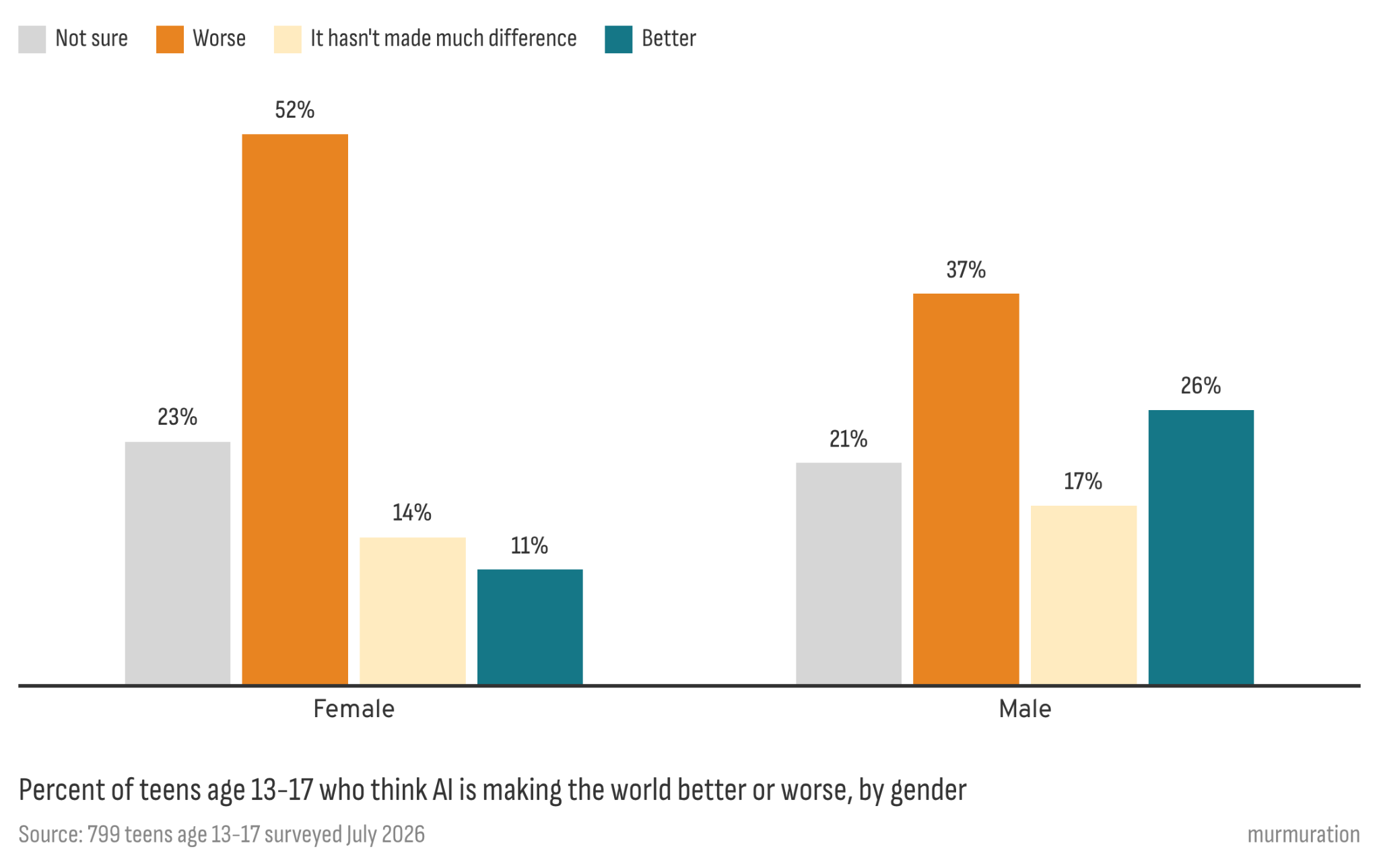
Teens are divided over whether AI is improving their own lives. Twenty-seven percent say it is making their life better, while 25% say it is making their life worse. Another 31% say it has not made much difference, and 16% are unsure. But their assessment becomes considerably more negative when they look beyond themselves. Forty-four percent believe AI is making the world worse, compared with just 19% who believe it is making the world better. Another 15% say it has not made much difference, while 22% are unsure.
That tension is clearest when they consider the future. Nearly half (46%) believe AI will be both one of the best things and one of the biggest problems for people their age. Twenty-one percent think it will primarily be one of the biggest problems, compared with just 8% who think it will primarily be one of the best things.
There are also notable differences between girls and boys. Thirty-seven percent of boys say AI is making their lives better, compared with just 16% of girls. Girls are also substantially more likely to say AI is making the world worse (52% vs. 37% among boys). Still, across groups, teens appear especially concerned about what AI could mean for independent thought. Nearly half (47%) believe AI makes people worse at thinking for themselves, while just 10% believe it helps people think for themselves. Another 31% say AI changes how people think, but not necessarily for better or worse.
Learning With AI
Nowhere are teens’ boundaries around AI clearer than in education. When asked what schools should prioritize, 62% say it is more important to teach students how to learn without using AI. Just 25% say teaching students how to use AI well should take priority. That preference is identical among younger teens ages 13 to 15 and older teens ages 16 to 17.
But teens do not want AI removed from the classroom. Instead, they make a fairly clear distinction between using AI to support learning and using it to replace the work of learning.
Nearly three-quarters (73%) believe students should be allowed to use AI to explain something they do not understand. Two-thirds (66%) support using it to check work for mistakes, while 62% support using it to look up information. More than half say students should be allowed to use AI to study for tests (58%) or come up with ideas (51%).
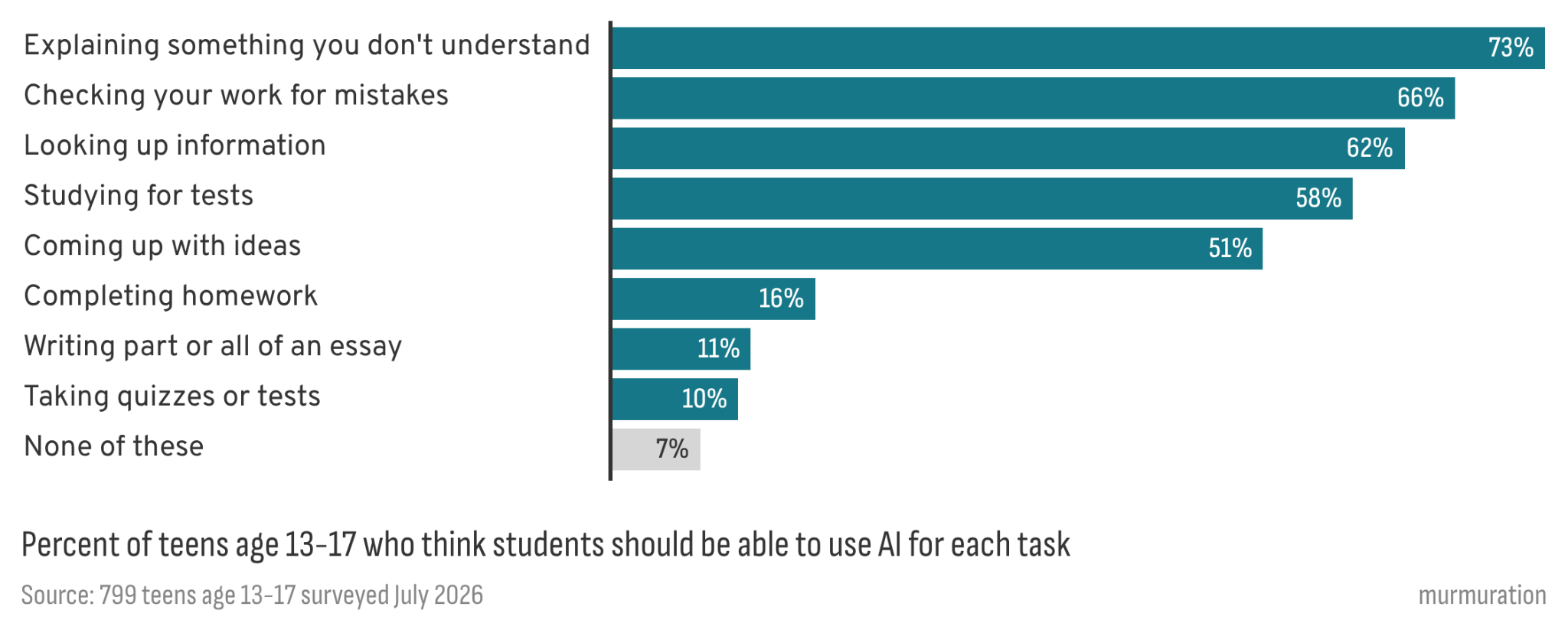
Support drops dramatically when AI begins doing the student’s work. Only 16% think students should be allowed to use AI to complete homework, 11% to write part or all of an essay, and 10% to take quizzes or tests.
Human Connection
The boundaries teens draw around AI extend beyond school. Nearly half say they would feel comfortable talking with an AI chatbot about a personal problem or important decision: 15% would feel very comfortable and another 34% mostly comfortable. At the same time, 37% say they would be not very or not at all comfortable doing so.
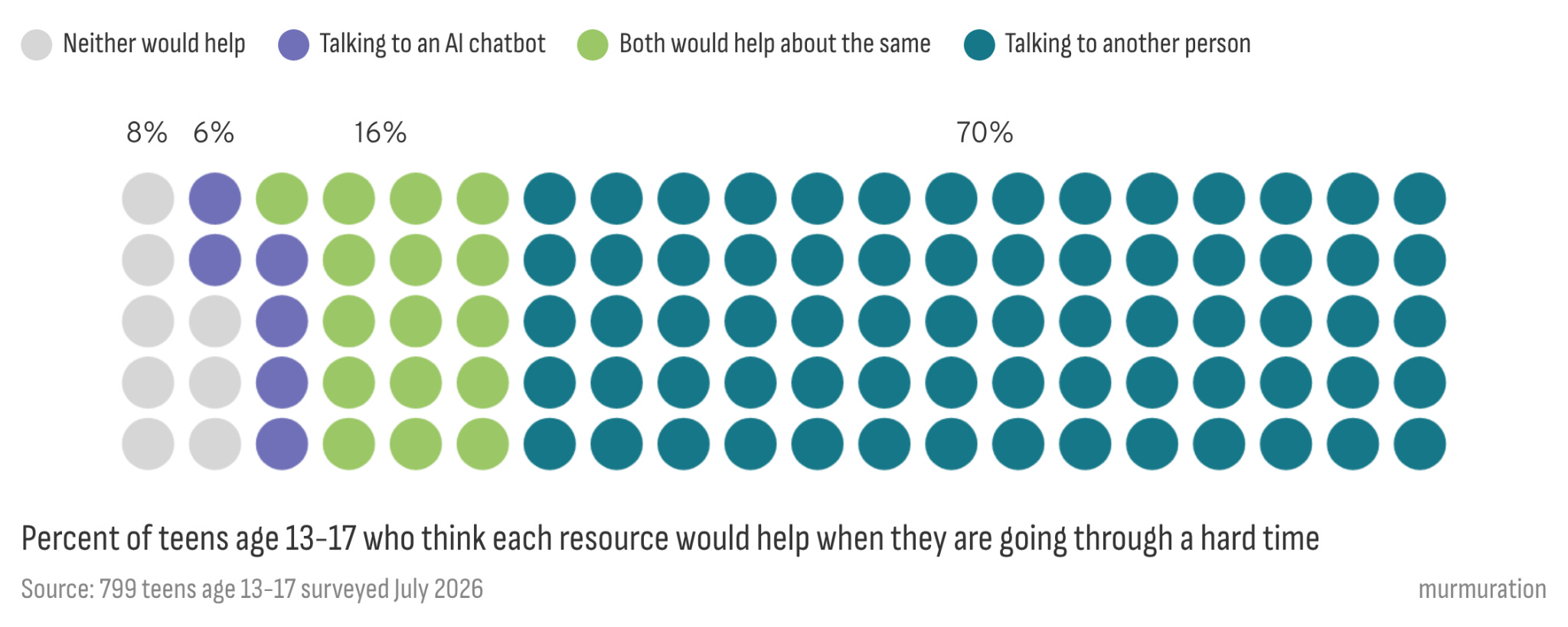
But willingness to talk with AI does not mean teens see it as a replacement for another person. Asked what would help most if they were going through a hard time, 70% choose talking to another person. Another 16% say talking with a person and an AI chatbot would help about the same. Just 5% say talking with an AI chatbot would help most.
Teens are similarly mixed about what AI could mean for loneliness. Twenty-one percent believe it will help people feel less lonely, while 15% think it will make people feel lonelier. The largest group, 41%, believes AI will do both.
Final Thoughts
Teenagers see AI as useful for explaining, checking, searching, studying, and generating ideas. At the same time, many worry that it could make people worse at thinking independently. They want schools to teach them how to learn without it. And although many are comfortable discussing personal problems with an AI chatbot, they overwhelmingly prefer another human being when they are actually going through a difficult time.
Perhaps most importantly, teens do not appear to think they need to choose between believing AI will be good or bad. Nearly half expect it to be both.
These findings are also a snapshot of a technology that is changing extraordinarily quickly. Our survey captures what 13- to 17-year-olds think in the summer of 2026. Their views may change as the technology becomes more capable, schools establish clearer norms, and teens themselves gain more experience living alongside it. That leaves us with important questions for what comes next:
What kinds of AI use strengthen young people’s ability to think independently, and when does assistance begin to replace learning?
When can AI support human connection, and when might it begin to substitute for relationships young people need?
Why are girls substantially more skeptical about AI than boys, and what do those differences tell us about how young people are experiencing this technology?
The challenge ahead is not simply teaching young people how to use AI. It is helping them build the judgment to decide when to use it, when not to use it, and what parts of learning and being human should remain their own. They may already be telling us where to start.
Turns out, teenagers have boundaries.
This research was supported by the Walton Family Foundation, which has funded Murmuration’s Gen Z research efforts since 2021. Learn more about our ongoing research partnership and findings on the youngest generation of voters here.
Murmuration is a non-profit that organizes a network of partners and equips them with the insights, tools, and services needed to help communities build and activate the power to transform America into a nation where everyone thrives. murmuration.org