


Every Women’s History Month, celebrated in March, we honor the women who came before—the ones who built things, fought things, refused to be quiet. This month, we want to talk about the women who are right now holding communities together, feeling fulfilled but often quietly, without recognition, and facing criticism for doing exactly that.
This conversation came into focus recently at a gathering in Los Angeles, where we celebrated Murmuration’s Founder and CEO Emma Bloomberg being named one of USA Today’s Women of the Year. That room felt like a mirror for something we see in the data over and over: leadership in America is often local and personal: people stepping up to provide care, organize their communities, or lend a hand. And the women doing it frequently carry a heavier burden than anyone acknowledges.
We took a closer look by fielding a national survey of 7,287 adults, specifically focused on women’s leadership in communities across the country.
Here’s what we found.
Who Holds it Together
When we asked Americans who shows up, keeps things running, and looks out for people in their community, most saw men and women sharing these responsibilities. But one in five said mostly women, compared to only about one in ten who said mostly men.
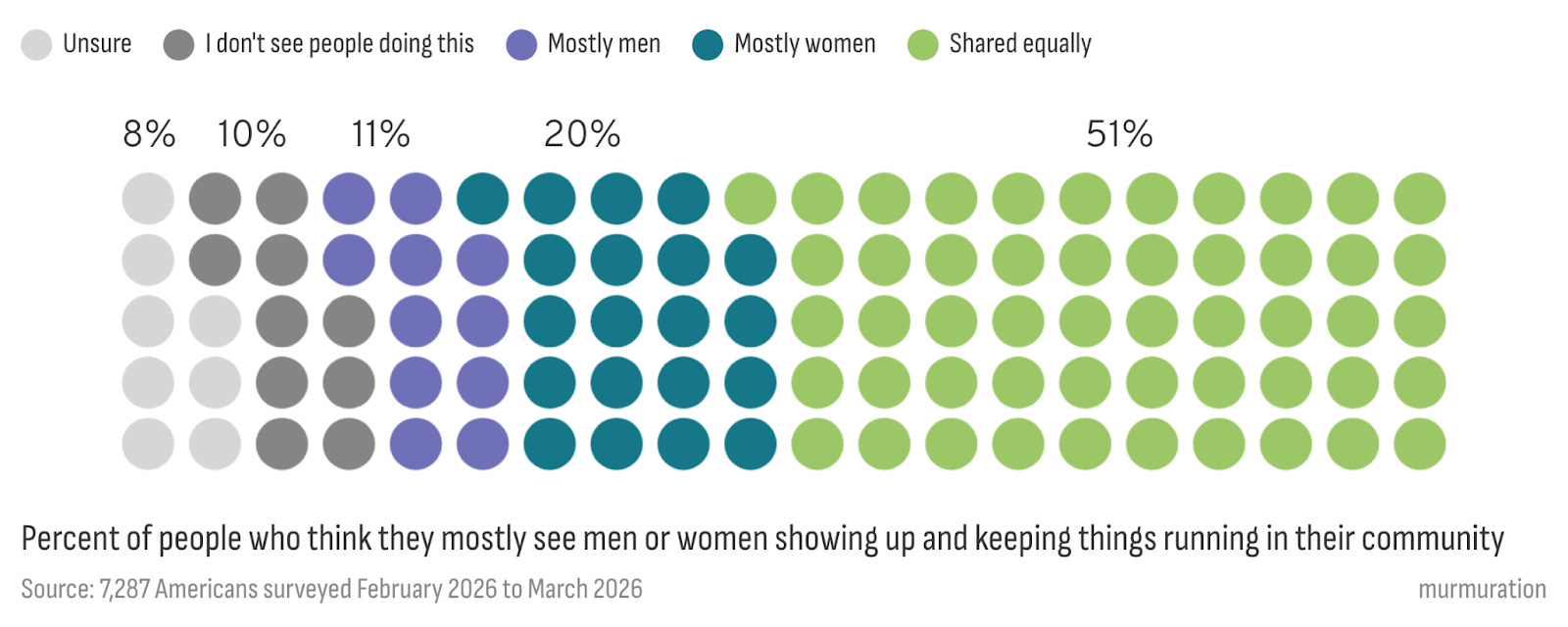
Here’s where it gets more interesting. Women and men don’t see this the same way. Among women, 25% said mostly women, and only 7% said mostly men. Among men, 14% said mostly women, and 15% said mostly men. Among women under 35, the perception is even stronger: three in ten say it is mostly women doing this work.
Nearly as many Americans see leaders in their community as informal – people in their own neighborhoods (36%) – as they see as formal leaders like elected officials or administrators (39%). And when we asked an open-ended question—who specifically holds your community together?—the answers deepened this. People named their informal anchors: the individuals and groups that they saw taking action in their everyday lives: “The mothers in the community are what seems to be holding everything together.” “Women because they are more nurturing.“ “Women, specifically black women.“
Americans are not limiting their understanding of leadership to titles. They recognize the everyday forms of authority that come from trust, proximity, and reliability.
The Cost of Showing Up
Most agree that taking on responsibilities in their communities is a source of personal fulfillment. Among those who are actively helping others or working on solving problems, 70% find the work more fulfilling than draining (20%). In fact, 39% of women and 36% of men say they want to be even more involved in their community than they currently are.
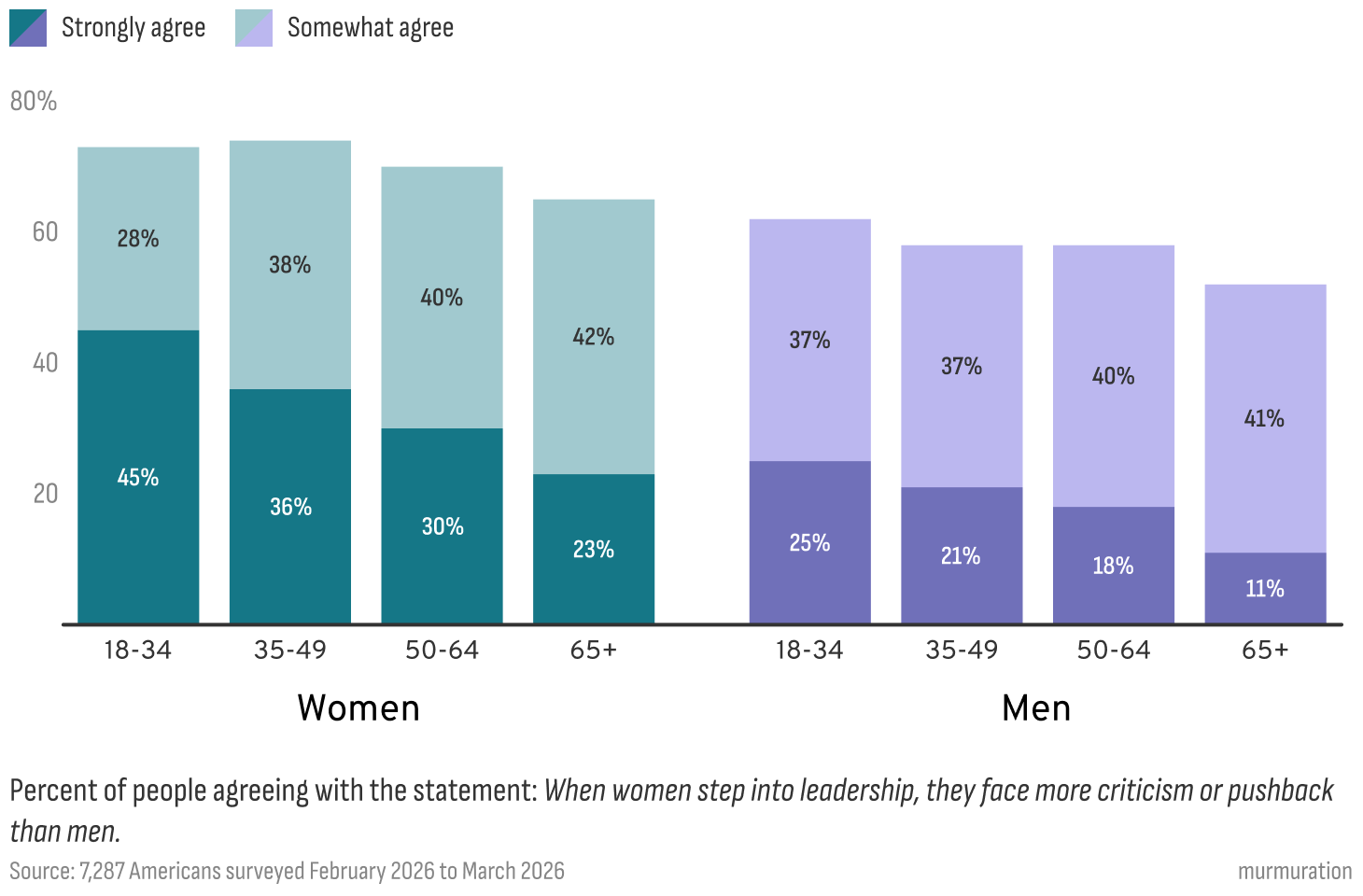
But here the similarities end. A majority (64%) of Americans agree that “when women step into leadership, they face more criticism or pushback than men.“ The gender breakdown is stark: 70% of women agree (33% strongly) vs. 58% of men (19% strongly). Among women 18-34, fully 45% strongly agree—nearly double the rate of women 65+ (23%). Even across party lines, there’s majority agreement: 78% of Democrats, 63% of Independents, and 53% of Republicans all agree that women face more scrutiny in leadership. These are majorities across the board.
At the same time, burnout is widespread—and it isn’t evenly distributed. Over the past year, 35% of women said they felt extremely or very burnt out, compared to 27% of men. That 8-point gap compounds at younger ages: among women 18–34, 44% fall in the high-burnout zone. Almost one in four young women say they have felt extremely burned out.
The data offers suggestions for why. Americans who are more involved in their communities are also more likely to be busier with family responsibilities at home. The work compounds. 42% of women are currently caring for children under 18, aging parents, or both—compared to 39% of men. Those caring for both generations are among the most civically active people in the country. They are more likely to volunteer, attend community events, sign petitions, and show up to town halls than those without caregiving responsibilities. These are people simultaneously sustaining households, sustaining communities, and sustaining everyone else.
“The everyday parents that take responsibility for their children, family and neighbors”– 57, Female, Republican, Clark, NV
The weight shows up again when you ask why women aren’t doing more. Feeling spread too thin is the top reason—peaking at 32% among women 35–49, and at 25% among women 18–34. But underneath that, something else surfaces: 22% of young women say they aren’t more involved because they simply don’t know where to start, which is 7 points higher than the national rate.
Women are seen as central to keeping communities running—and many are, in both formal and informal ways—while also managing caregiving demands, financial pressure, and some of the highest burnout rates in the country.
Traits of Community Leaders
We asked what people truly want and expect from leaders in their community. What characteristics matter most to them? The top answer, selected by more than half of Americans, was honesty and trustworthiness. The second was listening and understanding.
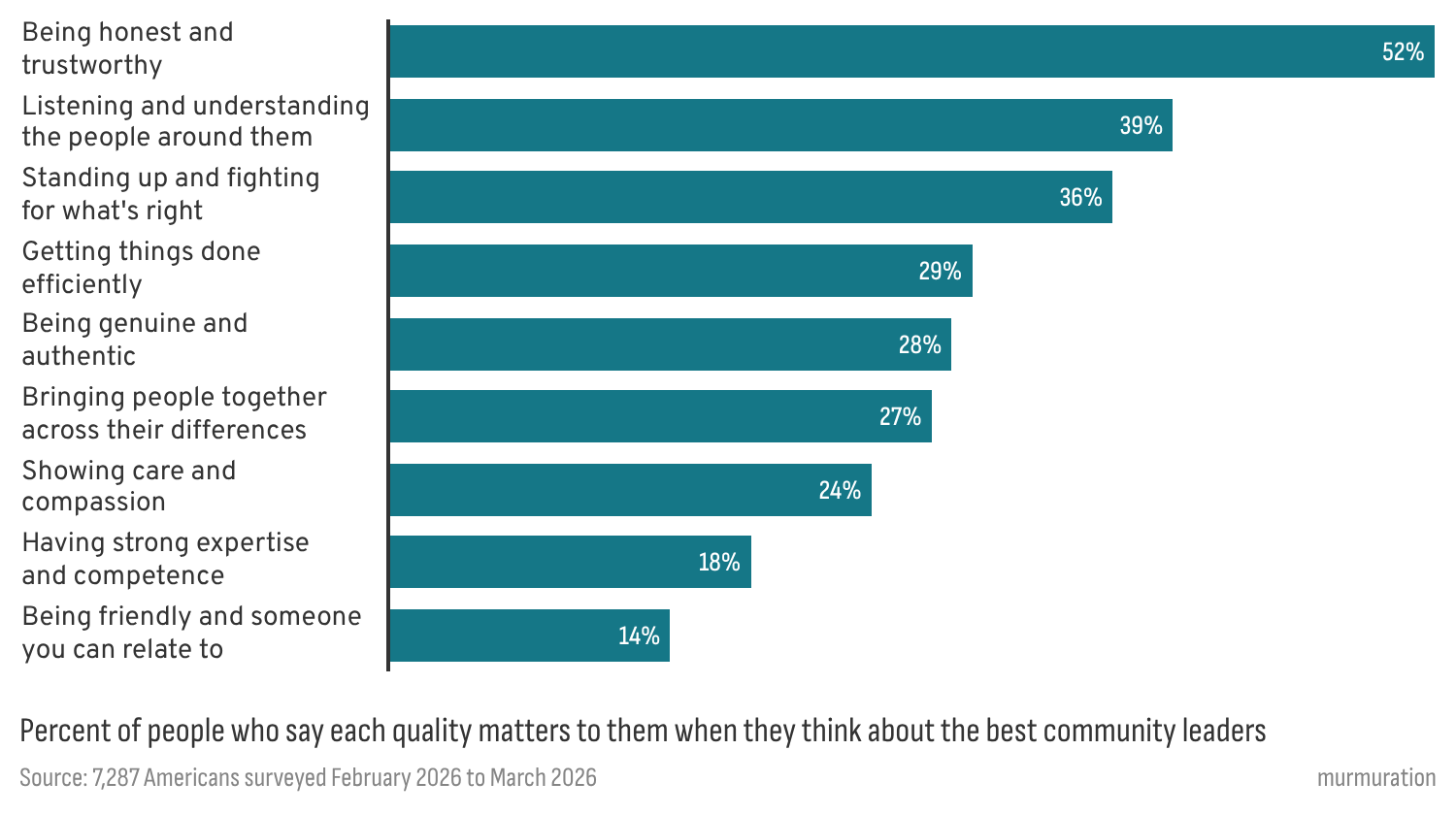
When broken down by gender, women prioritize listening and understanding at 42%, compared to 36% for men. Women select “showing care and compassion“ at 27%, men at 21%. Men are more likely to prioritize expertise and competence (21% vs. women’s 15%). But at the very top, the two groups converge: 53% of women and 50% of men chose honest and trustworthy.
What Americans say they want from community leadership—across gender, across party, across age—is, at its core, a feeling of confidence in those around them to treat them with honesty and respect, to hear their voices and concerns, and to keep their commitments to one another. It’s the kind of leadership that looks a lot like what women are already doing in neighborhoods and school boards and community organizations every day.
Final Thoughts
Women’s leadership is not a future aspiration. It is a present force shaping communities from the ground up, especially at a moment when the country feels fragile, frustrated, and uncertain.
And there is a gap between that reality and how we respond to it. Women are doing more of the work, facing more scrutiny when they step up, and burning out at higher rates—and yet they remain the most hopeful and the most hungry to do more. That combination is somewhere between remarkable and concerning.
So we are left with a set of hard but constructive questions.
What does it take to change the scrutiny people face when they lead?
How do we close the gap between women who want to be more involved and the on-ramps that would actually get them there?
What does it say that the qualities Americans most want in a leader are ones women are already demonstrating in communities every day?
The question now is not whether women are leading. It is whether we are fully seeing, and fully supporting, the leadership that is already here.
Turns out it’s women. And sure, maybe coffee too.
Murmuration is a non-profit that strengthens community-driven change at the local level. By equipping local organizations with powerful data, technology, and insights, Murmuration helps them amplify community voices, build collective power, and drive solutions that reflect the lived realities of the people they serve. murmuration.org