


Since last December, Minnesota has been in the national spotlight for federal immigration enforcement actions that impacted neighborhoods, workplaces, schools, and community spaces across the state. As a resident of Minneapolis said:
“It is strange to have the entire country focused on where you live, but it’s absolutely necessary, because this shit can and will happen again, and it can happen anywhere.” - 49, Male, Independent, Minneapolis, MN
Civic Pulse asked 1,231 people across Minnesota how they are experiencing their lives and these events in their own communities. When compared to the start of the year, 28% of Minnesotans say conditions have gotten worse, 33% say they’ve gotten better, and 27% say they feel about the same.
Those shifts don’t resolve into a single shared experience or storyline. The emotional landscape in Minnesota right now is layered: Anger and division are prominent, yet they coexist with resilience, determination, and support.
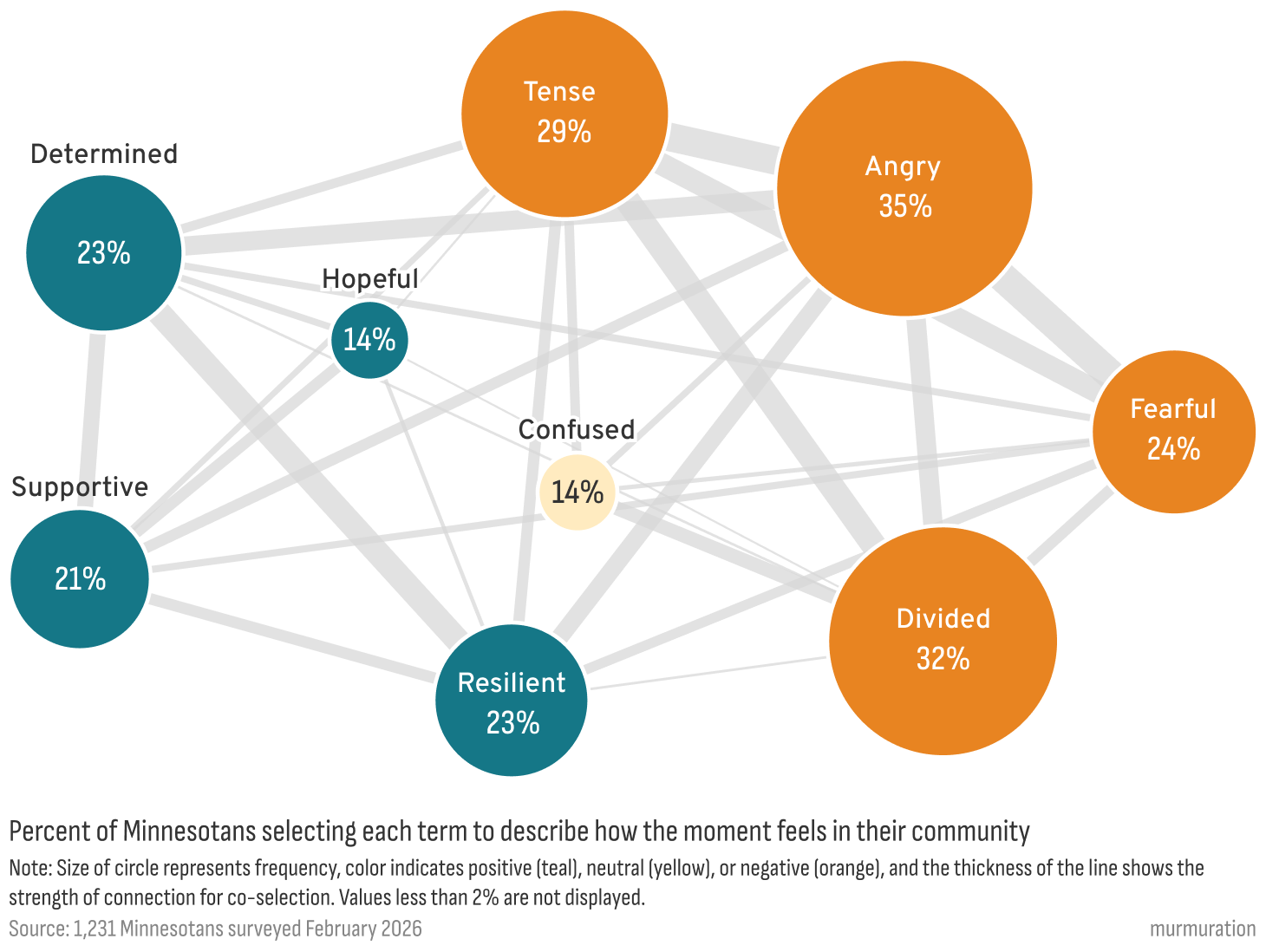
The graphic above is an overview of how people describe this moment in their community. Each circle represents an emotion people selected. The size of the circle reflects how many people chose that word. The lines between circles show how often those emotions were selected together by the same respondents. Thicker lines mean those feelings commonly co-occur. In other words, this chart doesn’t show separate camps of emotion. It shows how feelings overlap.
What Minnesotans told us points to something more complex than a simple political or partisan reaction. What we found was a state navigating strain, uncertainty–and solidarity–in real time.
The View From Here
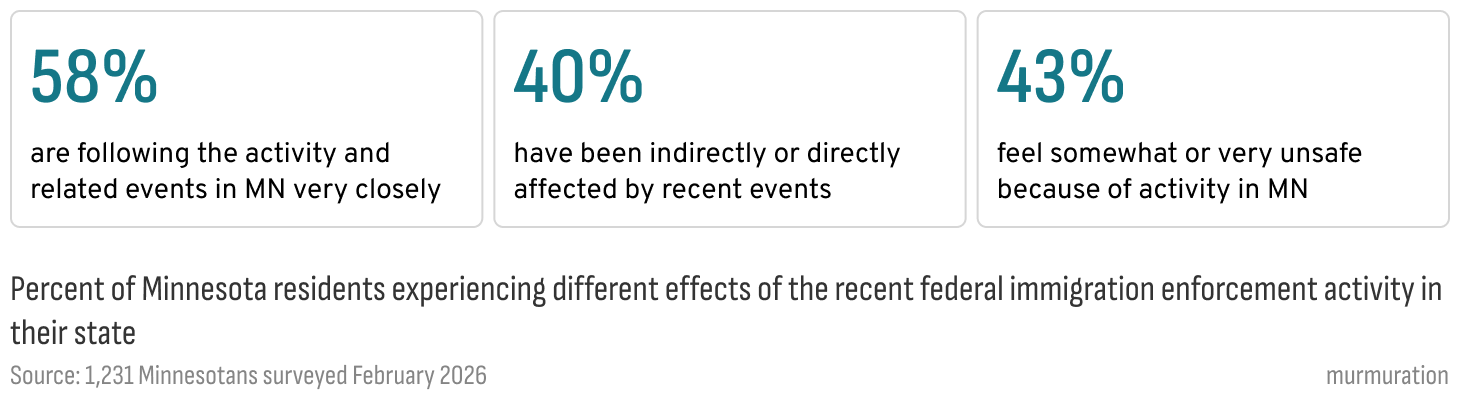
Civic Pulse asked what feels misunderstood about this moment in Minnesota and what people outside the state most need to understand about their lives right now. The context is important: large numbers of people are not only following events closely, but have been personally impacted by the federal immigration activity.
Several themes surfaced again and again: safety concerns, frustration with media narratives, and nuanced views about enforcement and limits.
Here is how Minnesotans put it, in their own words:
“People need to understand that people who are citizens have been afraid to leave their homes.” - 50, Female, Democrat, Minneapolis, MN
“The ICE officers are going basically door to door and do not give a hoot about anything [except] to get immigrants regardless if they’re legal or not. I am for illegal [immigrants] to be deported but to harass legal ones is insane”. - 32, Male, Republican, Shakopee, MN
“Support your community, support your local law enforcement and keep it peaceful.” - 57, Male, Independent, Inver Grove Heights, MN
“Government is seeking retaliation on democratic states… Minnesota is filled with wonderful people.” - 70, Female, Republican, Pierz, MN
“If it was only dangerous criminals being deported we would be fine. They are deporting and targeting individuals based on skin tone and that’s not okay… Just stay organized and positive, we will get through this together. Also, make sure to stay peaceful.” - 31, Female, Democrat, St. Louis Park, MN
“This is not about being a Republican or Democrat. It is about due process for all.” - 35, Male, Republican, Burnsville, MN
“There’s a lot of hate, and I think much of it is based on misinformation.” - 53, Female, Independent, Detroit Lakes, MN
And amid the tension, many people told us they are seeing something else too—neighbors stepping up to organize and respond.
When Neighbors Become Leaders
Across political lines, respondents described ordinary people doing small, steady things: checking in, arranging rides, showing up at gatherings, sharing information, standing watch, keeping the peace. And many agree that people are mobilizing and coming together at the community level.
As one woman from Wrenshall put it:
Although our citizens have been abused and threatened, we have become stronger as a community because we had to. - 53, Female, Democrat, Wrenshall, MN
Before turning to more of their words, three numbers help frame what’s happening beneath the headlines:
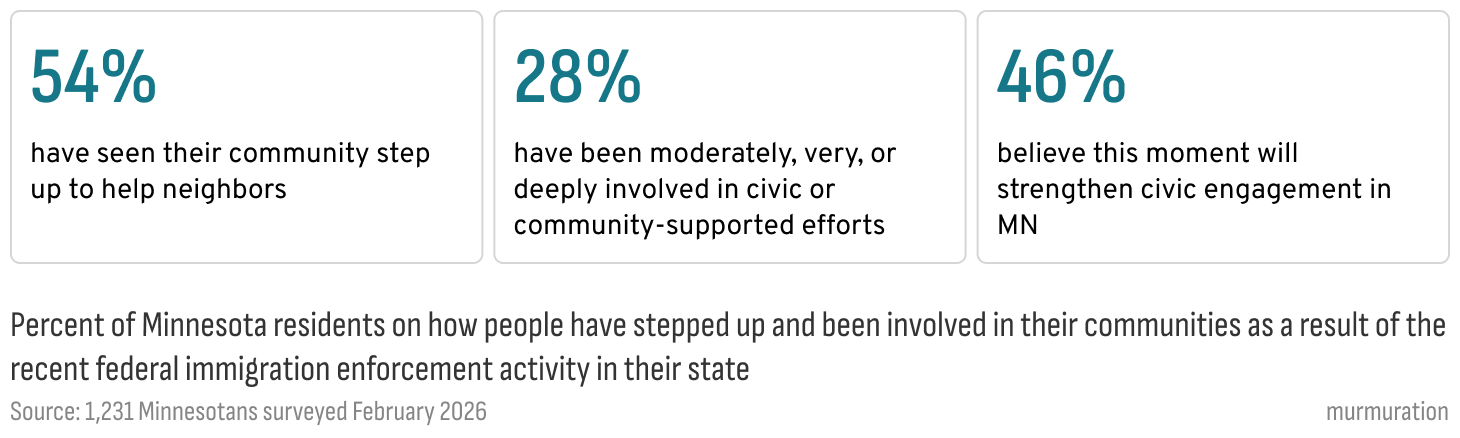
That combination is striking. Even amid anger and division, more than half are witnessing acts of care—and nearly half believe something lasting could grow from it.
Here’s how they described who is stepping up:
“Kids, elderly, neighbors” - 34, Female, Independent, Minneapolis, MN
“Local people who have no political experience” - 32, Female, Republican, Cold Spring, MN
“Everyday housewives from the burbs are putting themselves in danger to protect others.” - 43, Male, Democrat, Plymouth, MN
“I see local law enforcement do a great job.” - 48, Male, Republican, St. Cloud, MN
“I noticed that a lot of small businesses and restaurants have stepped up a lot” - 31, Female, Democrat, St. Louis Park, MN
And when people talk about what care and support actually look like on the ground, the details become even more tangible:
“Providing a warm place for protesters to warm with some hot chocolate and treats....and rallying together to fight for the rights of innocent lives. Truly touching to witness.” - 51, Female, Independent, Saint Paul, MN
“We brought food and diapers to a family who’s been affected and can’t work” - 55, Male, Republican, Farmington, MN
“My church delivers meals to people who don’t want to leave home.” - 39, Female, Democrat, Rochester, MN
“My children’s school’s social worker drives a young girl to and from school because she is too afraid of riding the bus because of her and her family’s race and how parents have been detained at the stop.” - 33, Female, Independent, Blaine, MN
Taken together, these examples are not abstract. They are practical. Local. Often quiet. In a moment defined by national attention, much of the response is happening at the block, school, church, and storefront level—neighbor to neighbor.
Final Thoughts
In Minnesotans’ own words, what we heard over these two weeks is not a single narrative but a portrait of a community navigating tension and care at the same time. People described fear and vigilance, but also solidarity. They described division, but also neighbors showing up for one another. This moment feels unsettled, and its long-term impact is still unfolding.
One man from Lake Elmo put it this way:
“They are focusing on only the conflict. Officials on both sides should be working together to solve the crisis, not further division.” - 38, Male, Republican
His words reflect something we heard repeatedly: Many Minnesotans want less escalation and more problem-solving. And this moment should leave all of us with questions:
How do we create more pathways for everyday leadership in our communities, not just in moments of emergency?
How can communities of support and organizing continue to persevere and sustain longer-term efforts?
And can national conversations hold space for complexity rather than flattening lived experience into partisan shorthand?
If we want to understand the civic health of this country, we have to listen at the community level. Not only to what people believe, but to what they feel. And one thing we heard over and over again was captured by this woman from Inver Grove Heights:
“If [people] think these things can’t happen in their own cities, they are dead wrong.” - 43, Female, Independent, Inver Grove Heights, MN
Elevating community voices.
Murmuration is a non-profit that organizes a network of partners and equips them with the insights, tools, and services needed to help communities build and activate the power to transform America into a nation where everyone thrives. murmuration.org.