


Thanksgiving is a holiday built around food. For many Americans, it’s a time to gather with family and friends, prepare familiar recipes, and carry on traditions that have been part of their lives for generations.
But food plays an important role in our lives well beyond the holidays. It’s part of how we spend time together, celebrate milestones, care for people going through difficult times, and maintain connections to our families and cultures.
So this week, we’re taking a closer look at what food means to Americans, how sharing it helps us care for one another and build community, and how rising costs are affecting the choices people make.
The Role of Food
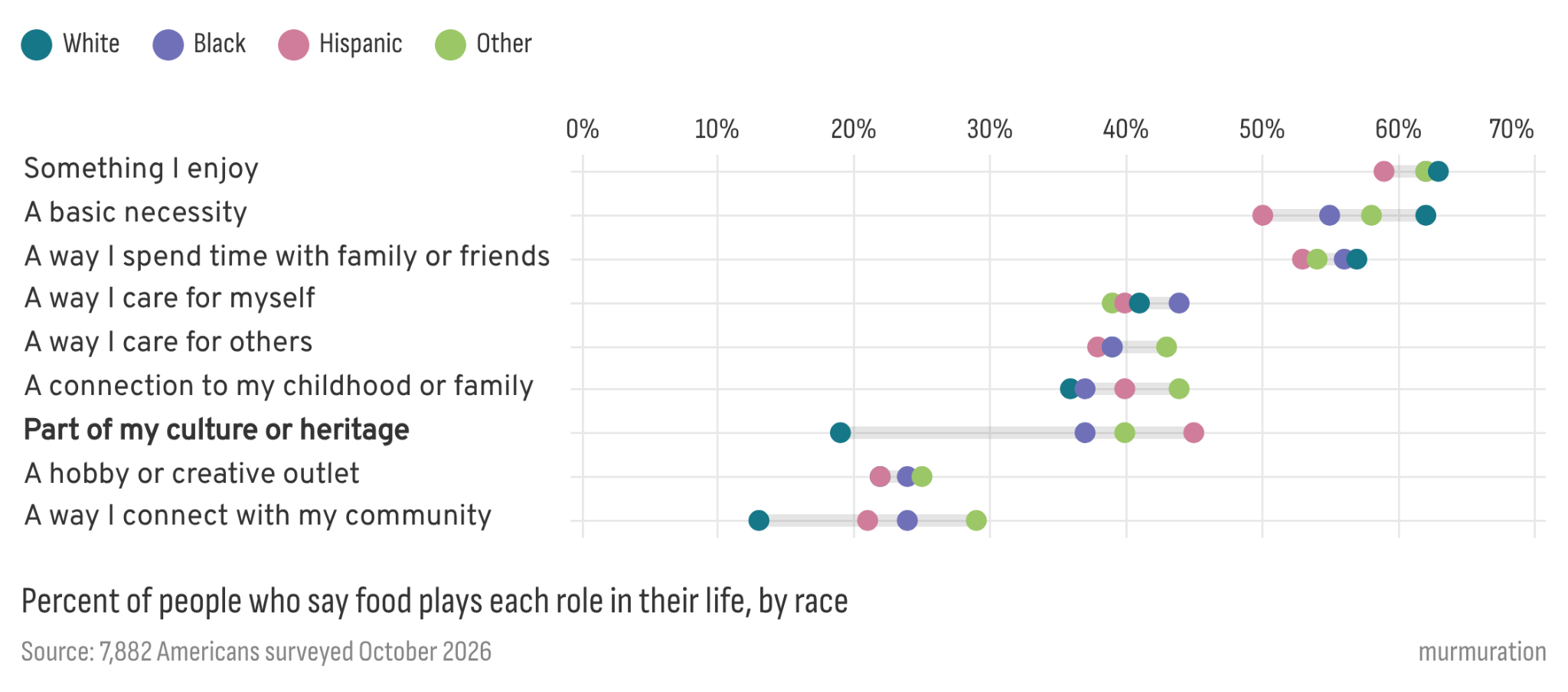
When we asked Americans what role food plays in their lives, the answers went well beyond nourishment. While 59% describe food as a basic necessity, 62% say it’s something they enjoy, and more than half (56%) see it as a way to spend time with family and friends. Another 38% connect food to their childhood or family, and 28% see it as part of their culture or heritage. Those connections are particularly strong for some Americans (see below).
And people overwhelmingly believe that sharing food can help build connections beyond their immediate families. Nearly nine in ten (89%) agree that sharing a meal can help people feel connected, even when they don’t have much else in common, including 51% who strongly agree.
Food doesn’t just bring us together. It’s also one of the ways we show up for one another. Forty-one percent of Americans say food is a way they care for themselves, while 39% see it as a way to care for others.
Women are considerably more likely than men to describe food as a way of caring for others (47% versus 31%). But when we look at what people actually do, the differences are much smaller. Women and men report sharing food with people outside their households at nearly identical rates.
And sharing food is remarkably common. In the past year, 82% of Americans have provided food to someone they don’t live with, whether by cooking for them, having them over for a meal, or giving them something to eat. Nearly half (47%) have done so at least once a month.
These acts of care extend beyond our immediate relationships. Nearly two-thirds (65%) say it’s common for people in their family or community to bring food to someone going through a difficult time. Whether it’s a meal for a neighbor recovering from surgery, food for a family experiencing a loss, or an invitation to someone who might otherwise spend a holiday alone, sharing food is a familiar way of offering support.
And many communities have traditions and institutions built around sharing food. More than half of Americans report food pantries or community fridges (58%) and schools, churches, or other groups providing meals (50%) in their communities. More than a quarter (27%) report community meals or potlucks, while 20% say neighbors gather for cookouts, block parties, or other shared meals.
Some of these activities help meet people’s basic needs, while others create opportunities to gather and build relationships. Many do both.
What’s especially interesting is how closely these experiences are associated with people’s sense of belonging. Among Americans who feel a great deal of belonging in their communities, 48% say bringing food to someone going through a difficult time is very common. Among those who don’t feel they belong at all, just 13% say the same.
People who feel strongly connected to their communities are also more likely to share food themselves. Fifty-seven percent provide food to people outside their households at least monthly, compared with 33% of those who feel no sense of belonging. And 27% of those with a strong sense of belonging explicitly identify food as a way they connect with their community, compared with just 8% of those who feel no belonging.
Beyond the Grocery Bill
Of course, there’s another side to this story. Food may be an important source of connection and care, but it’s also becoming harder for many Americans to afford.
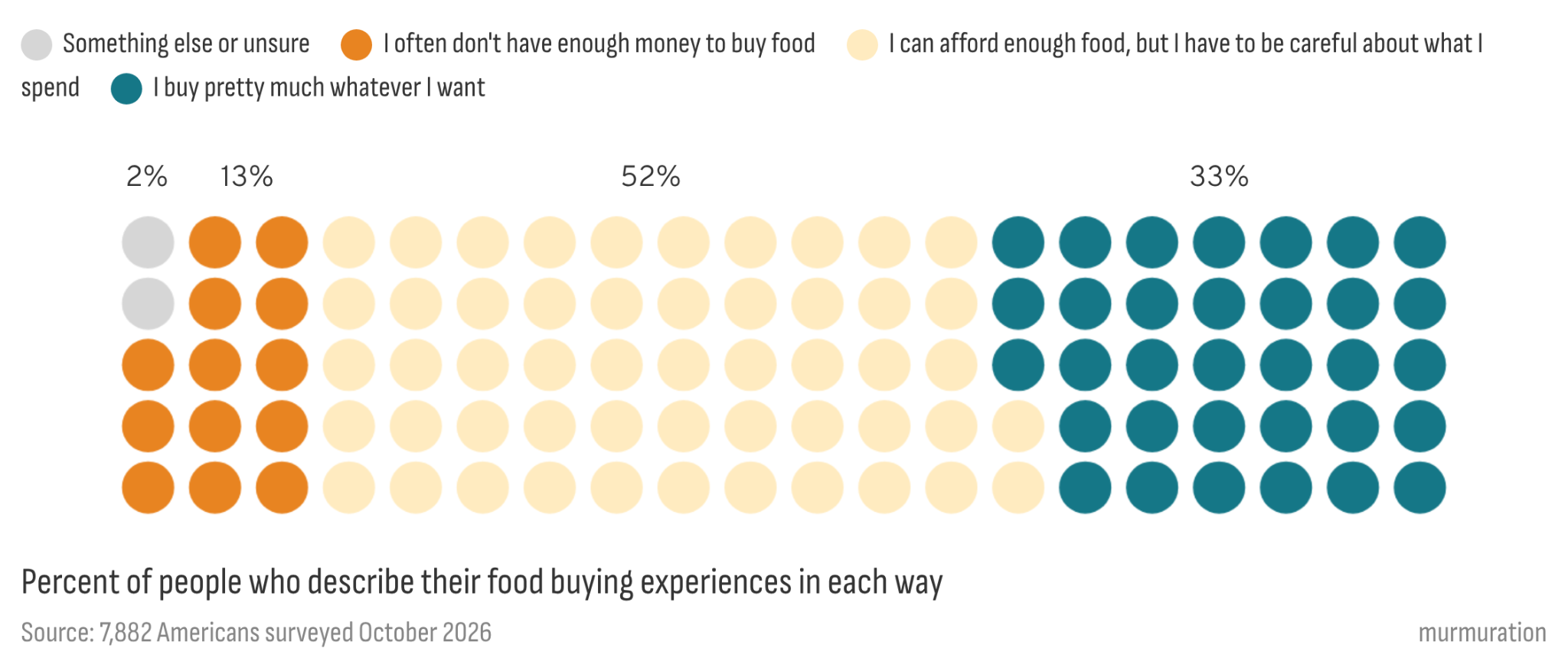
Nearly two-thirds (63%) say buying groceries is a greater financial burden than it was a year ago, including 32% who say it’s become much more burdensome. And when asked about their ability to afford food, just one-third (33%) say they can buy pretty much whatever they want.
Those financial pressures are changing what Americans eat and how they spend their money. More than half (53%) have switched to cheaper brands, 48% have cut back on snacks or treats, and 42% are eating out or ordering takeout less often. More than a third (36%) have purchased less meat or seafood because of costs.
But for many Americans, the adjustments go well beyond cutting back on things they enjoy. Nearly three in ten (29%) say they’ve skipped meals or eaten less than they wanted because of food costs, while 26% have purchased fewer fresh fruits and vegetables. Nearly a quarter (24%) have used a food pantry or other food assistance, and 19% have put off paying another bill to buy food.
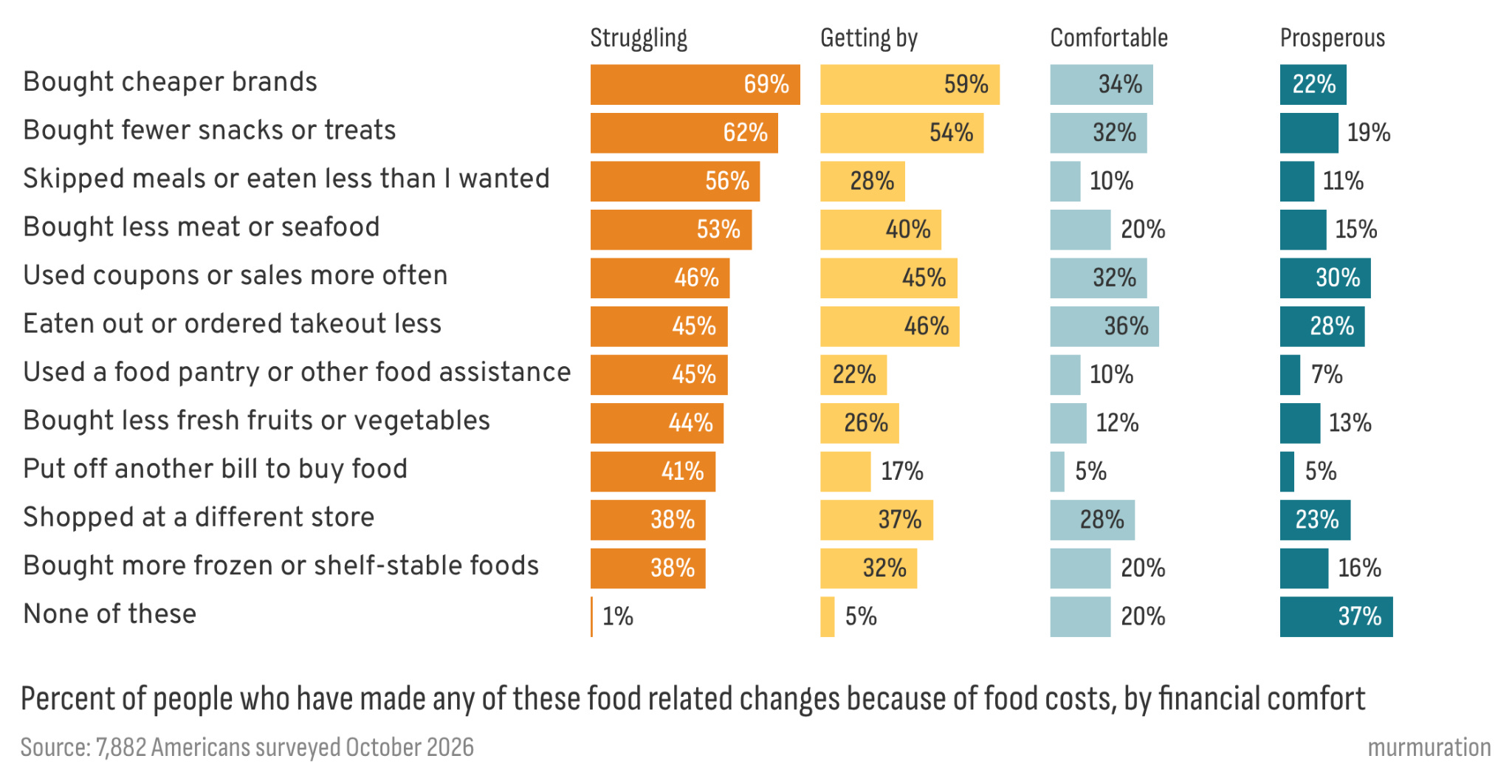
These experiences aren’t evenly distributed. Among Americans who describe their households as financially struggling, 56% have skipped meals or eaten less than they wanted, and 45% have used food assistance. Younger and middle-aged adults are also more likely to report going without food. Thirty-six percent of adults ages 18–34 and 35–49 say they’ve skipped meals or eaten less than they wanted, compared with 15% of adults 65 and older.
And these changes aren’t simply about adjusting preferences. Sixty-two percent of Americans say it bothers them somewhat or a lot when food costs force them to buy something different from what they’d prefer. Food is a necessity, but as we’ve seen, it’s also a source of enjoyment, cultural identity, family tradition, and connection.
The Holiday Table
With Thanksgiving approaching, those financial pressures are also shaping how people think about the holidays. When we asked Americans what they’re worried about this holiday season, money and rising costs were the most frequently mentioned specific concerns (21%), ahead of cooking, hosting, or working during the holiday (11%) and family drama or social anxiety (10%). Another 7% mentioned being alone or away from family.
One respondent explained:
“I’m not sure we’ll be able to have a traditional holiday meal for ourselves, let alone for guests.” - 66, Female, Lead Hill, AR
That response captures something important about the relationship between food and community. The financial burden isn’t necessarily limited to what people can afford to eat themselves. It can also affect what they’re able to share, how they celebrate, and whether they can participate in traditions that matter to them.
Of course, meaningful gatherings don’t require expensive meals, and people find ways to care for one another even when resources are limited. But when food becomes harder to afford, some of the everyday ways people gather, celebrate, and support one another may become harder to sustain.
Still, there’s something reassuring in what Americans remember about past Thanksgivings. When we asked people to share their most memorable moments, their answers were less about the food itself and more about the people, traditions, and experiences surrounding it.
The most common memories were about time spent together. Forty-three percent recalled moments with family and friends, while 19% remembered a particular food or loved one’s cooking, and another 19% recalled something funny or embarrassing. Eleven percent even remembered something going wrong with the food.
Some memories were simple:
“My grandma cooking greens.” - 34, Female, San Bernardino, CA
Others captured the traditions and experiences that become part of growing up:
“Eating at the little table (“kids”) could not wait to eat at the big table.” - 70, Male, New Salisbury, IN
And some were about making room for someone new. One respondent remembered a Thanksgiving when a colleague couldn’t travel home:
“Instead my parents invited him to come to our house and he was treated like one of the family. We are still close friends.” - 60, Male, Bryan, TX
Even the mishaps become part of the memories families carry forward, with stories about ruined turkeys, cooking disasters, and holiday plans that didn’t quite work out.
One respondent remembered a Thanksgiving that took an unexpected turn:
“I burned more than one dish. We ordered pizza and played video games! One of our best holidays!” - 50, Female, Oldenburg, IN
Another recalled a particularly unfortunate encounter between the family dogs and Thanksgiving dessert:
“One year, grandma made pecan and pumpkin pies like always, and sat them outside to cool. The dogs were let out and scarfed down all of them- 6 pies gone” - 24, Female, Harrisburg, PA
Final Thoughts
Food… It’s a reason to get together, a way to show someone we care, and a tradition that connects us to people and places across generations. And much of this happens without anyone thinking of it as an effort to build community.
But these findings also highlight the importance of being able to participate. When food becomes harder to afford, people aren’t just making different choices at the grocery store. They may also have fewer opportunities to host, share, and carry on traditions that matter to them.
So, a few questions we’re left with:
How much of our sense of community comes from the small, everyday ways people care for one another?
What happens to those relationships and traditions when financial pressures make it harder to gather and share?
And how can we support the informal networks of care that already exist in our communities, rather than always trying to create something new?
Food won’t solve all the challenges facing our communities. But the findings suggest that some of the connections we’re trying to strengthen are already happening around dinner tables, at neighborhood cookouts, and through meals shared with people who need them.
Save a seat for someone.
Murmuration is a non-profit that organizes a network of partners and equips them with the insights, tools, and services needed to help communities build and activate the power to transform America into a nation where everyone thrives.