


The midterms are next week, which means a lot of people in our world are currently operating on some combination of adrenaline, caffeine, and very little sleep. With stress running high and the stakes even higher, we thought we’d offer a brief reprieve from the polls and predictions you’re likely inundated with.
So, in the spirit of the season, we asked Americans about a different set of things that keep us up at night: ghosts, spells, and the things we can’t quite explain.
These stories don’t just tell us what people believe; they’re also part of the traditions and experiences we share. At a time when it can feel harder to connect with our neighbors, is Halloween still one of those rare occasions that gets people out of their houses and into their communities?
Do We Believe?
For all the ghosts, witches, and monsters we treat as fiction this time of year, belief in the supernatural is hardly unusual in America.
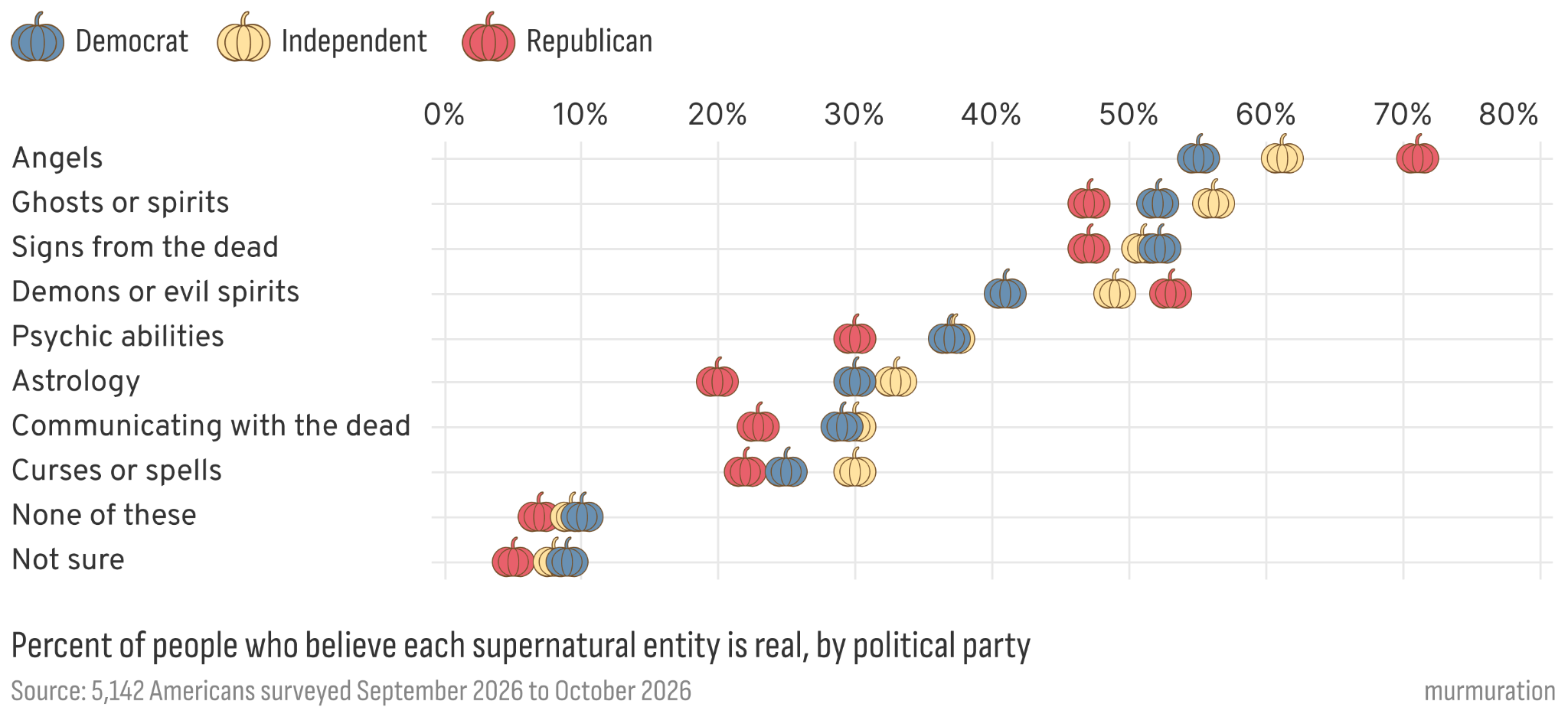
More than half of Americans (56%) say stories about ghosts, haunted places, or supernatural events were common in their family or community growing up. And when we asked what shaped people’s beliefs, Hollywood wasn’t at the top of the list. Personal experiences came first (38%), followed by the experiences of family or friends (36%) and religious or spiritual beliefs (35%). Movies, television, books, and podcasts came in at just 24%.
“Long ago, I was living with my family in a house we had recently moved into. We were all sitting in the living room after supper when we heard a noise coming from the kitchen. It was loud enough we all heard it; it sounded similar to the sound a bowling ball makes when hitting the surface and rolling down the lane. We all jumped, then scurried to the kitchen to see what had fallen and rolled on the floor. We found absolutely nothing on the kitchen floor. We checked the other nearby rooms to see if we had misjudged the exact location, but didn’t find anything out of place. The house did not have a basement or an upper story. For as long as my family lived there, this occurred periodically, always with nothing we could find to explain it. At first it was a joke when we said it must be a poltergeist, but we never came up with another explanation!” - 71, Male, Democrat, Hancock County, IN
Those stories become attached to places, too. More than half of Americans (56%) say there is a place in or near their community that people claim is haunted. About one in five even know the story behind it.
“I grew up in York County PA. Getting to drive around to all the haunted and mysterious places with my sisters was a very fond memory.” - 39, Female, Democrat, El Paso County, CO
Of course, knowing the local ghost story is one thing. Being asked to do something about the supernatural is another. In perhaps our least serious measure of civic duty, we asked people to imagine being told they were the next Slayer—chosen to protect the world from vampires, demons, and other forces of darkness. Even if they were allowed to decline being chosen, fifty-two percent said they would probably or definitely accept the job.
The Neighborhood Comes Alive
For all the ghosts, costumes, and promises of fright, Halloween is also one of the few holidays that sends us out our front doors and into our neighborhoods.
Nearly eight in ten Americans (78%) say trick-or-treating happens in their community, while 73% see Halloween decorations. Majorities also report pumpkin patches or fall festivals (60%), trunk-or-treat events (59%), haunted houses or ghost tours (53%), and school Halloween events (53%). Just 4% say none of the activities we asked about happen where they live.
“The whole neighborhood where I live has a decorating contest that we all do. And then on halloween, we all go around looking at each other’s houses and lights and decorations” - 18, Female, Democrat, Platte County, MO
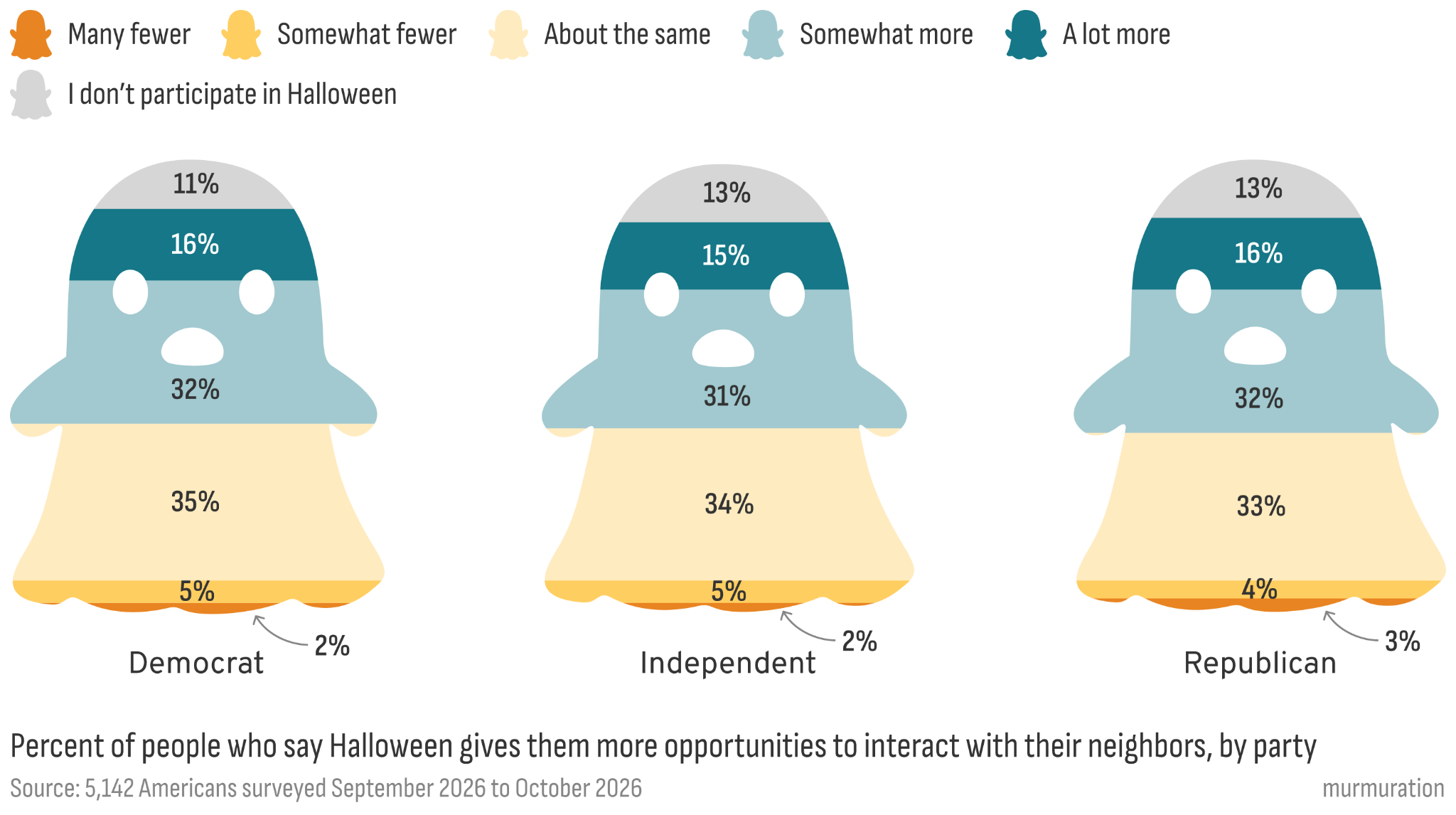
And all of that activity appears to create something increasingly unusual: a reason to interact with the people who live around us. Nearly half of Americans (47%) say Halloween gives them more opportunities to interact with their neighbors than they otherwise would, compared with just 7% who say it gives them fewer.
“Our tradition is to participate in the town’s business trunk or treat. We dress up and get kids from neighboring towns to come to get candy from each business on our stretch of street.” - 43, Female, Republican, Hardeman County, TN
What people enjoy about Halloween also changes as we get older. Among adults under 35, being scared is one of the biggest attractions: 38% say it’s among the things they like most about Halloween. Among Americans 65 and older, just 12% say the same. Instead, more than half of older Americans (51%) say they enjoy seeing kids trick-or-treat—compared with just 20% of adults under 35. When asked to share their favorite Halloween memory, some older Americans seem to prefer to do the scaring:
“Giving [my] daughter, her friend and their kids a hay ride behind my tractor back in my woods. My son was dressed up like Jason with the trench coat, mask and chainless chain saw. He jumped up in the woods and really scared everyone. My granddaughter would not come back to my home for over a year.” - 83, Male, Republican, Collier County, FL
“I had kids over for treats and games, and we were in our basement that had sliding glass doors. My husband snuck outside dressed in a dark, scary costume, appeared at the sliding glass doors and SCARED them silly. The kids had a GREAT time and really enjoyed the scare.” - 72, Female, Republican, Moniteau County, MO
And yet, even as Halloween continues to bring people together, nearly half of Americans still feel we’ve lost something. Forty-eight percent say Halloween feels less like a community event today than it did when they were growing up. Just 20% say it feels more like one.
But the experience of Halloween looks very different depending on how connected people already feel to the place where they live.
Among Americans who feel strongly that they’re part of a community where people care about them and they matter, 59% say Halloween gives them more opportunities to interact with their neighbors. Among those who don’t feel part of such a community at all, just 30% say the same, and more than a quarter (27%) don’t participate in Halloween activities at all.
The divide is even more striking when people look backward. Among those who don’t feel part of a caring community at all, 62% say Halloween feels less like a community event today than when they were growing up, while just 8% say it feels more like one. Among people who feel the strongest sense of belonging, those numbers are almost perfectly balanced: 35% say Halloween has become less communal, while 34% say it has become more communal.
Interestingly, the difference isn’t simply whether Halloween exists in someone’s neighborhood. Trick-or-treating is nearly equally common among the most- and least-connected Americans. The larger gaps show up in activities that require more collective participation: neighborhood parties, costume parades, school events, and community festivals.
Final Thoughts
Halloween obviously can’t solve our larger problems of connection and community. But there is something notable about a tradition that still gets millions of people to decorate their homes, walk around their neighborhoods, knock on one another’s doors, admire each other’s children, and participate in the same slightly strange ritual year after year.
“When I was little my sister and I used to dump our candy after trick or treating and trade each other for our favorites. Now my kids are old enough to do the same and I love to watch the tradition continue” - 35, Female, Independent, Cuyahoga County, OH
That leaves us wondering:
What other traditions, rituals, and shared experiences still reliably bring people out of their homes and into contact with one another?
How much does a sense of community depend on having places and occasions where connection can happen casually, without needing to be organized or planned?
As some of our shared traditions become less communal, what would it look like to create new reasons for people to participate in the life of their neighborhoods and communities?
Maybe building stronger communities doesn’t always have to start with something big. Sometimes it starts by giving people a reason to open the door.
Who you gonna call?
Murmuration is a non-profit that organizes a network of partners and equips them with the insights, tools, and services needed to help communities build and activate the power to transform America into a nation where everyone thrives.