


Before we dive in, a quick note: our Substack is now simply Murmuration—formerly Insights by Murmuration. The work and content will remain the same, but now we’re even easier to find at substack.murmuration.org. Any previous links will automatically redirect.
Technology is often told as a generational story. Younger Americans are supposed to be the ones who adapt first—the “digital natives” who grow up alongside new tools and incorporate them into everyday life. From social media to smartphones, each wave of technology has arrived with the assumption that younger people will lead the way. Artificial intelligence might seem like the next chapter in that pattern.
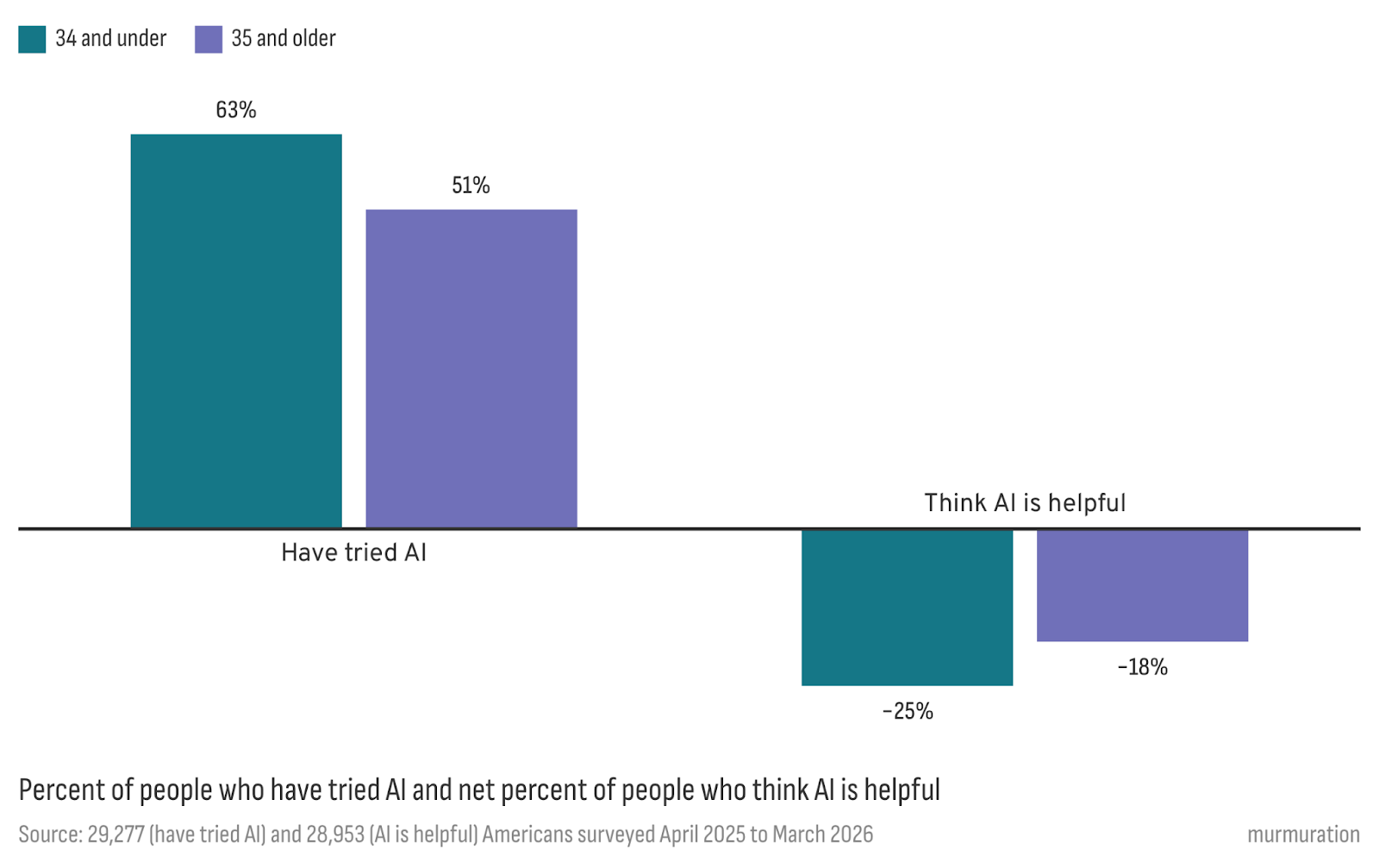
And in one sense, it is. Younger Americans are experimenting with AI tools more than anyone else. They’re using them to write, summarize, organize ideas, plan projects, and navigate everyday tasks. AI is showing up in homework, early careers, creative projects, and even personal decision-making.
But the data tells a more complicated story. The same generation using these tools most frequently is also among the most skeptical about what they do and what they might become.
Heavy Use, Growing Doubt
Artificial intelligence is already woven into daily life for many Americans, but using AI and trusting AI are two very different things. In fact, the data reveals a stark reality: despite all of the hype around AI technology, most Americans remain deeply skeptical.
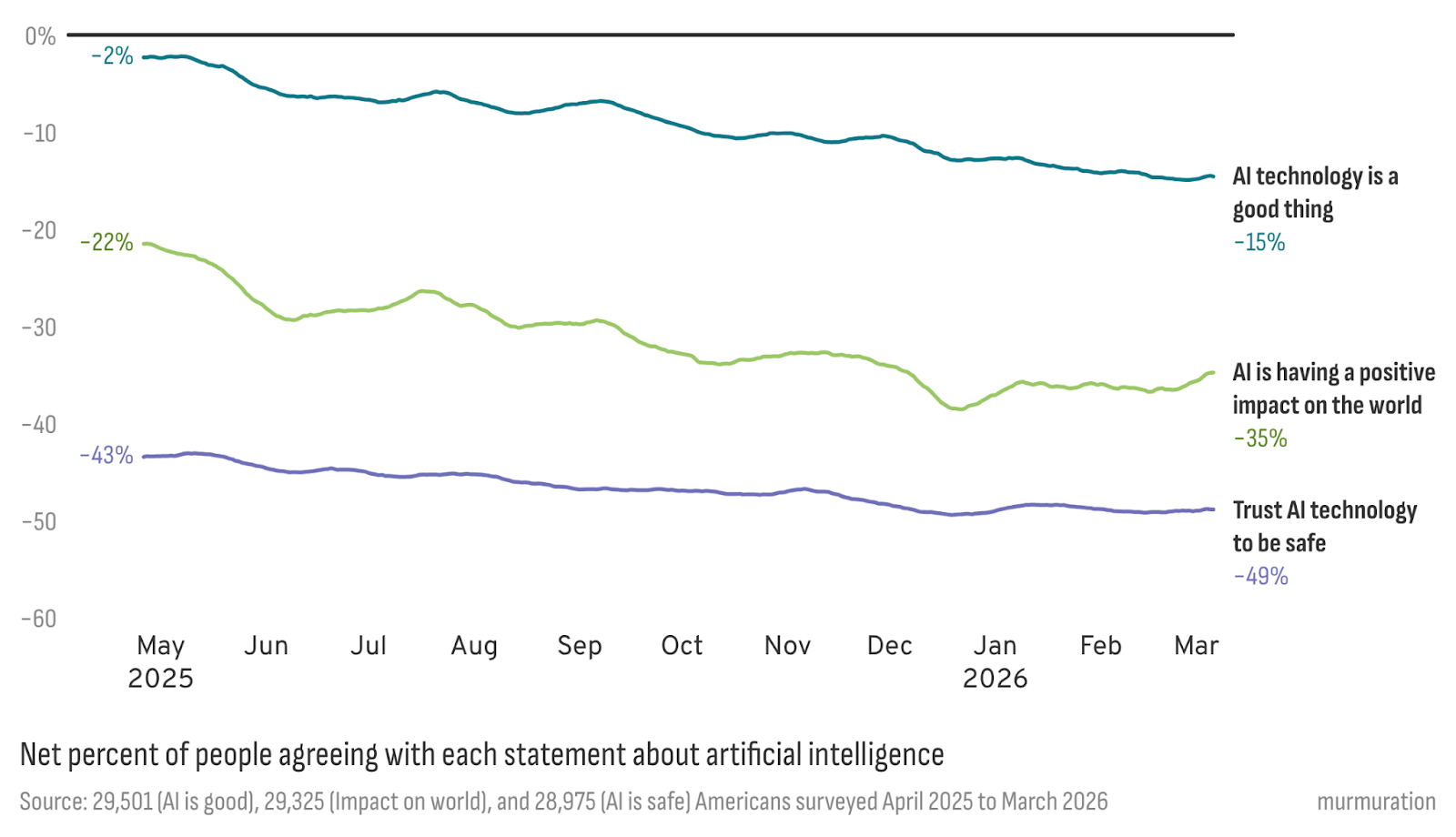
Increasingly, Americans are saying that they think Artificial Intelligence technology is a bad thing and that it is having a negative impact on the world. Young Americans are leading the way. Above age 35, 46% say AI is bad; under age 35, it is 58%. Above age 35, 49% say AI is having a negative impact on the world; under age 35, it is 66%.
It is not only that younger Americans are more negative in their assessment—they are also more certain. Uncertainty about the impact of AI is much higher among older Americans. Over a third of those age 65+ say they are unsure whether AI is having a positive or negative impact on the world. It is possible that as older Americans have more experience with AI, they will come around to the views of younger people.
Most strikingly, Americans—especially younger people—simply do not trust AI to be safe. Nearly seven in ten (67%) say they lack confidence in its safety, a concern that is even more pronounced among those aged 18–34, where 70% express the same skepticism.
The Worries Behind the Numbers
When Americans talk about AI in their own words, the concerns come into focus quickly. They are not abstract worries about the future of technology. They are specific, practical fears about how these systems work today and how they might be used tomorrow.
The most common concern centers on misinformation. Many respondents worry about tools that generate confident answers without actually knowing whether those answers are true. In our data, 21% of participants raised concerns about AI producing false or misleading information. People also worry about how easily these tools could be used for manipulation with 14% mentioning malicious use by bad actors, and 12% pointing to the lack of regulation or oversight.
As respondents put it:
“Artificial meaning fake, need we say more?” - 64, Female, Hidalgo, TX
“How many instances do we see of AI providing false information? A government report used AI and was filled with nonsense.” - 29, Female, Eagle, ID
“The current implementation lies frequently with extreme confidence.” - 30, Male, Leon, FL
“AI can be trained to produce lies and fake narratives.” - 73, Male, San Francisco, CA
Another concern that surfaces often is dependence. People worry about what happens when judgment, creativity, or decision making begin to migrate from humans to machines. About 11% of people talk about people losing the ability to think critically or function independently if AI becomes too embedded in everyday life.
This is captured best by the following responses:
“It is destroying the ability to think critically about sources and research.” - 27, Male, Baltimore, MD
“It removes the need for humanity to exercise critical thinking skills.” - 43, Male, Salisbury, NC
“It will erode the users’ ability to think for themselves, making them easily manipulated.” - 70, Female, Richmond, VA
For younger Americans, these concerns are unfolding in a particular social and economic context.
This is a generation already navigating a fragile information environment. Trust in institutions is low, and the line between real and manufactured content is increasingly difficult to see. AI does not create that instability, but it amplifies it. Tools that can generate convincing text, images, and voices raise the stakes of discernment at a moment when many people already feel overwhelmed by information. In about 8% of responses, there are specific concerns about deepfakes, impersonation, and identity fraud. As one 32-year-old man put it, “Fake images, videos, and voices can be used to confuse or lie to nations.”
At the same time, young adults are entering a labor market shaped by uncertainty. Concerns about job displacement and economic disruption show up clearly in the responses. There is a recurring sense that AI may replace work faster than it supports workers, particularly for early career professionals and people in creative fields.
“[AI] takes jobs away from artists and writers. It prevents people from using critical thinking and using their own talents.” - 26, Female, Riverside, CA
“Employers will use it to replace human functions rather than passing the benefits off to employees.” - 20, Male, New York City, NY
“It has the potential to prematurely upset a jobs-based society, or prematurely bring about an apocalypse.” - 36, Male, Somerset, NJ
“I feel that it will take away jobs of my great grandchildren. Exactly what jobs will be in store for them to have if AI takes over?” - 75, Female, Glen Carbon, IL
Taken together, these responses suggest that the anxiety around AI is not only about the technology itself. It is about trust, information, work, and the pace of change in a society that already feels unstable to many people.
Final Thoughts
What’s notable is how often these worries are framed not as personal inconvenience, but as collective risk. People talk about AI changing society, reshaping opportunity, and shifting power. They are asking, implicitly: Who is this for? Who decides how it’s used? And who bears the cost when it goes wrong?
Beneath the polling numbers sit deeper questions:
What would it look like for people to have meaningful input into how or if AI is deployed in their schools, workplaces, and communities?
How do we build norms and guardrails that increase transparency without stifling innovation?
How do we ensure that the potential benefits of new AI technologies do not bypass the generation most anxious about its consequences?
These are not questions engineers can answer alone. They require public deliberation, institutional trust, and civic infrastructure strong enough to hold complex tradeoffs.
Still thinking for ourselves.
This research was supported by the Walton Family Foundation, which has funded Murmuration’s Gen Z research efforts since 2021. Learn more about our ongoing research partnership and findings on the youngest generation of voters here.
Murmuration is a non-profit that strengthens community-driven change at the local level. By equipping local organizations with powerful data, technology, and insights, Murmuration helps them amplify community voices, build collective power, and drive solutions that reflect the lived realities of the people they serve. murmuration.org