


Valentine’s Day (which I am told happened over the weekend) is about love in its most optimistic form—cards and flowers, promises made for a hopeful future. But the vows that tend to last aren’t just about romance. They’re about commitment during times of uncertainty. About staying through disagreement, fear, and moments when the path forward isn’t clear.
Nations, like relationships, are tested in the same way.
In the last few weeks, our State of Us work has focused on a harder truth. Americans feel deeply divided, and increasingly unsure that we’re moving toward a better future at all. Together, our findings point to a country where people are alarmed by what they see happening around them, yet still deeply invested in one another and in the ideas of kindness and empathy.
So we asked Americans to look ahead and tell us what they hope might improve, and what they fear may lie ahead. This is what they said, for better or worse.
For Better
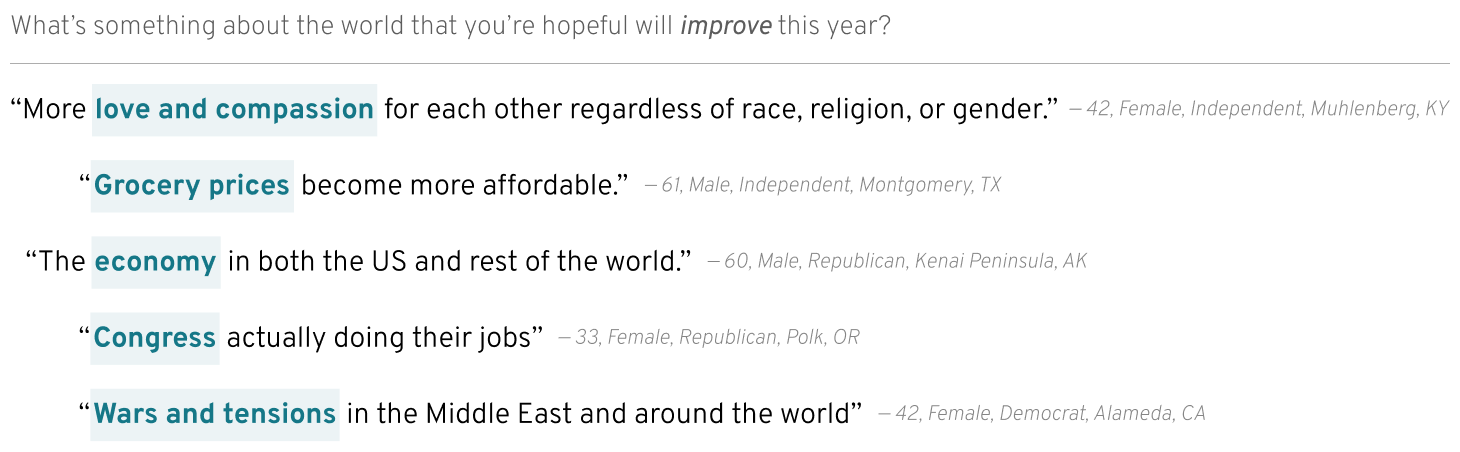
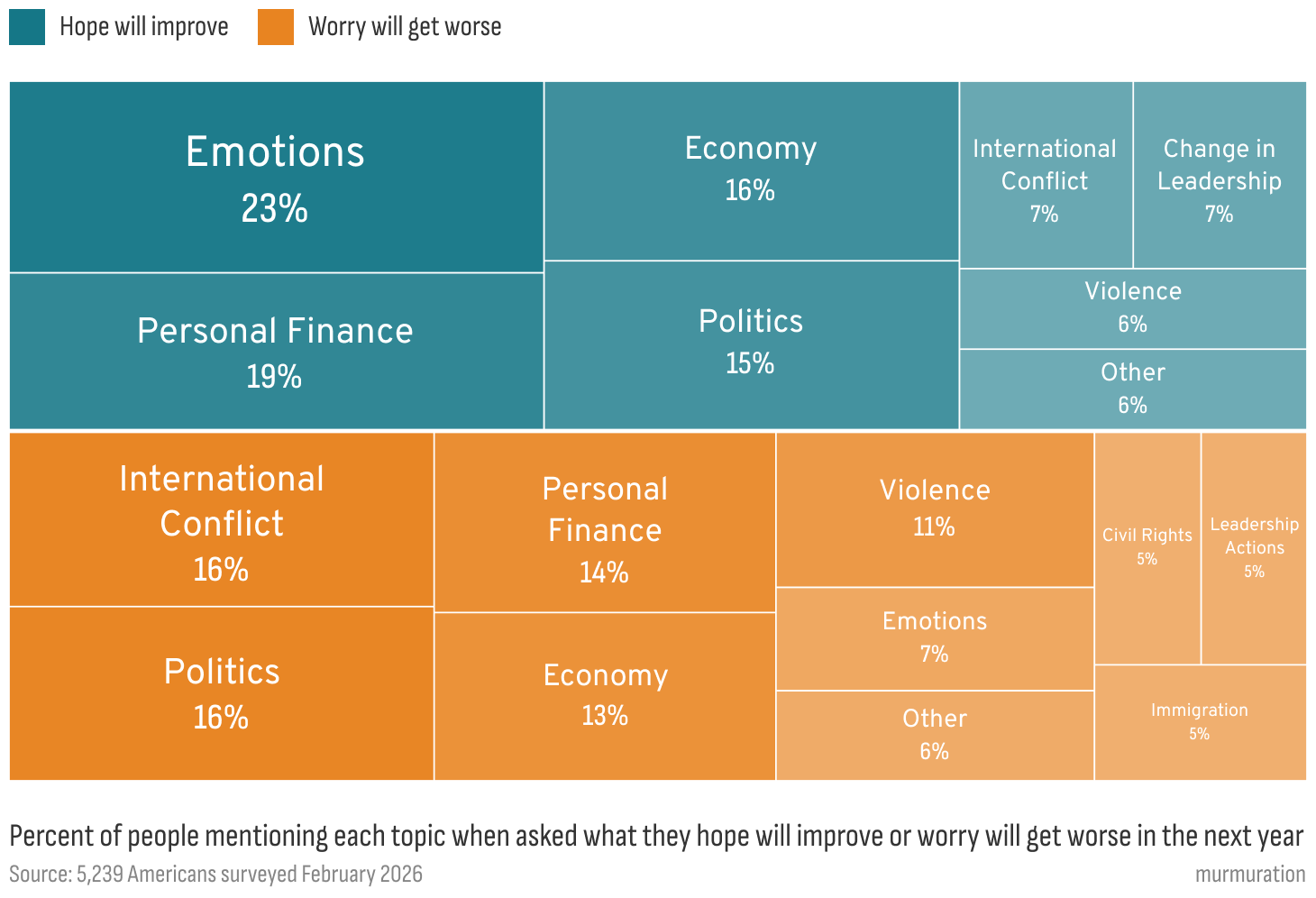
When people talk about what they hope will improve this year, they are most often reaching for something emotional rather than institutional. The single most common hope is not about policy or finances, but about how people treat one another. More than one in five respondents (23%) expressed hope for less hate, more kindness, greater empathy, and a sense that people might find ways to coexist more peacefully. In a moment defined by polarization and fatigue, many are yearning for emotional relief and social repair—less anger in public life, fewer divisions in everyday interactions, and a softer tone overall.
Economic hopes come next, but they are strikingly personal. Nearly one in five people (19%) focused on personal finances and the hope that everyday costs like groceries, gas, and rent become more manageable, or that the cost of living eases its grip. A similar share (16%) spoke more broadly about the economy, referencing inflation, interest rates, the stock market, or national debt. Together, these responses suggest that optimism is closely tied to financial breathing room: people aren’t necessarily imagining abundance, but stability, predictability, and a sense that things won’t keep getting harder.
Politics also surfaces as a source of hope for a meaningful group of people (15%). These responses are less about enthusiasm and more about resolution including hopes for calmer governance, better leadership, functional policymaking, or simply an end to constant political turmoil. A smaller but notable group explicitly expressed hope tied to opposition to the current administration (7%), reflecting a desire for change, accountability, or limits on executive power rather than confidence in any single alternative.
Beyond the most common themes, a long tail of smaller, more diffuse hopes rounds out how people imagine things getting better. Some respondents are looking beyond U.S. borders, expressing hope for de-escalation abroad, an end to ongoing wars, or more stable global relations (7%). Others talk about safer communities and less violence (6%), progress on immigration (5.0%), greater protection of civil rights (4%), and improvements in healthcare access (4%). Far fewer respondents named housing, climate, education, or technology, but their presence still reflects a broad and interconnected view of what “getting better” could mean.
For Worse
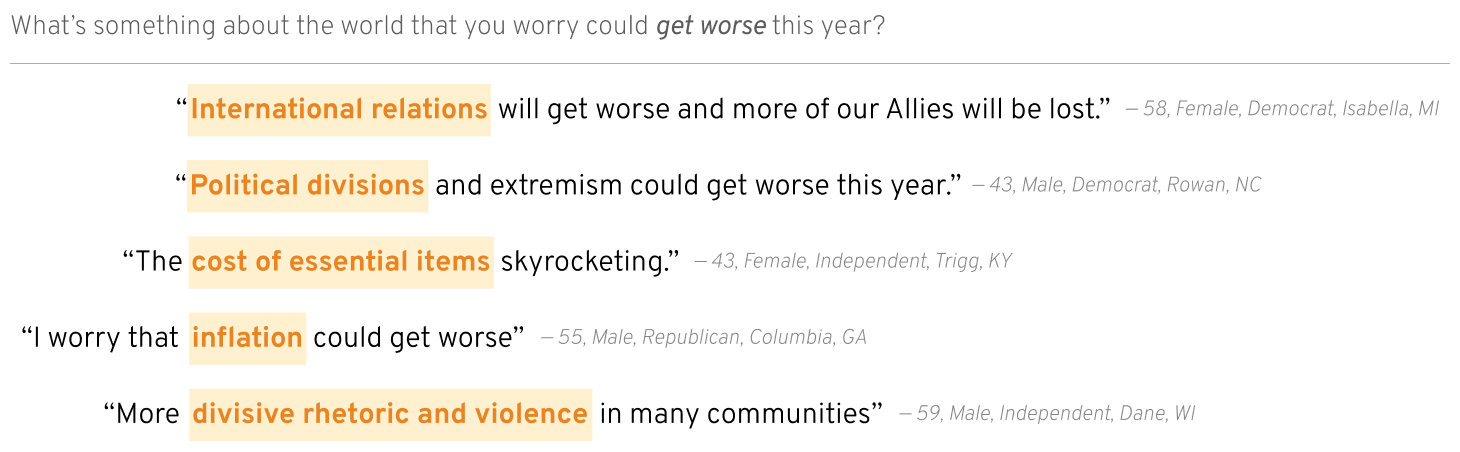
When people talk about what they fear could get worse this year, their concerns shift outward and upward—from interpersonal strain to large-scale instability. The most common fear centers on political conflict:
Nearly one in five respondents (18%) worry about international matters like escalating wars, widening global unrest, or deteriorating foreign relations. These responses often carry a sense of powerlessness, reflecting anxiety about forces far beyond individual control and the possibility that global violence could intensify rather than resolve.
An identical share (18%) have fears about politics at home. They anticipate worsening political dysfunction including deepening polarization, policy failures, democratic backsliding, or further erosion of trust in government. For many, the concern is not just disagreement but a sense that the political system itself may become more chaotic, punitive, or unresponsive.
Economic anxiety remains central, but again appears in both personal and national forms. About 15% fear their personal financial situation will deteriorate, citing rising costs, stagnant wages, or growing precarity, while 14% worry more broadly about the economy (e.g. recession, inflation, debt, or market instability). Together, these responses suggest a pervasive fear that financial strain may intensify, leaving households with even less margin for error.
Violence also looms with nearly 12% of people worrying about increased violence, declining public safety, or the prevalence of guns. These fears are often rooted in concerns about crime, mass violence, or a general sense that everyday spaces feel less safe.
A smaller but still notable share expresses fear that social and emotional conditions will worsen. About 8% worry about rising hatred, anger, or cruelty, suggesting concern that social norms around empathy and coexistence may continue to erode. Others fear rollbacks in civil rights (6%), harsher immigration enforcement or deportations (6%), negative outcomes tied to opposition to the current administration (6%), environmental and climate deterioration (3%), housing instability (2%), worsening healthcare access (2%), job insecurity (2%), protests and unrest (2%), unchecked technological change like AI (1%), and declines in education or faith in institutions. While each is named by relatively few individuals, together they convey a diffuse sense that multiple systems could fray at once.
Final Thoughts
Reading these responses side by side, one thing becomes clear. People haven’t lost the capacity to hope. They’ve lost confidence that hope will be protected.
Hopes for the year ahead are modest, human, and close to home. They’re hoping for less pressure, less anger, fewer shocks and a world that feels a little more livable than it does right now. Fears, by contrast, are sharper and more structural. They cluster around escalation rather than improvement: widening wars, deepening political dysfunction, rising costs, growing violence, and eroding rights.
The imbalance is telling. It suggests that while people still believe things could get better, they are far less convinced that the forces shaping their lives are moving in that direction. This raises deeper questions about:
Are people who fear systemic collapse still willing to invest in local efforts?
Do people see emotional repair as a precondition for political repair?
At what point does financial insecurity start to reshape people’s expectations of democracy, fairness, or government responsibility?
What comes next depends on whether people believe that our future can be made, protected, and sustained.
Love, tested by reality
Murmuration is a non-profit that organizes a network of partners and equips them with the insights, tools, and services needed to help communities build and activate the power to transform America into a nation where everyone thrives. murmuration.org