


Last week, we explored how food brings Americans together, from the meals we share with neighbors to the traditions we carry across generations. Since then, we’ve been thinking more about something that came through in those findings: when people remember the meals that matter most, they’re often remembering much more than what was on the table.
There are a lot of ways to ask people what matters to them. We can, and have, asked about their priorities, their values, what makes them happy, or what they hope their lives will look like.
This time, we tried something a little different. We asked three pretty ordinary questions:
Think of a place where you have truly felt at home. What made it feel that way?
What is one thing you own that you would be most upset to lose?
Think about a meal that has special meaning to you. What is it, and why does it matter?
On the surface, those are questions about places, possessions, and food. But reading through hundreds of answers, they started to feel like versions of the same question: What are the things that make our lives meaningful, familiar, and uniquely ours?
And more often than not, the answer was other people.
What Makes a Place Home
When Americans describe somewhere they have truly felt at home, they don’t tend to start with the house itself.
Nearly four in ten (39%) talk about comfort, peace, or safety. More than a third (36%) mention family, while 31% describe welcoming people or a sense of belonging. Just 10% simply name a place without explaining what made it feel like home.
Sometimes that distinction is explicit.

For others, home is a place precisely because of the history accumulated there. One man described his grandmother’s house, where he has fond memories of sleepovers and Christmas celebrations.

Another woman, who moved frequently as a child, told us that the only place she has ever really felt at home is her best friend’s house.

The Things We Hold Onto
Places aren’t the only things that seem to absorb meaning over time.
We also asked people to name the one thing they own that they would be most upset to lose. More than one in five (22%) didn’t really name a possession at all. They named people. Among those who did name something, the answers were varied: 16% said a vehicle, 15% their home, 14% photographs or keepsakes, 12% something related to a hobby or entertainment, and 10% a phone or computer.
But the object itself only tells part of the story. Thirty percent explained why something mattered in sentimental terms, slightly more than the 28% who focused on its practical value. And that distinction changes depending on people’s circumstances. Among Americans who say they are struggling financially, practical value rises to 32%, compared with just 8% among those who describe themselves as prosperous.
In other words, sometimes the thing we can’t afford to lose is irreplaceable because of what it means. Sometimes it’s irreplaceable because we need it to get through the day.

And then there are the things whose value comes almost entirely from repetition and recollection.
When we asked people about a meal with special meaning, 43% talked about family cooking or recipes, 34% about eating together, 23% about holidays or celebrations, and 22% about childhood or nostalgia. Nine percent explicitly connected the meal to someone who had died.
The answers make clear how quickly food can become something much bigger than food.
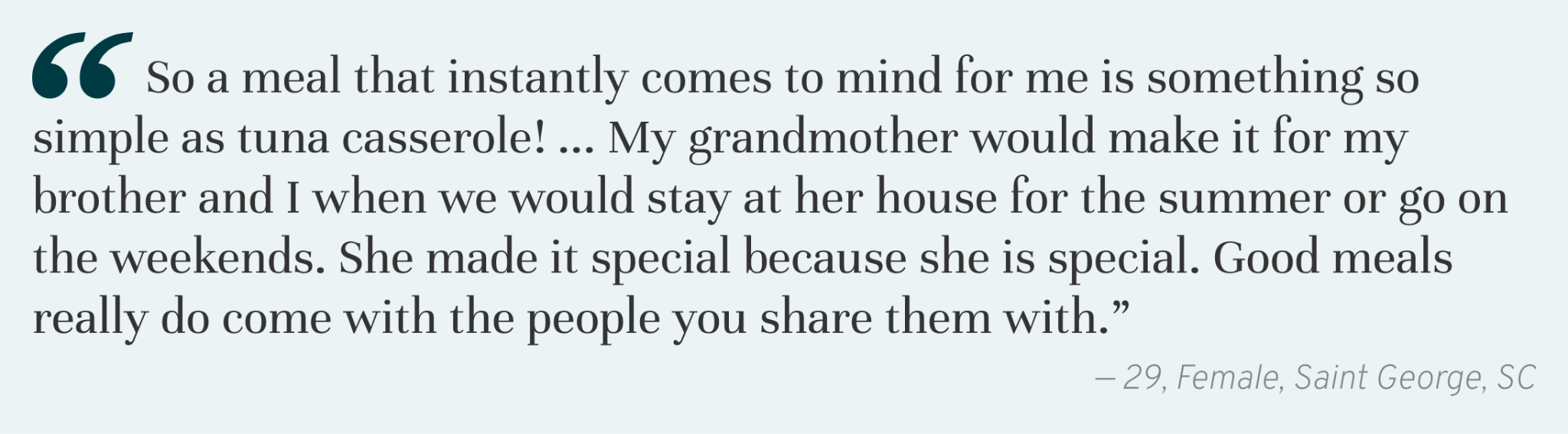
Another man described how food brings up memories of family members, both past and present..

And there is an interesting difference by age. Among adults ages 18–34, 43% describe the meaning of a meal in terms of taste or a favorite food, while just 19% talk about eating together. Among adults ages 50–64, that pattern nearly reverses: 25% emphasize taste while 47% talk about eating together. Holidays and celebrations also become much more prominent with age, rising from 11% among adults under 35 to 34% among those 65 and older.
Final Thoughts
These answers suggest that a lot of what makes our lives meaningful is surprisingly ordinary. It’s a room where you can exhale. A photograph you’d grab on the way out the door. A recipe written in someone’s handwriting. The same meal on the same holiday. People who know you well enough that you don’t have to explain yourself.
So, a few questions we’re left with:
Do people have enough stable places and relationships to build that kind of shared history?
What happens when money, mobility, or distance make it harder to maintain the routines that keep us connected?
And when people say they want more connection, what are the ordinary things that actually help create it?
There isn’t one answer to what makes somewhere feel like home. But across these questions, people, familiarity, and shared history come up again and again.
There’s no place like home.
Murmuration is a non-profit that organizes a network of partners and equips them with the insights, tools, and services needed to help communities build and activate the power to transform America into a nation where everyone thrives.
Hi. I'm writing a new book on how people find support and belonging outside of romantic relationships and traditionally defined family. I'm intrigued by this part of your post:
"Nearly four in ten (39%) talk about comfort, peace, or safety. More than a third (36%) mention family, while 31% describe welcoming people or a sense of belonging. Just 10% simply name a place without explaining what made it feel like home."
Do you have a published report on this research? If so, what is it and where can I find it? If this is not published research, I'd like to know a bit about your methodology:
1. Which survey the answers came from.
2. The sample size and when it was fielded.
3. How the open-ended answers were coded into the percentages.
I might want to cite your work in my book, so I'd like to understand it better to cite it accurately and in context.
Thanks!
Amy Gahran
Author, Stepping Off the Relationship Escalator: Uncommon Love and Life
amy@gahran.com