


Belief in the power of education remains one of the most widely shared values in American public life. Across party lines, across regions, and across family situations, people think it is important to have high quality local schools. They want children to be safe, teachers to be supported, and communities to have real opportunity. In that sense, education is still sacred in the American imagination.
At the same time, education is not experienced as a standalone issue. It is crowded into the same political and economic space as every other pressure people are carrying right now. When voters think about their lives, they are thinking about grocery bills, rent, childcare, healthcare, crime, and jobs. Schools matter deeply, but they are competing with a long list of urgent concerns that feel immediate and relentless.
Young people, in particular, offer a revealing lens into this tension. Looking at education through their eyes helps clarify why it matters and why it so often gets crowded out.
Education as a Voting Issue
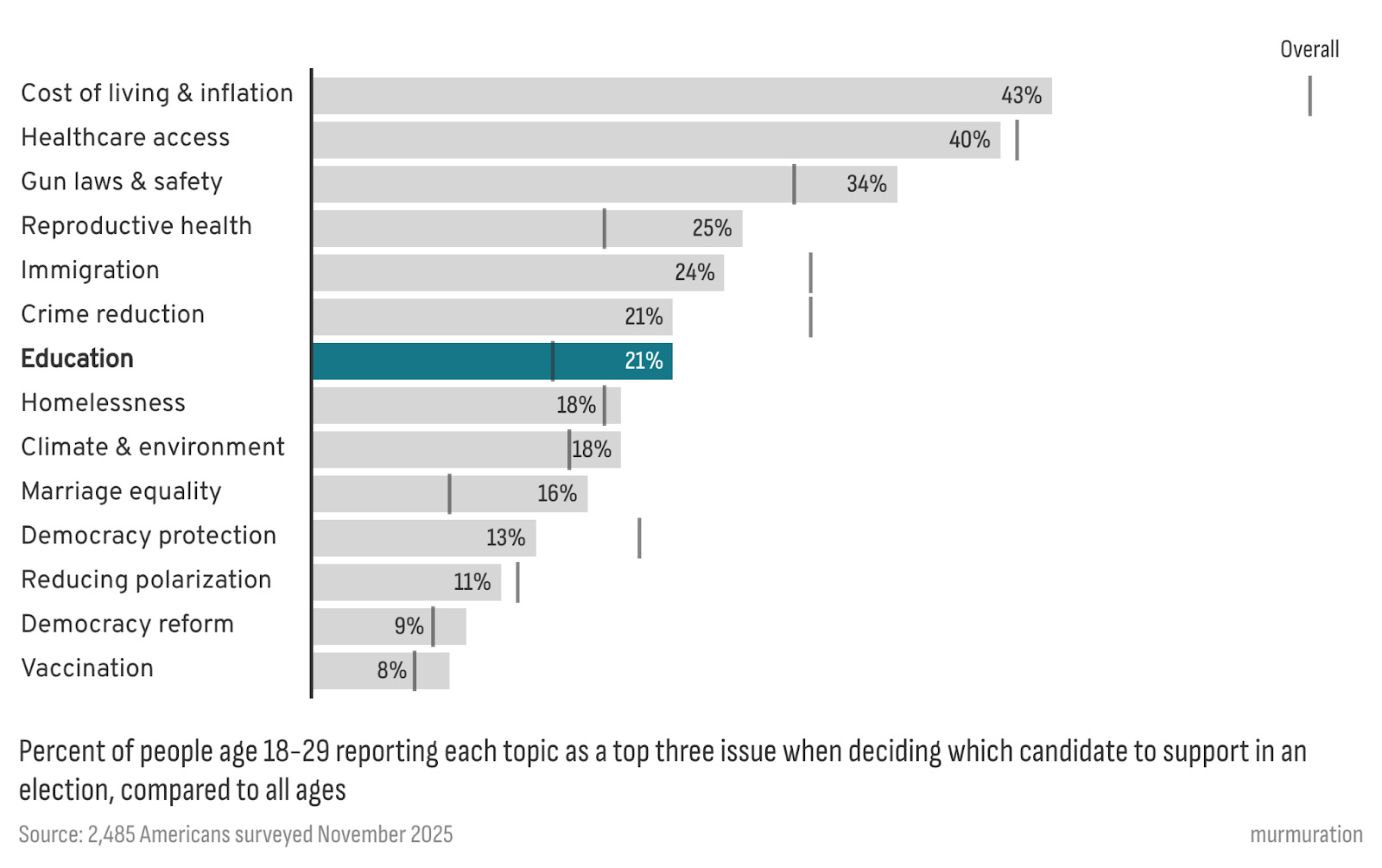
As important as education is to many, it is rarely the single defining issue driving vote choice. A very small share of voters (9%) say it is their top issue. Most (64%) call it very important but stop short of calling it their top issue. For the rest, it falls even further down the priority list.
This pattern reflects a broader reality: education matters, but it is competing in a crowded field of urgent concerns. People do not separate schools from the rest of their lives, and they evaluate them alongside the pressures shaping their day-to-day experience.
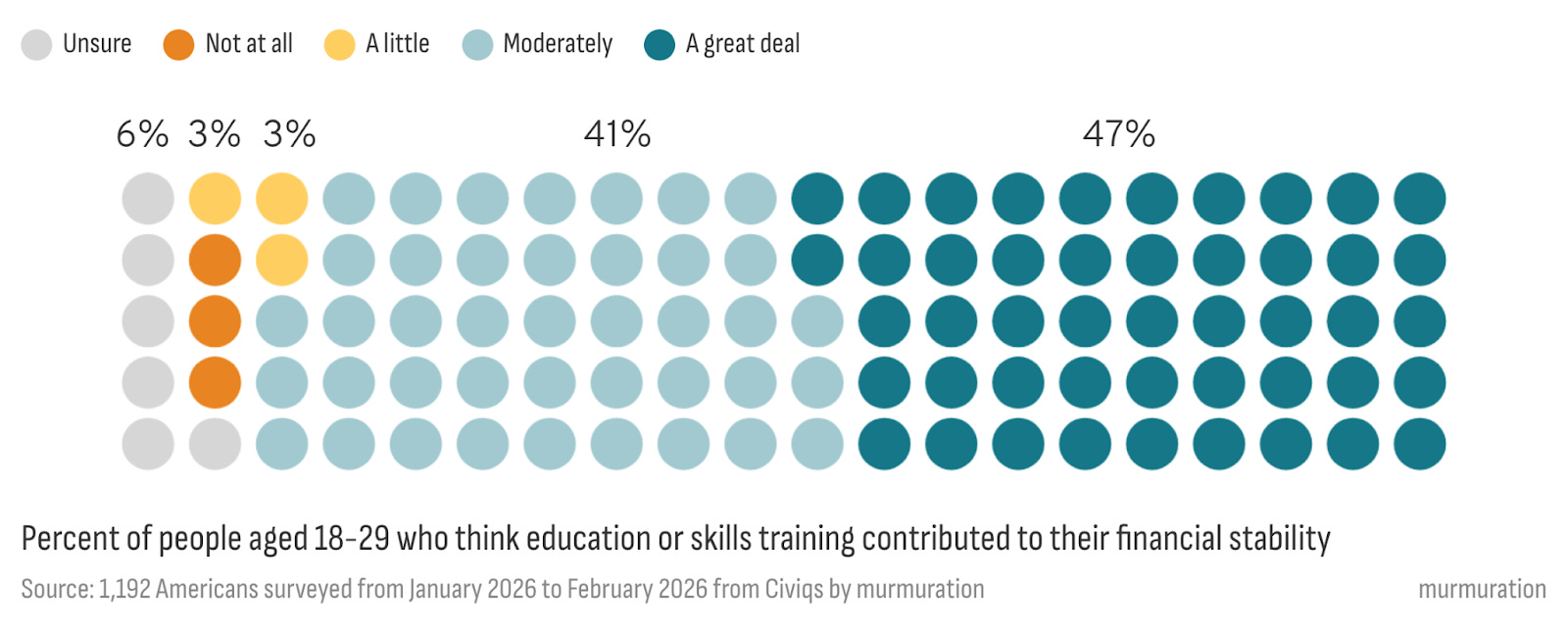
For young voters, this dynamic is especially pronounced. Gen Z is navigating high costs of living, student debt, and a volatile labor market. Education is not just about schools in the abstract; it is about whether learning, credentials, and job training will actually translate into financial stability.
That said, economic issues offer a bridge to education as a voting issue. Americans overwhelmingly agree that education and job training are among the best paths to financial stability. For many families—and especially for younger adults—education is fundamentally about whether the next generation will be able to build a secure life at all.
Education as Community Stability
When we ask people directly about local schools, most Americans (71%) say the quality of schools in their community is very important to them. And, across generations, people describe schools as anchors of community life—places that reduce stress for families, support opportunity, and create the conditions for long-term flourishing.
That belief, especially amongst young people, comes through clearly in broad agreement with statements like:
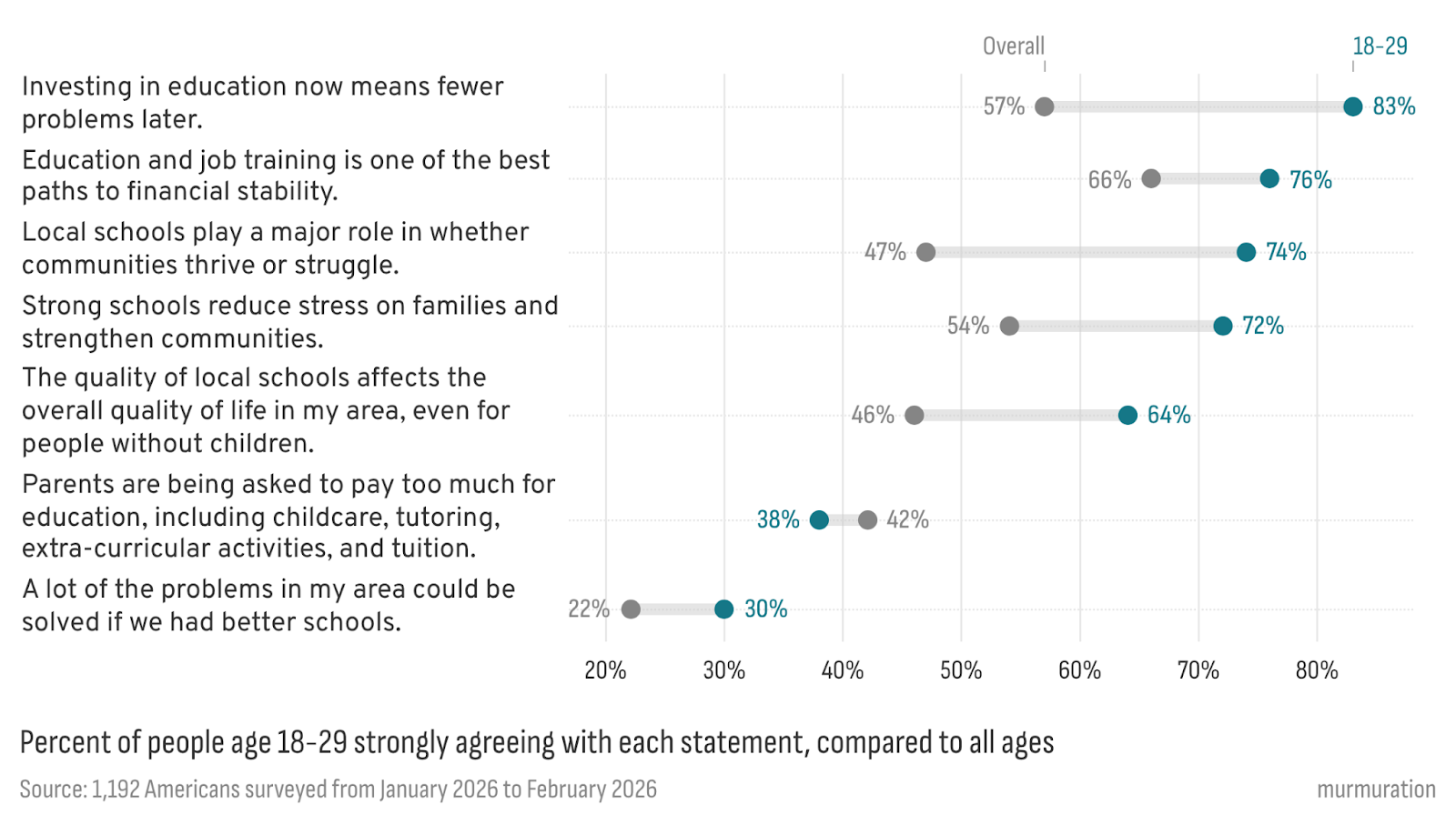
For Gen Z, these ideas land with particular force. Young adults are more likely than older Americans to strongly endorse the view that education shapes economic outcomes, community stability, and the future health of society. In their own words:
“Schools can help uplift students and help them become productive members of society.” – 28, Male, Democrat, Ohio
“Better schools produce more well-rounded adults. If those adults stay in the community then the community succeeds. Also, people struggle to read information critically and do research in today’s society. A more educated populace is one with more critical thinking skills.” – 29, Female, Democrat, Kentucky
Final Thoughts
Education remains one of the clearest shared aspirations Americans have. But it is also increasingly experienced as part of a broader struggle: the struggle to stay afloat, to raise children in a stable environment, and to believe that the future can still be better than the present.
If we want to elevate education in public life, we need to talk about it as what it truly is: one of the foundations of community well-being and one of the most tangible paths to stability in an uncertain time.
All of this points to some larger questions about schools, stability, and community life:
How might our local conversations about schools change if we started with the pressures people are facing first, like affordability, safety, and economic insecurity?
How much of our economic anxiety is really an education anxiety, about whether the next generation will be able to build a secure life?
What kinds of investments in schools today would prevent the biggest problems communities are worried about tomorrow?
The question is not whether Americans care about schools. They do. The question is whether we can speak about education in a way that meets people where they are, in the full reality of their lives.
Report card: we have work to do.
This research was supported by the Walton Family Foundation, which has funded Murmuration’s Gen Z research efforts since 2021. Learn more about our ongoing research partnership and findings on the youngest generation of voters here.
Murmuration is a non-profit that organizes a network of partners and equips them with the insights, tools, and services needed to help communities build and activate the power to transform America into a nation where everyone thrives. murmuration.org.