


“The economy.”
It is one of those phrases that becomes almost unavoidable during an election. Pollsters ask voters whether it is their most important issue. Campaigns promise to fix it. Analysts look to inflation, unemployment, wages, consumer sentiment, and the stock market to explain how Americans are feeling about it.
But most people don’t experience “the economy” as a single issue. They experience it through their own finances—what they earn, what they spend, and what they can afford.
They experience it when the grocery bill is higher than they expected. When the rent goes up again. When their paycheck doesn’t stretch as far as it used to. When they are worried about losing their job or whether the job they have will ever pay enough to get ahead. When buying a home feels impossible, health care costs too much, or an unexpected expense could throw the rest of the month into question. And those aren’t interchangeable experiences.
To understand what those pressures actually look like, Murmuration, in partnership with Voto Latino Foundation, surveyed 7,765 people nationwide about their economic experiences, expectations of government, and priorities for the next Congress. You can read more in the full report “Economic Pressure and Political Voice”.
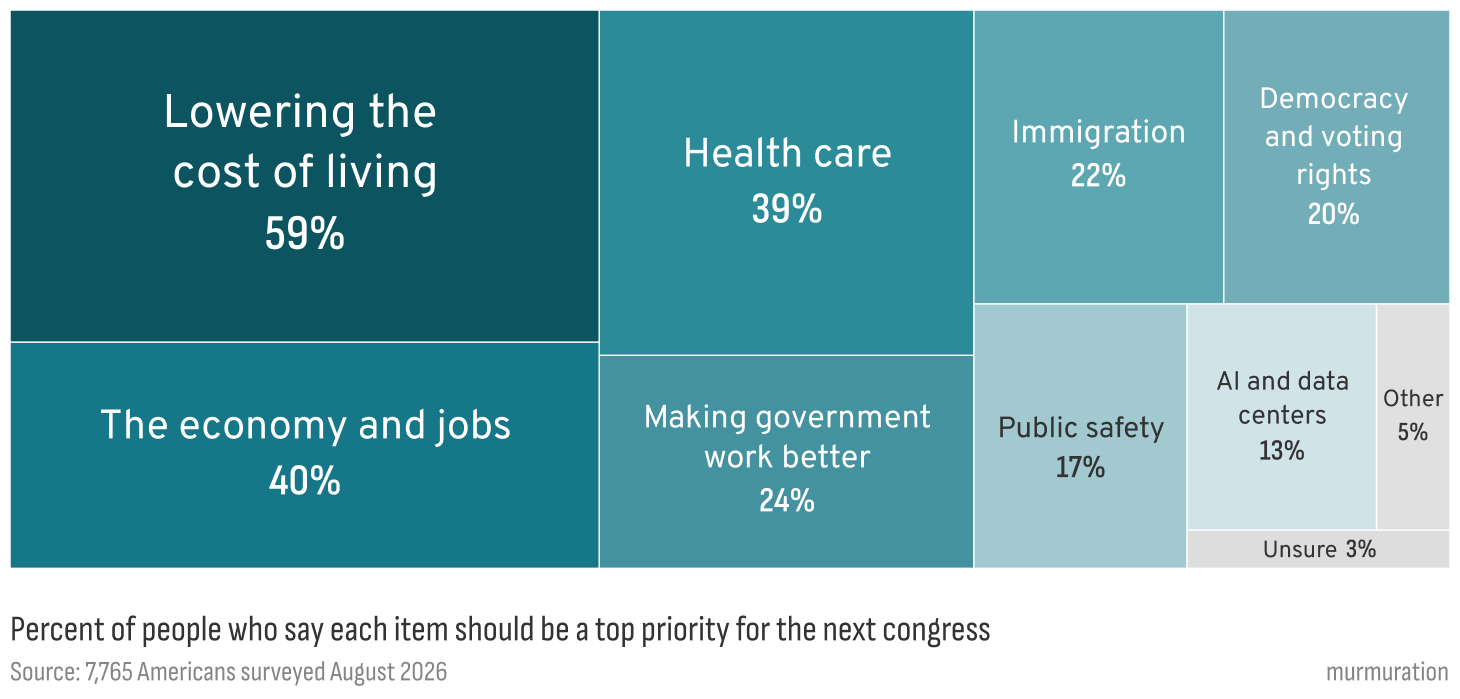
The topline is clear: 59% say lowering the cost of living should be the highest priority for national leadership.
Many Economies
Asked what the government could do over the next two years to make their lives better, one person told us simply: “Make wages match the cost of living. I cannot afford to live anymore.” Another said, “make housing affordable for young adults who can’t afford to live on their own and still live with their parents.” Someone else framed the problem differently: “Let me actually keep the money I’m making instead of taxing it so I can take care of my children instead of relying so much on the government and charity to just survive.”
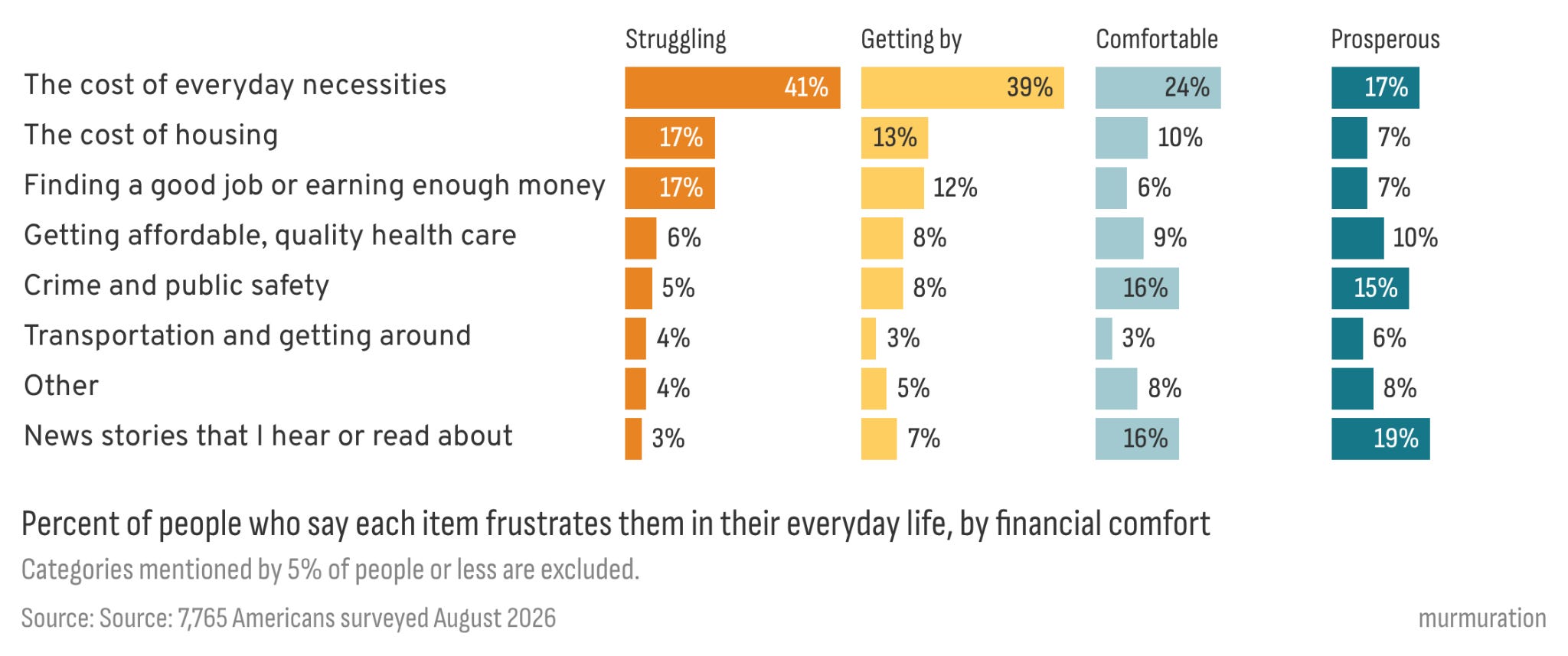
That variation appears throughout the survey. When we asked Americans what frustrates them most in their everyday lives, 35% pointed to the cost of everyday necessities, 13% to housing, 11% to finding a good job or earning enough money, and 8% to getting affordable, quality health care. Another 10% chose crime and public safety.
But their priorities depend on the financial comfort of their household.
Different experiences also shape what people want the next Congress to prioritize. Among Americans most frustrated by the cost of necessities, 73% want Congress to prioritize lowering the cost of living. The same is true of the 66% of people most frustrated by housing and 66% of those most frustrated by jobs and wages.
But beyond that shared concern, priorities begin to diverge. Among people struggling with jobs and wages, 52% prioritize the economy and jobs, while 40% of those struggling with necessities prioritize health care.
The differences become even more clear when people are allowed to describe, in their own words, what the government could do over the next two years to make their lives better. Among people most frustrated by necessities, 41% independently say lowering prices or the cost of living. Among those most frustrated by housing, 20% specifically name housing—more than three times the share among people focused on necessities. Among those struggling with jobs and wages, 19% say better jobs or wages, more than twice the national average.
In other words, “make the economy better” means something quite different depending on where someone sits within the economy. But material circumstances are only part of the story. Our experiences also sit alongside different explanations for why things have become harder and different ideas about what the government should do next.
Among Americans most frustrated by the cost of necessities, there is no dominant explanation for rising costs. Seventeen percent point to tariffs and trade policies, 16% to inflation, 14% to government economic policies, and 14% to companies trying to make larger profits. People struggling with housing distribute responsibility somewhat differently: 16% point to inflation, while 15% each point to government economic policies and corporate profits.
Yet for the 10% of Americans whose main issue is crime and public safety, a very different story emerges. The largest group of these people (19%) say that immigration is the main reason costs have gone up, and another 10% blame the COVID-19 pandemic. Relatively fewer point to trade policy (7%) or corporate profit-seeking (9%).
So the difference is not simply that one person is paying too much for rent while another is paying too much for groceries. What people experience as the problem connects to the broader story they tell about what is happening around them—and those stories can lead people experiencing a broadly shared concern about affordability toward very different diagnoses and priorities.
What Makes Life Better?
Those different diagnoses become even more consequential when we move from identifying problems to solving them.
Among Americans most frustrated by the cost of necessities, 46% want Congress to limit excessive price increases by companies, 39% want a higher minimum wage, 36% want tariffs reduced, and 30% want greater food assistance. Among people struggling with jobs and wages, support for raising the minimum wage rises to 48%. Among people most concerned about crime and public safety, support for limiting corporate price increases falls to 36%, and support for raising the minimum wage to 31%.
Housing provides an especially clear example of how the experience of a problem can shape what people believe would solve it.
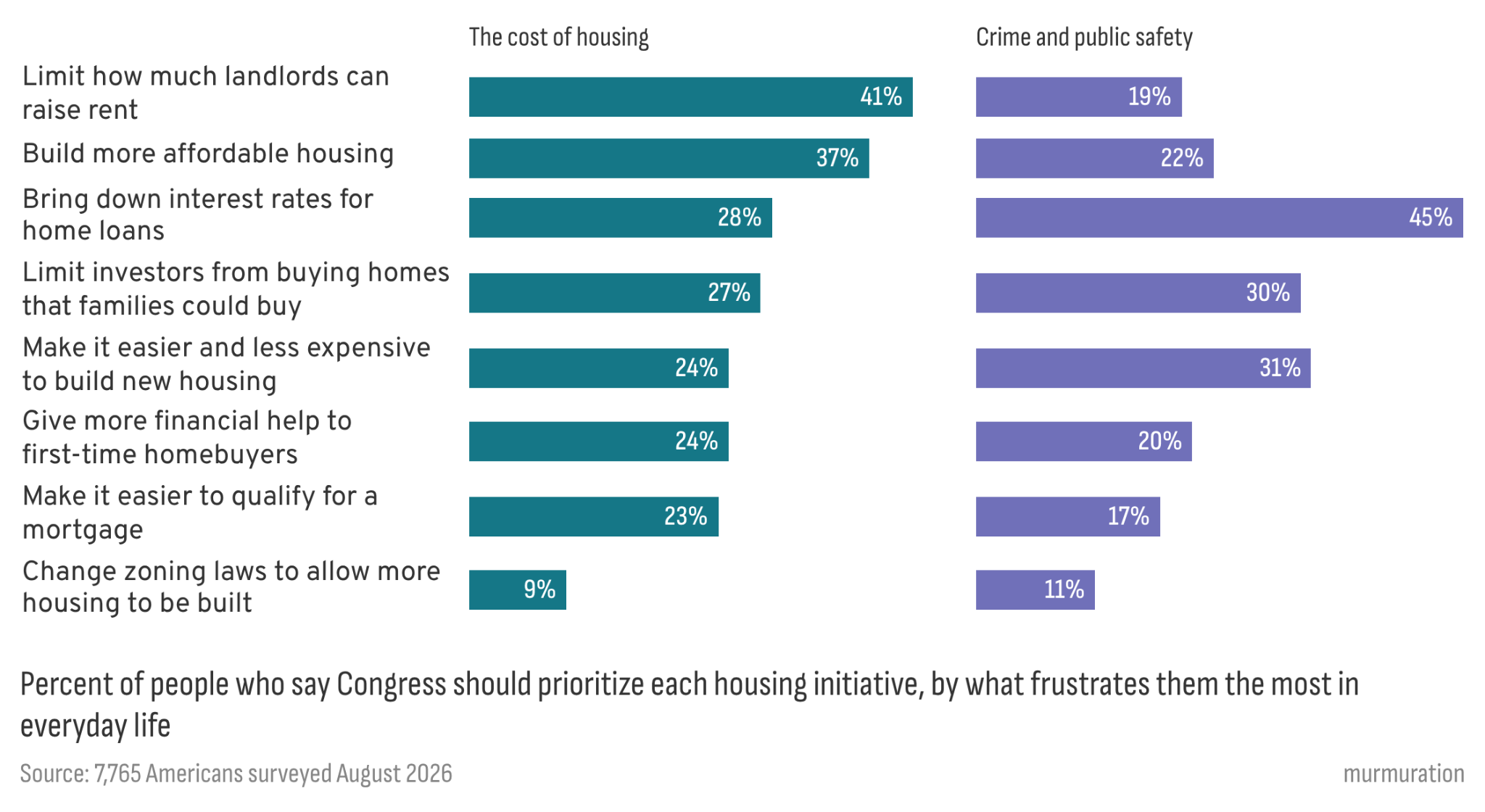
Both groups can look at the same housing market and conclude that housing costs too much. But they appear to be describing different housing problems. For one group, the pressure is more closely connected to rents and the availability of affordable housing. For the other, the cost of financing a home looms much larger.
The urgency of a solution also depends on where people are starting from. Across the country, 55% say political leaders should prioritize long-term changes that address the root causes of economic problems, compared with 37% who want immediate financial relief. But that balance changes sharply with people’s own financial circumstances.
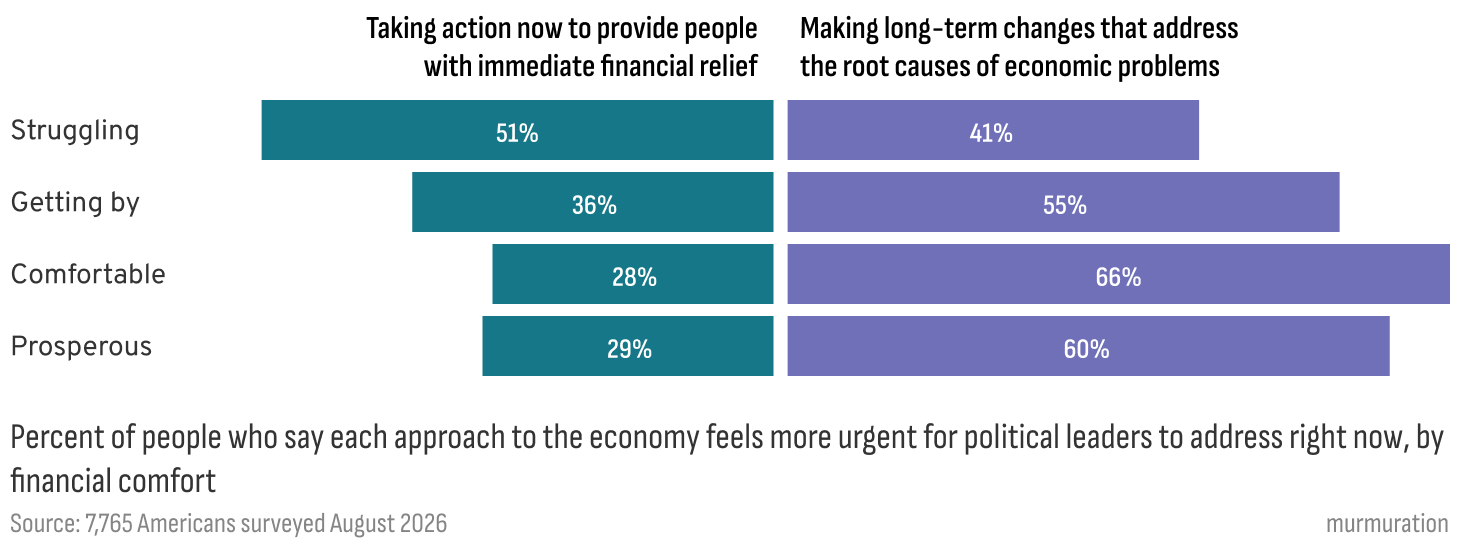
The same pattern shows up in what people want Congress to focus on. Lowering the cost of living is a top priority for 71% of struggling Americans, compared with 48% of those who are comfortable and 33% of those who describe themselves as prosperous.
Final Thoughts
There is a lot of agreement in this data. Americans are worried about affordability. Many want something to change. And most can point to something quite specific that would make their own lives easier. But “the economy” flattens those experiences into a single category.
People worried about necessities are especially focused on prices. People worried about work emphasize jobs and wages. People worried about housing are much more likely to want action on rents and affordable housing. And people focused on crime and public safety are more likely to connect economic conditions to immigration and to prioritize a very different set of issues.
Those aren’t simply different opinions about the same political issue. They are different experiences of security, constraint, and possibility. If we want to understand what people actually need, we may need to ask a different set of questions:
Are we listening closely enough to the specific problem people want solved, rather than the broad issue they say they care about?
What does it take for economic improvement to become something people can actually feel in their own lives?
When people disagree about what caused economic hardship, can the same policies ever feel like solutions to both?
The economy may be measured nationally. Financial security is lived one household at a time.
Not everyone is paying the same price.
Murmuration is a non-profit that organizes a network of partners and equips them with the insights, tools, and services needed to help communities build and activate the power to transform America into a nation where everyone thrives.
Voto Latino Foundation is a civic advocacy organization dedicated to educating and empowering the next generation of Latino voters while working to build a more inclusive and representative democracy.