


As we head into Thanksgiving, when friends and families gather—sometimes laughing, sometimes arguing, sometimes doing both at once—it’s worth remembering this where democracy really lives. It lives around the kitchen table where people talk about what actually matters to them. Not the “issue of the week,” not the latest poll, but the things that make or break daily life.
In this spirit, right before the November elections, we asked people two questions that you might expect to lead to similar answers:
When you sit down with family or friends and talk about what’s happening in your lives, what everyday concerns have come up in conversation lately?
As we head into elections this November, which issue(s) are most important to you when deciding how to vote?
They often don’t. But, the real surprise is just how similar Americans sound when they’re talking about their lives.
A Snapshot of Shared Concerns
People talk about all sorts of things in Civic Pulse and it’s often more than any one static chart could ever neatly hold. We’ve narrowed the visual below to a few key themes not because the others (politics, school, religion, environment, etc.) don’t matter, but because these four topics are the places where there’s far more partisan unity than you might expect.
One more caveat on the Sankey diagram below: the categories aren’t mutually exclusive. When someone says, “Money is really tight, so we can’t afford to go to the doctor,” that is reflected as both a money concern and a health concern. In practice, that gives us 9,187 respondents but 16,964 flow lines on the diagram. We are comfortable with that because real life doesn’t fit into a single box and neither do the worries people share.
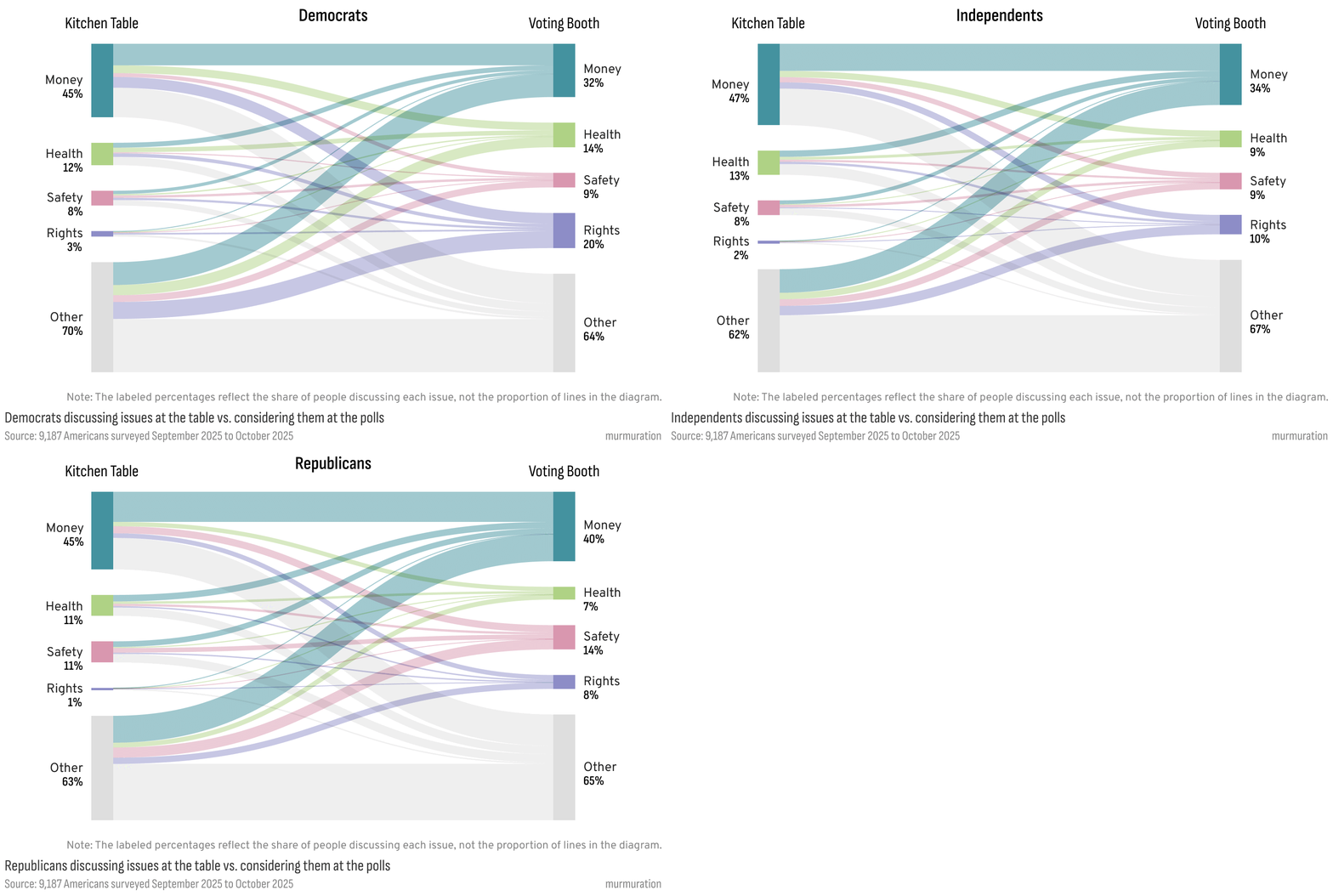
If you just watched the GIF of the Sankey shift across parties, you’ll see that many issues are shared both around the kitchen table and, often, even in the voting booth. So what actually changes when we vote?
It’s not that people stop caring about what affects them. It’s that so often the political system doesn’t give them a way to vote for those things—only to vote around them or against them. When you read the responses, everyday worry about affording a doctor’s visit gets translated into “Medicare expansion” or “abortion access.” The cost of living becomes “inflation.” A desire for safer neighborhoods becomes “gun control.” All of these are vital, of course, but they sit at a layer removed from the lived experience and are filtered through the language of national partisan conflict rather than the way people talk about their own lives.
So here’s what it looks like when we step back and separate the lived reality from the political reality, across four big domains of American life: money, health, safety, and rights.
Economics of Ordinary Life
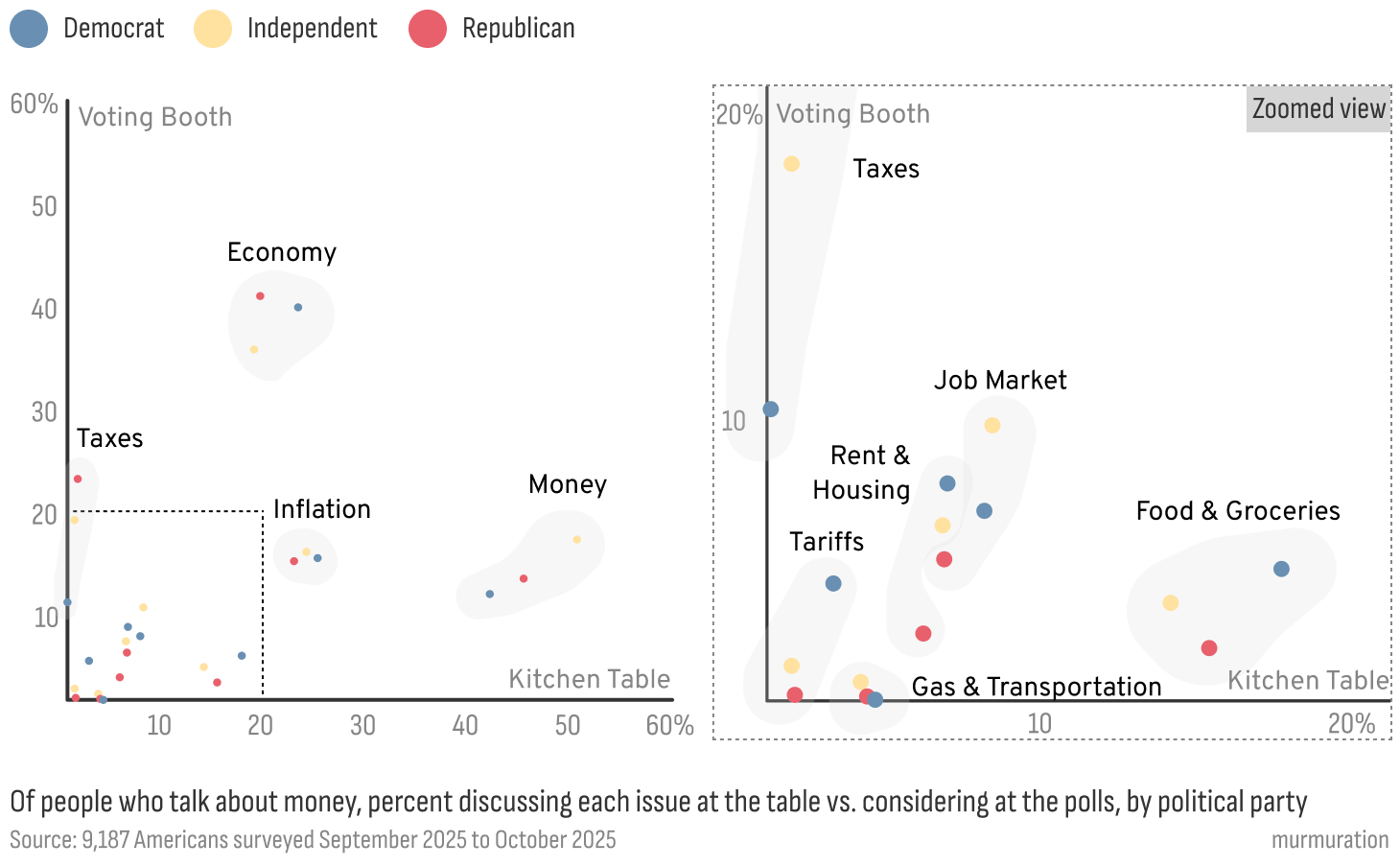
If there is one universal language in American life, it’s money. Not in the abstract, but in the painfully literal: the rent that went up again, the groceries that don’t stretch as far, the car repair you weren’t planning on, or the math you do at the pharmacy counter. Across parties, this is the kitchen table through line. Democrats, Republicans, and Independents all talk about the simple, stubborn fact that life feels more expensive than it used to be. And they talk about it in nearly identical proportions: 45% of Democrats, 45% of Republicans, and 47% of Independents.
But once people shift from talking to voting, the shared vocabulary fractures. Republicans (40%) tend to translate those same concerns into taxes and the broader economy. Democrats (32%) are more likely to frame them as cost of living or wages. Independents (34%) scatter a bit, but the common thread is this: everyone is trying to voice their financial anxiety, and the system offers party-coded translations instead of the plain-spoken worries people actually have.
Human Side of Healthcare
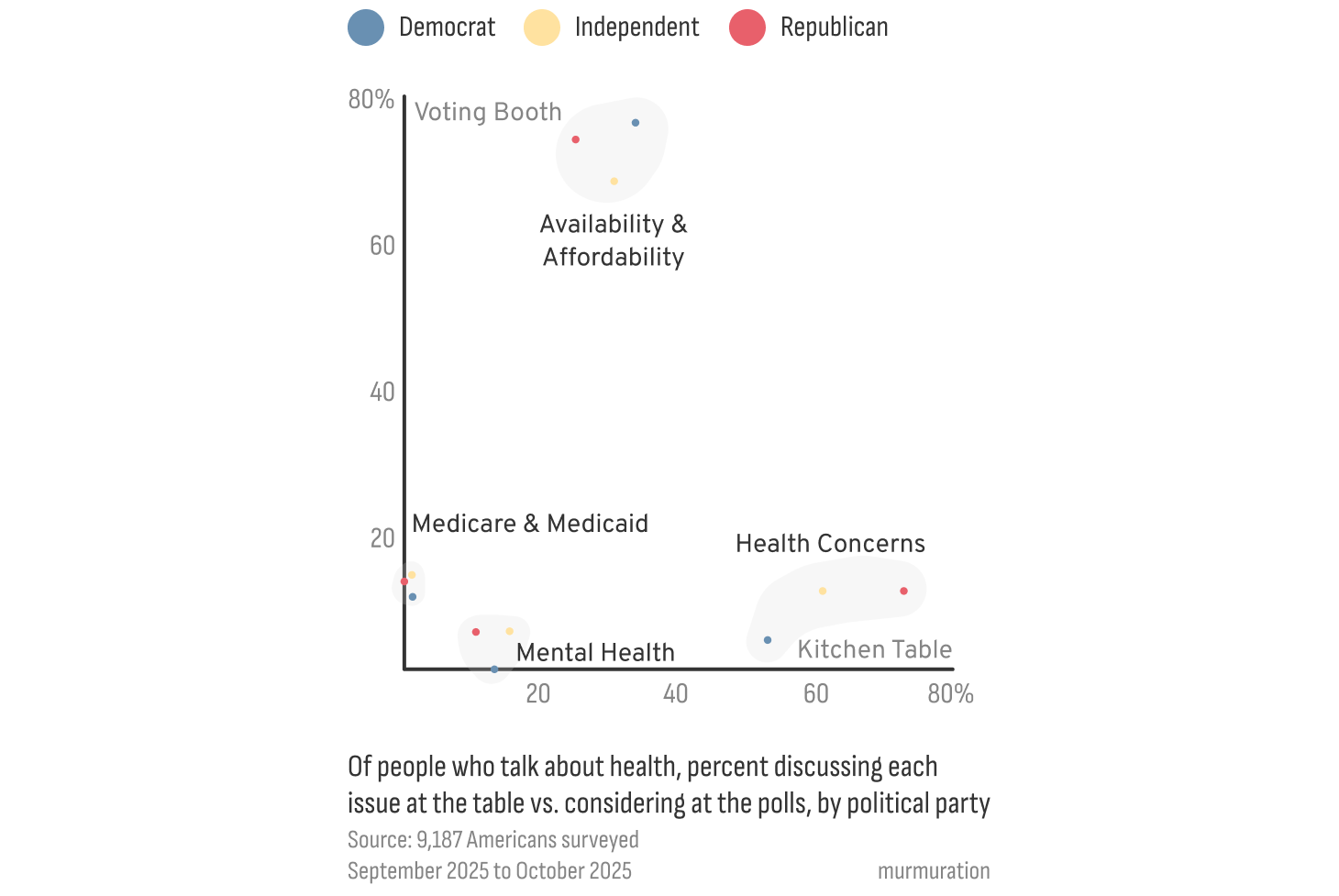
When Americans talk about their lives, “health concerns” and “healthcare affordability” show up across the board. It’s reflected by 12% of Democrats, 11% of Republicans, and 13% of Independents. They’re all navigating aging parents, insurance fights, surprise bills, chronic conditions that are getting worse, and the sense that getting care is harder (and often more expensive) than it should be.
The split comes when people try to convert those experiences into political choices. For Democrats (14%), the translation tends to become healthcare access and reproductive rights. For Republicans (7%), it leans toward insurance costs and Medicare. Independents (9%) hover somewhere between. But again, the lived worry is shared: people want to stay healthy, keep their families healthy, and be able to afford it should they need care.
Unease in Our Neighborhoods
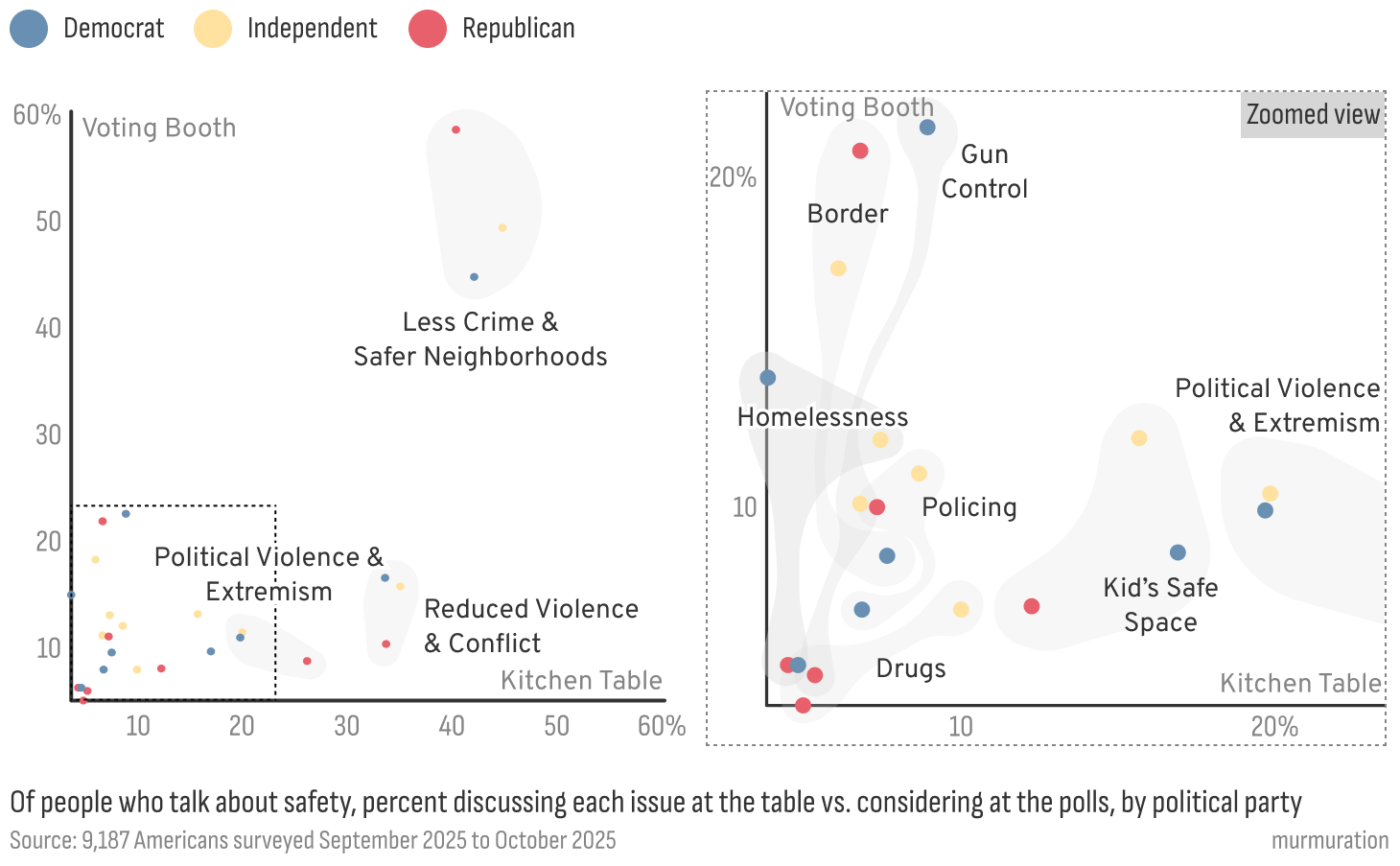
On the kitchen table side, people across parties talk about crime, neighborhood safety, drugs, and the general sense that their communities feel more unpredictable than they used to. It shows up for 8% of Democrats, 11% of Republicans, and 8% of Independents. More than that, it’s also the emotional texture that repeats: wanting the people they love to be safe when they leave the house and wanting fewer moments that make them check the locks twice.
At the ballot box, safety becomes one of the most dramatically reframed issues. Republicans (9%) tend to interpret safety as border security or policing. Democrats (9%) tend to focus on gun violence, community violence, and political extremism. Independents (14%) show bits of both. The experience is shared—walking home at night, worrying about your kid at school—but the political language splinters, pulling people into different policy universes even though the root anxiety is the same. So, if this chart feels messier than the others, it’s because views about homelessness, drugs, and policing tend to blur together in people’s minds, and the data reflects that complexity.
Tensions Around Our Rights
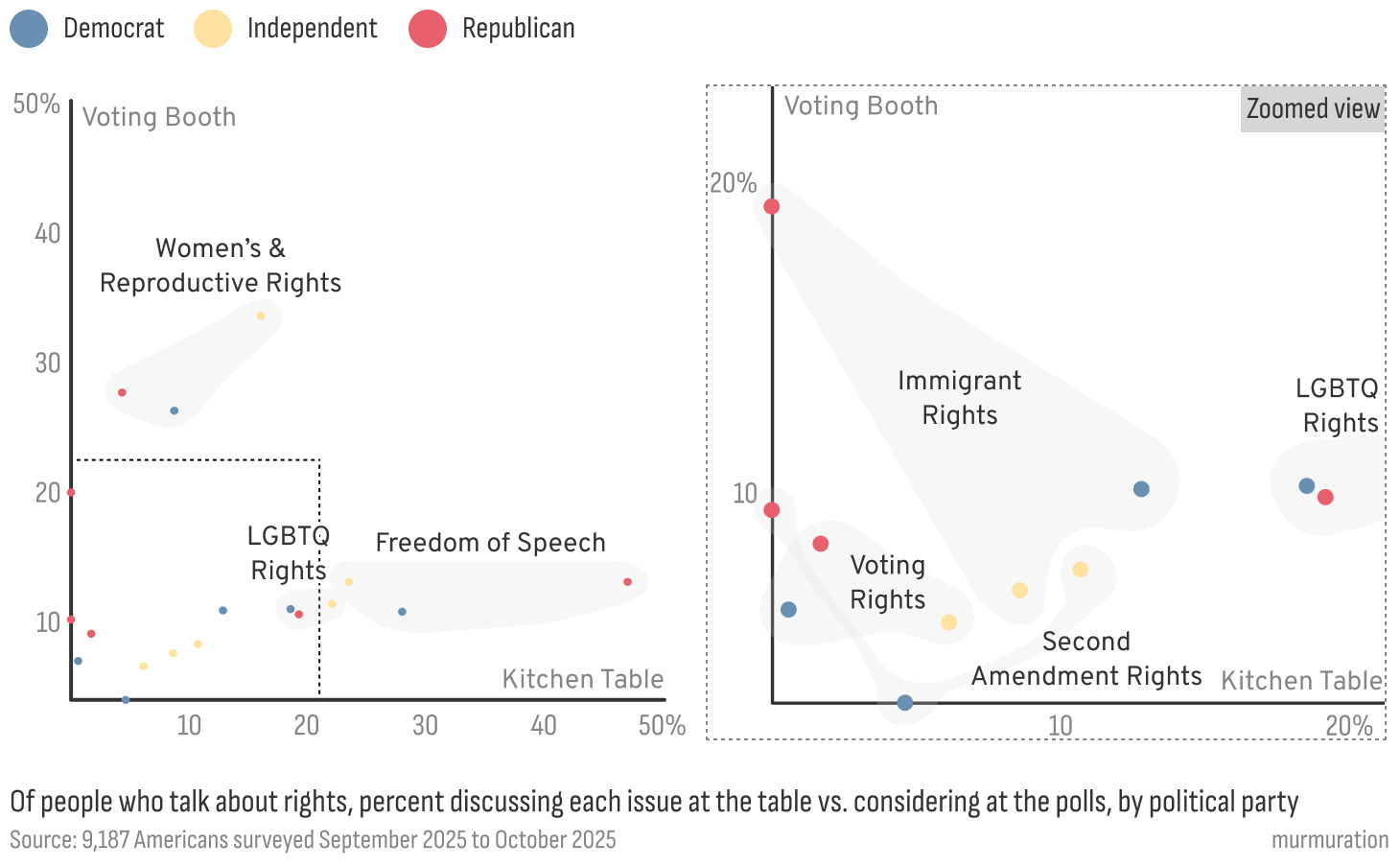
Rights are the one domain where kitchen table conversation just isn’t really happening, being mentioned by only 3% of Democrats, 1% of Republicans, and 2% of Independents. But, in those few occurrences the baseline still holds: people are talking about fairness, freedom, and who gets to live the kind of life they want without interference. We also see shifts in focus. Democrats bring up LGBTQ+ rights, reproductive rights, and immigrant rights. Republicans talk about free speech and Second Amendment rights. Independents express concerns about fairness, corruption, and personal liberties.
However, when these concerns hit the voting booth, the salience intensifies and the divergence widens. Democrats (20%) center reproductive rights and voting rights. Republicans (8%) emphasize gun rights and speech. Independents (10%) are the only group that keeps rights relatively close to how they appear at the kitchen table, but even they experience the gravitational pull of partisan framing.
Final Thoughts
One way to react to this story is where you focus on the divisions. Because yes, the political system is divided, and the vote-issue data reflects that. But underneath it, in the spaces of everyday life at the kitchen tables, the waiting rooms, the gas stations, or the late-night budgeting sessions, most people are experiencing the same pressures, anxieties, and hopes.
For now, we will leave you with this:
What if we took people’s actual lives as seriously as we take our interpretations of their vote intentions?
What would our politics look like if the kitchen table set the agenda?
And what might change if we measured our democracy not by how loudly we disagree, but by how much we quietly share?
Maybe the future of American democracy depends not on getting people to agree politically, but on helping our politics reconnect with the things Americans already agree on. We have the data now, day after day, showing that the common ground is much larger, and much quieter, than that national narrative would have you believe.
More soon, from my kitchen table to yours. Happy Thanksgiving.
Murmuration is a non-profit that strengthens community-driven change at the local level. By equipping local organizations with powerful data, technology, and insights, Murmuration helps them amplify community voices, build collective power, and drive solutions that reflect the lived realities of the people they serve. murmuration.org