


Across America’s cities, the large majority of people say they are happy with where they live, feel they belong there, and plan to stay. That’s the good news.
But for many people, something essential is missing. They don’t feel connected to other people in their community. They rarely spend leisure time with others or in places outside their work or home. And the more people feel alone, the less likely they are to participate in—and contribute to—the social, cultural, and economic life of their city.
This summer, Murmuration partnered with Chamber of Connection to survey nearly 5,000 adults across seven U.S. metro areas (Baltimore, Chicago, Nashville, Pittsburgh, San Diego, San Francisco, and Seattle) about their relationships with the places and people around them. We asked about everything from belonging and neighbors to socializing, third places, community activities, and what gets in the way of making and maintaining connections (see here).
Here’s what we learned about the state of connection in America and what it takes to build community in our lives today.
Feeling At Home
Nearly eight in ten people (79%) say they feel like they completely or mostly belong in their area. Eighty-one percent are very or moderately happy with their community and neighborhood. And 73% say they’re likely to still be living there five years from now (50% very likely and 23% somewhat likely).
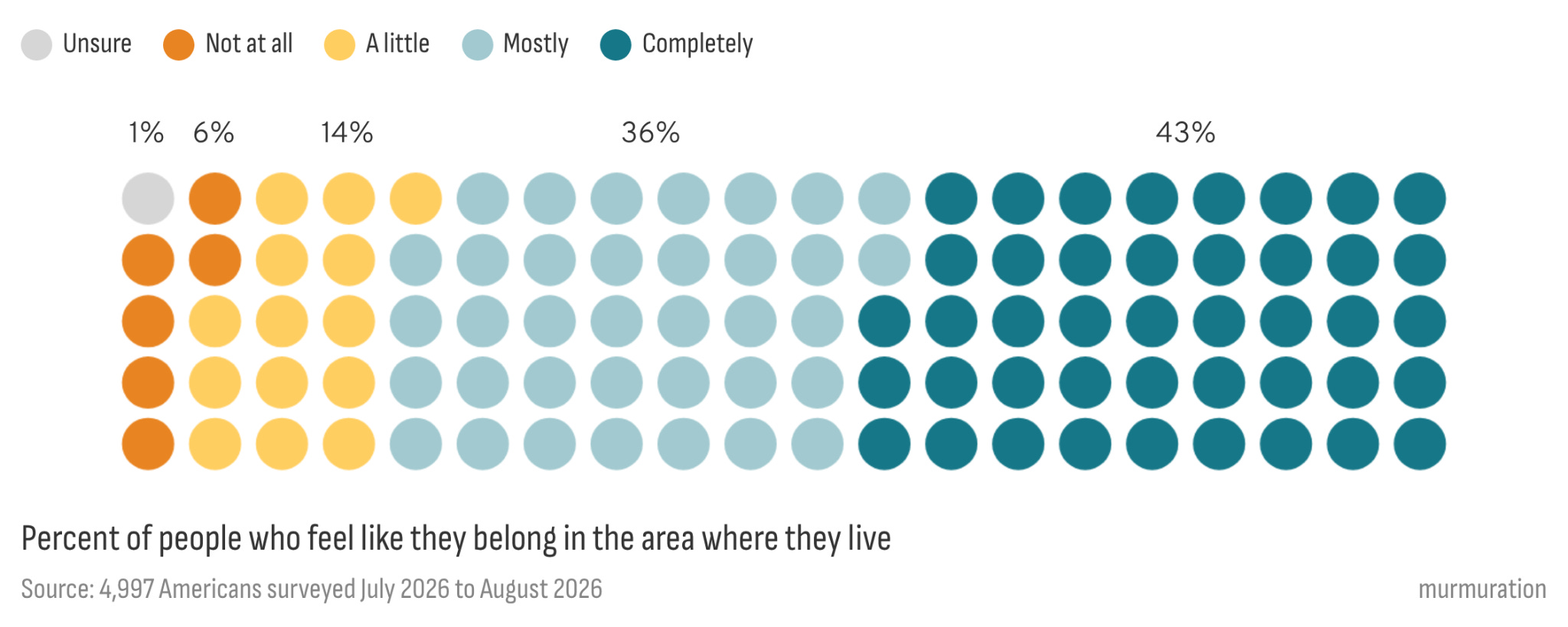
That attachment isn’t confined to the places that tend to top “best places to live” lists. In Baltimore (where I personally live and love), 74% of residents say they feel like they mostly or completely belong, and nearly three-quarters are happy with their community and neighborhood.
That sense of connection extends to the people around us, too. Two-thirds of adults say they have at least one neighbor they would feel comfortable asking for help, and 63% say they are part of a community of people who share similar values and life experiences.
But being rooted in a place is only one part of connection. Fewer than half of adults (48%) say they are part of a community of people who actually do activities together. Forty-seven percent regularly engage in community service or activities that help others. And 21% say they never or almost never spend time socially with people outside their household in a typical week.
The places and institutions that make repeated interaction possible aren’t a regular part of everyone’s lives either. Only 29% regularly spend time somewhere outside home and work where they feel a sense of belonging—a coffee shop, library, gym, religious space, community center, or somewhere similar. Twenty-eight percent say they don’t have a place like that at all. And 43% have no active membership or commitment that requires showing up somewhere in person.
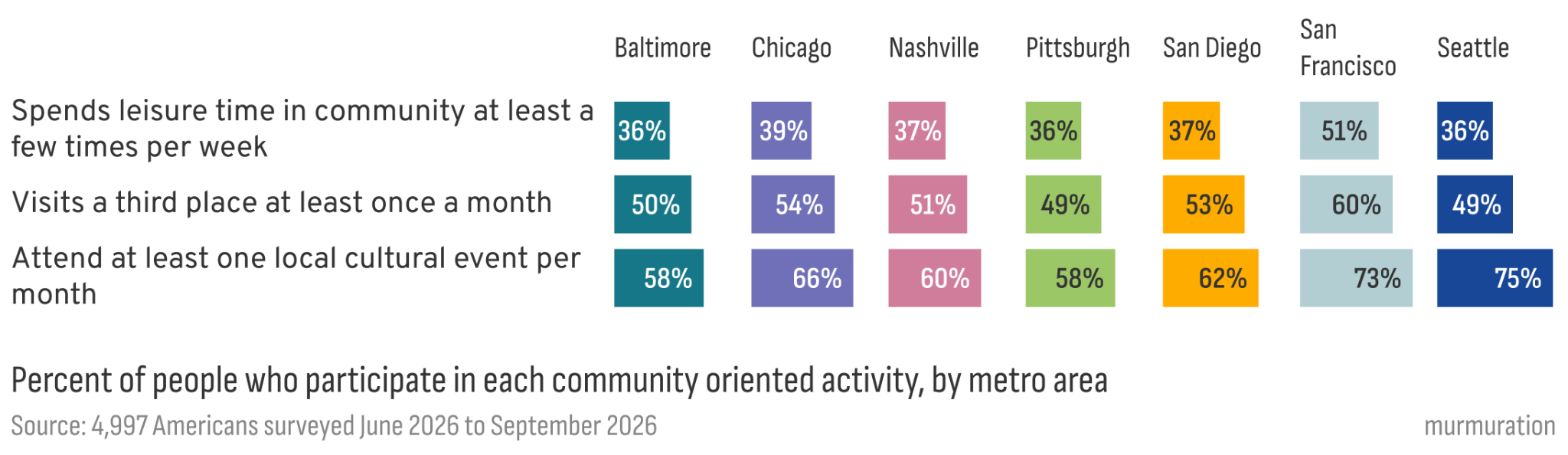
People who have relationships with their neighbors, who spend time socializing, and who have places where they feel they belong are far more likely to describe themselves as happy. But they are also more likely to engage in a range of other prosocial behaviors: donating to charitable causes, being members of community organizations, attending local cultural events, and generally taking advantage of leisure time to be outside of their home.
Making Connection Possible
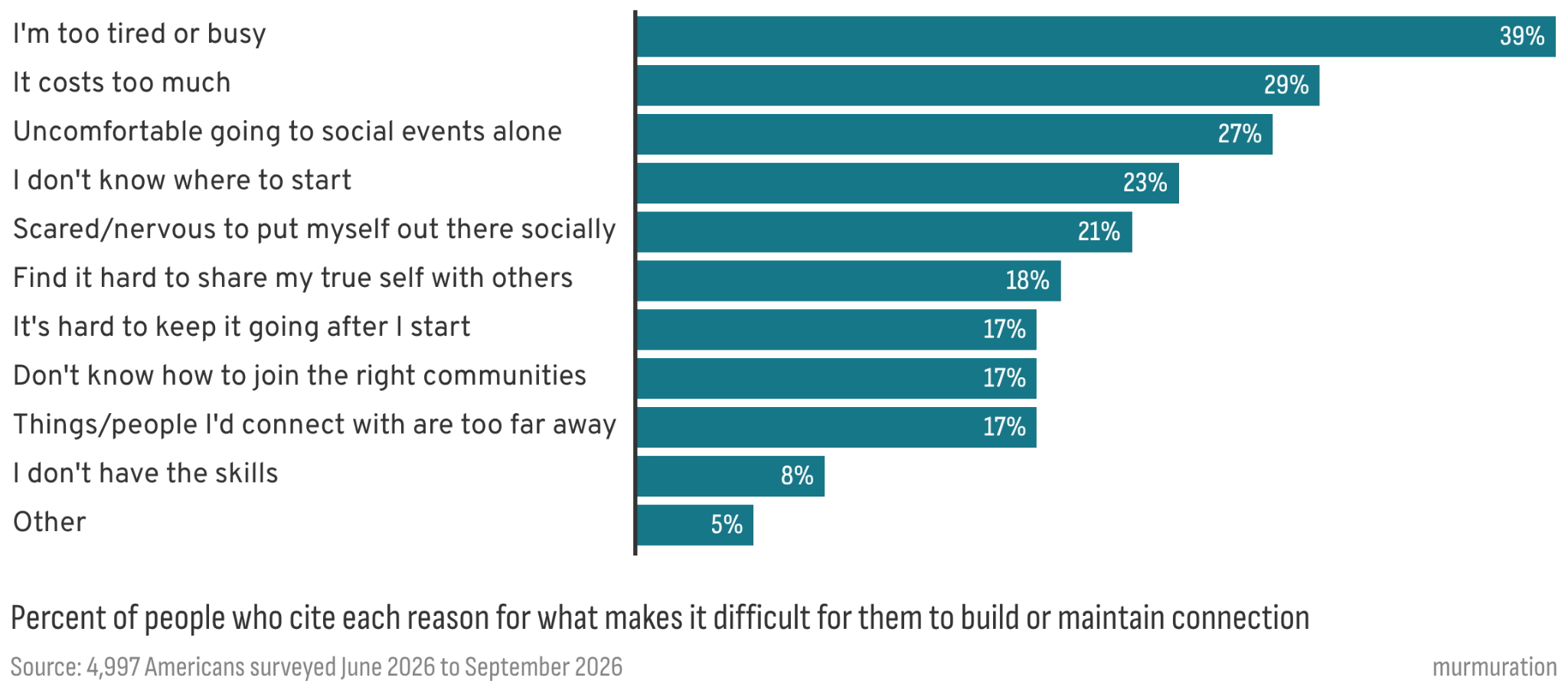
When we asked people what makes it difficult to build or maintain connections, the most common answer was remarkably ordinary: we’re tired and busy.
Thirty-nine percent say being too tired or busy gets in the way. Twenty-nine percent say it costs too much. Twenty-seven percent are uncomfortable going to social events alone. Twenty-three percent don’t know where to start, and 21% are scared or nervous to put themselves out there socially. Others say they find it hard to share their true selves, don’t know how to join the right communities, or struggle to keep connections going after they start.
Those barriers look somewhat different depending on where you live. In Seattle, cost is especially prominent: 35% say connecting costs too much, the highest of the seven cities. In San Francisco, time and energy loom largest: 45% say they’re too tired or busy, also the highest of the cities we studied.
Financial comfort also has an impact. Those struggling financially are not only most likely to say building or maintaining connections costs too much (52%), but also more likely to experience barriers to connection overall. Just 8% of those who are financially struggling say that they have run into “None of the above” barriers, compared to 16% overall and 31% of those who say they are financially prosperous.
It is easy to treat connection as something that should happen naturally if people want it enough. But much of what we think of as community requires resources. It takes time to go somewhere after work. It can take money to join something, get across town, hire a babysitter, or meet someone for dinner. It takes energy to make plans when you’re already tired. And it takes repetition to turn the people around us into people we actually know.
There is also a more hopeful side to the story. In Pittsburgh, we asked whether people who had recently sought help from their neighbors actually received it. Of the 59% who said they had asked for help, 56% said they always or almost always did, and another 34% received help some of the time. Only 10% said they didn’t get the support they needed.
Politics Keeps Us Apart
We also asked people what kinds of differences they’d be open to crossing to connect with someone else. Across the seven metros, 71% would be open to connecting with someone of a different race or ethnicity. Sixty-seven percent said nationality. Sixty-four percent said gender, and the same share said education. Sixty-two percent said income. Fifty-six percent said religious belief, and 55% said sexuality. Political ideology had the lowest percentage at 38%.
The question didn’t ask whether people would agree with someone politically, vote for the same candidates, or even become close friends. It simply asked whether they would be open to connecting.
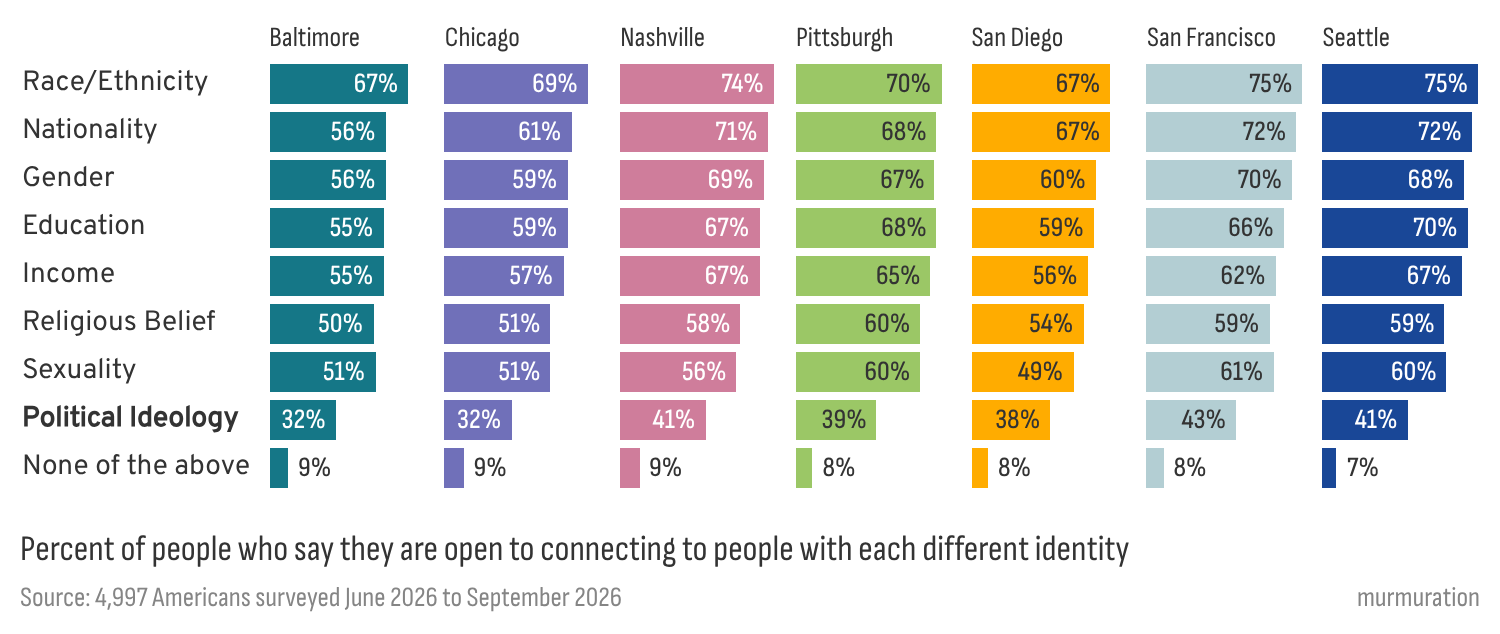
And this wasn’t being driven by one particularly polarized place. Political ideology ranked last in every city we studied. Even in Nashville, where willingness to connect across political ideology was among the highest of the seven cities at 41%, it still trailed every other type of difference we asked about.
Final Thoughts
What stands out in these findings is that the desire for connection does not seem to be the problem. People still feel attached to where they live. Most have someone nearby they could imagine asking for help. Many are open to connecting with people whose backgrounds and experiences differ from their own.
The harder part is turning that potential into something lived.
Connection needs places to happen. It needs enough time and energy to keep showing up. It often needs money, information, or simply the confidence to walk into a room alone. And it needs opportunities to encounter people we might not otherwise choose for ourselves.
That leaves us with a few questions worth asking:
How do we make it easier for people to participate in community life when time, money, and energy are already stretched?
What kinds of places and institutions create repeated, low-stakes opportunities to know the people around us?
And how do we preserve spaces where people can build relationships across political differences?
Communities thrive in part because of the people we come to know there. And if there is something hopeful in these findings, it’s how many of those relationships still seem possible—with the neighbor we haven’t asked for help, the familiar face we haven’t introduced ourselves to, or the person we haven’t yet thought to know.
Murmuration is a non-profit that organizes a network of partners and equips them with the insights, tools, and services needed to help communities build and activate the power to transform America into a nation where everyone thrives.
US Chamber of Connection is a civic institution dedicated to building and sustaining the core infrastructure needed to address the greatest issue facing society today—our lack of connection. They mobilize and equip cross-sector leaders to unite in collective ownership and action to create connection and trust in their community