


Picture turning on the news and hearing there’s a thunderstorm warning, only to step outside and find blue skies. That’s how crime coverage feels in many American cities. National outlets forecast danger in places like Washington, D.C., Los Angeles, and Chicago (all larger metro areas where there has been a push to send in the National Guard).
But if you ask people who actually live in those cities? The story changes.
I live in Baltimore. Recent political rhetoric has used the word “hellhole” to describe it. National coverage makes it sound like chaos. But on my downtown block, the neighbors wave, kids ride scooters, music pours out from local bars, the farmers market brings crowds out on the weekends, and life feels—dare I say—safe. But it isn’t just a feeling, it’s reality supported by data that shows many measures of crime have declined.
And it isn’t just me. Across cities in Civic Pulse, the data shows the gap between local and national perceptions on crime and safety.
The National vs. Local Split
When Americans talk about crime at the national level, the mood is almost entirely grim. Eighty-seven percent of mentions are negative. Crime, in this context, becomes shorthand for political disillusion and discontent.
But when people describe their own neighborhoods, the picture shifts. Nearly half of the time, safety comes up in a positive way, as something that feels steady, ordinary, even good. This echoes a familiar pattern in American opinion: people often think things are worse for the country than they are close to home.
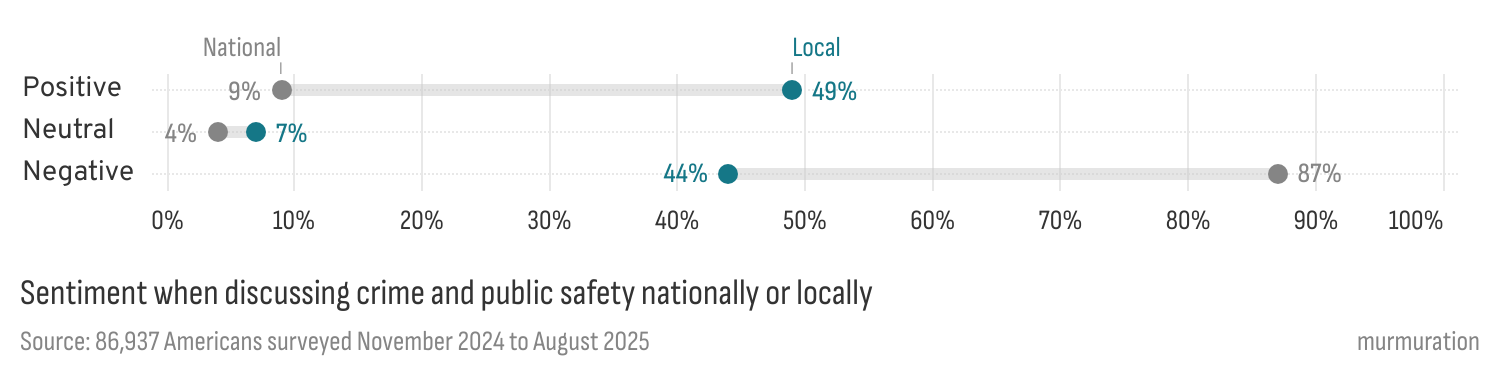
Locally, people define safety differently. It’s about whether you can walk your dog at night, whether your kids can bike to school, whether your neighbor checks in when you’re sick. And those everyday measures of safety often skew positive.
Here is an example of what that sounds like in people’s own words:
“The community comes together to make our neighborhood safer, aesthetically appealing and our town to have many ways of supporting local businesses.” – 53, Female, Republican, Sherburne, MN
These voices do not match the national headlines. They describe something quieter: safe streets, active neighbors, clean spaces, communities that work. And while they do not erase the very real challenges some places face, they remind us that the lived experience of safety often looks far less dire than the national story.
So, perhaps, it’s not surprising then that when people talk about their communities, crime does not top the list. In May, we reported that the most common theme about communities was relationships with neighbors, which came up 27% of the time. Economic and housing challenges followed at 20%. General quality of life was next at 18%. Crime and safety, by comparison, were mentioned only 11% of the time.
Cities Under the Microscope
For many of the biggest metro areas, net positive sentiment about safety is actually higher than the national average. We define net positive sentiment as the delta between the share of people speaking positively about safety and those speaking negatively. In other words, in some of the cities most often portrayed as unsafe, more residents tilt toward saying they feel good about where they live.
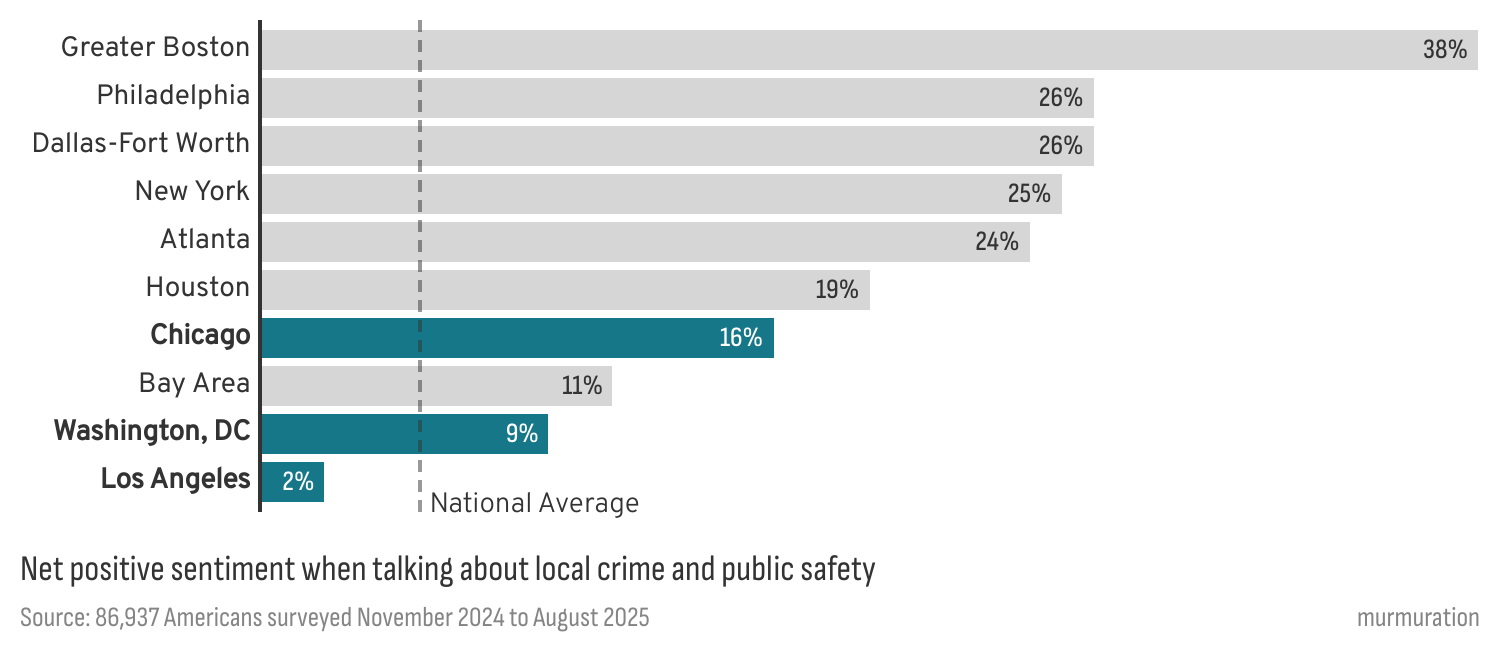
To see how this gap plays out more clearly, it helps to zoom in on a few cities that have recently been a part of the national conversation about crime.
In Los Angeles, people describe neighborhoods that feel secure:
“I live in a nice area with low crime, clean streets, and an overall sense of safety and security.” – 52, Female, Independent, Los Angeles, CA
In Washington, DC, people feel safe and connected:
“We live in a multi-cultural neighborhood where everyone seems to be friendly and active about the safety of our community.” – 62, Male, Democrat, District of Columbia, DC
And in Chicago, residents tell a similar story:
“There is not much crime or violence in my area and a lot of people feel very safe and in good hands knowing that the neighborhood is really quiet.” – 27, Male, Democrat, Cook County, IL
These voices do not erase the very real challenges in each city, but they complicate the dominant narrative. Nationally, these metros have been portrayed as symbols of crisis. Locally, people often talk about them as safe, supportive, and livable.
Steadier Than the Story
When we track mentions of crime and safety over time, the story is not one of crisis spikes but of relative calm. Again, in Los Angeles, DC, Chicago, and Baltimore, people bring up safety at a fairly consistent clip. There are small bumps around specific event—a protest, a viral news story—but nothing resembling a sustained surge.
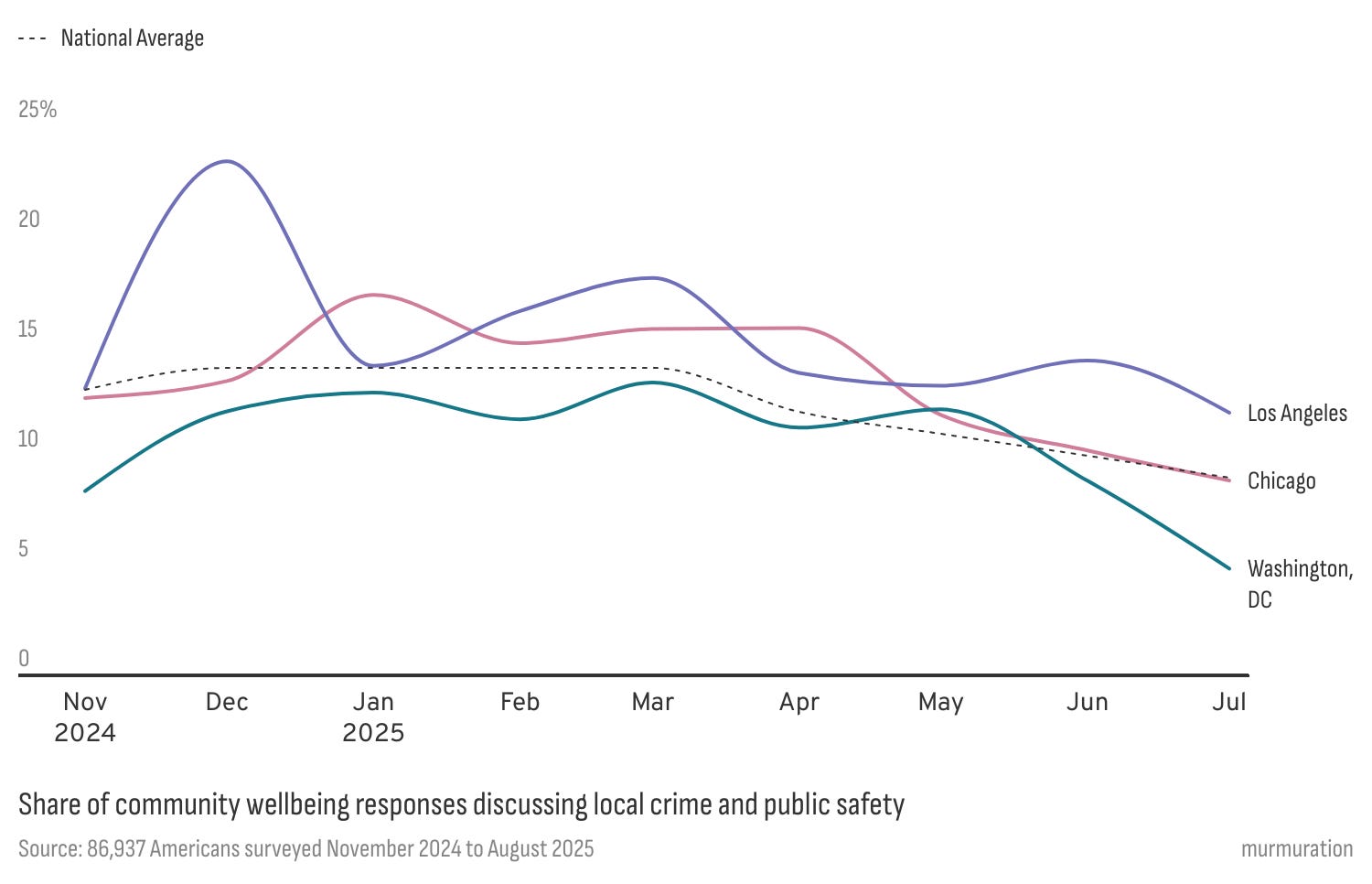
In other words, these places are kind of just steady. They are not seeing crime and safety dominate the conversation month after month. Instead, talk about public safety rises and falls minimally, sitting alongside other local concerns. That’s important. Because while national rhetoric frames these cities as if they are in freefall, the people living there aren’t constantly raising alarms.
Final Thoughts
This doesn’t mean communities are free of problems. And right now, in Memphis, that tension is on full display. In Memphis, we see a higher incidence of people speaking negatively about crime and public safety. But even there, the story isn’t simple because it’s tangled up in larger questions about constitutionality, effectiveness, and the actual resources communities need to feel safe.
But the conversation about crime has been co-opted by a narrative of collapse that doesn’t reflect how many people actually live. If our politics are built on that skewed perception, we risk pouring resources into fighting the wrong battles and missing the resilience, stability, and strength already present in local life.
And so we find ourselves wondering:
What happens when national narratives overshadow local realities?
Could amplifying everyday experiences of safety build more trust and shift policy?
If people in “unsafe” cities feel okay on their blocks, what does that say about how we measure risk in the first place?
When crime does need attention, can we take a coordinated approach that balances enforcement with prevention, outreach, and community care?
So maybe the real question isn’t: Are cities safe or unsafe? It’s: Whose reality are we listening to… the headlines, or the people who live there?
The Wire premiered 23 years ago. Maybe it’s time to visit Baltimore.
Murmuration is a non-profit that strengthens community-driven change at the local level. By equipping local organizations with powerful data, technology, and insights, Murmuration helps them amplify community voices, build collective power, and drive solutions that reflect the lived realities of the people they serve. murmuration.org