


Political labels are supposed to tell us something.
Identify someone as a Democrat or Republican, liberal or conservative, and we assume we’ve learned something about what they believe. Often, people go further: they might use those few words to make guesses about their values, priorities, and even the kind of person they are.
But what happens when people stop believing those labels are particularly informative?
Murmuration data suggest that may already be happening, especially among younger Americans. The story isn’t simply that younger people are choosing different political identities, or combining several of them. It’s that they appear increasingly skeptical that a political identity can tell you very much about a person in the first place.
Labels Aren’t Enough
The strongest finding in the survey is not that younger Americans are rejecting politics. It is that they appear to be rejecting the idea that a political label can fully describe a person. Adults ages 18 to 34 are the generation most likely to say political and ideological labels “can be useful, but often oversimplify people.” Thirty-five percent hold that view, compared with 30% of adults ages 35 to 49 and just 21% of adults ages 50 to 64. Another 16% of young adults believe political labels are generally useful ways of understanding people.
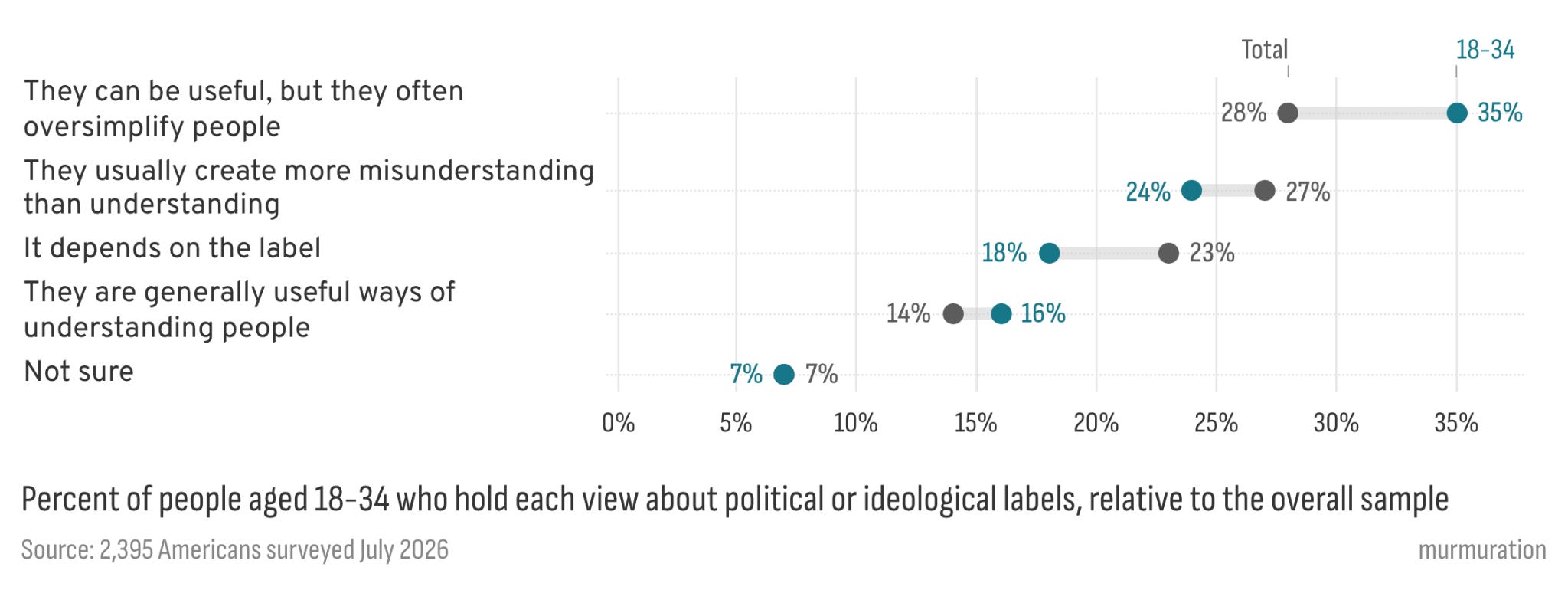
That skepticism runs deeper than simply questioning whether labels are helpful. Nearly four in ten young adults (39%) say most people are more complicated than any political label can capture. Just 16% believe people generally fit well into the labels they choose. Another 18% say people often use labels that do not actually reflect what they believe, while 22% say it depends on the individual.
In other words, younger Americans are not rejecting political labels outright. They see them as incomplete: a label may tell you something about a person, but not nearly enough to understand what that person actually believes. Among adults ages 18 to 34, 56% say someone’s actions and behavior are the best guide to their beliefs, and another 23% would rather hear the person explain their views in their own words. Just 9% say the political labels people choose for themselves are the most useful signal.
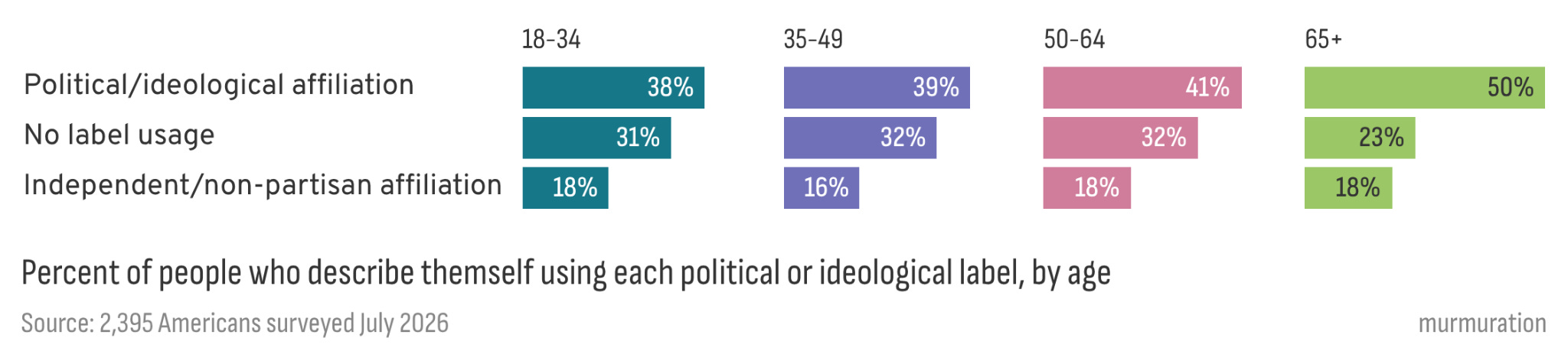
Moreover, among adults ages 18 to 34, just 38% use a political party or ideological affiliation to describe themselves, compared with 50% of adults 65 and older. Nearly a third of young adults (31%) use no label at all, while another 22% use some other type of label (value-based, behavior, etc.) and 18% describe themselves as “independent” or “non-partisan.”
Emotional Power of Labels
If the first finding is that younger Americans see political labels as incomplete, the second is that many of those labels simply provoke less emotion than they once did. For decades, political identities have become increasingly tribal. Among younger Americans, that emotional charge appears to be weakening for many ideological terms.
Only 13% of adults ages 18 to 34 feel very negatively toward the label liberal, compared with 26% of adults ages 65 and older. Likewise, only 6% of young adults feel very negatively toward progressive, compared with 15% of seniors.
The differences become even more striking around labels that have historically generated some of the strongest reactions in American politics. Just 12% of young adults feel very negatively toward socialist, while that number rises to 38% among adults 65 and older. For Democratic Socialist, only 15% of young adults express very negative feelings, compared with 34% of seniors.
These are substantial generational differences, but they should not be interpreted as overwhelming enthusiasm. Young Americans are not rushing to embrace these identities. In fact, the most common response to many political labels is simply neutrality. Large shares of young adults neither strongly identify with nor strongly reject terms like moderate, libertarian, centrist, and capitalist. Across the population as a whole, even the most positively viewed labels inspire more neutrality than excitement. Independent receives the broadest positive ratings nationally, while moderate is viewed favorably by many but passionately by very few.
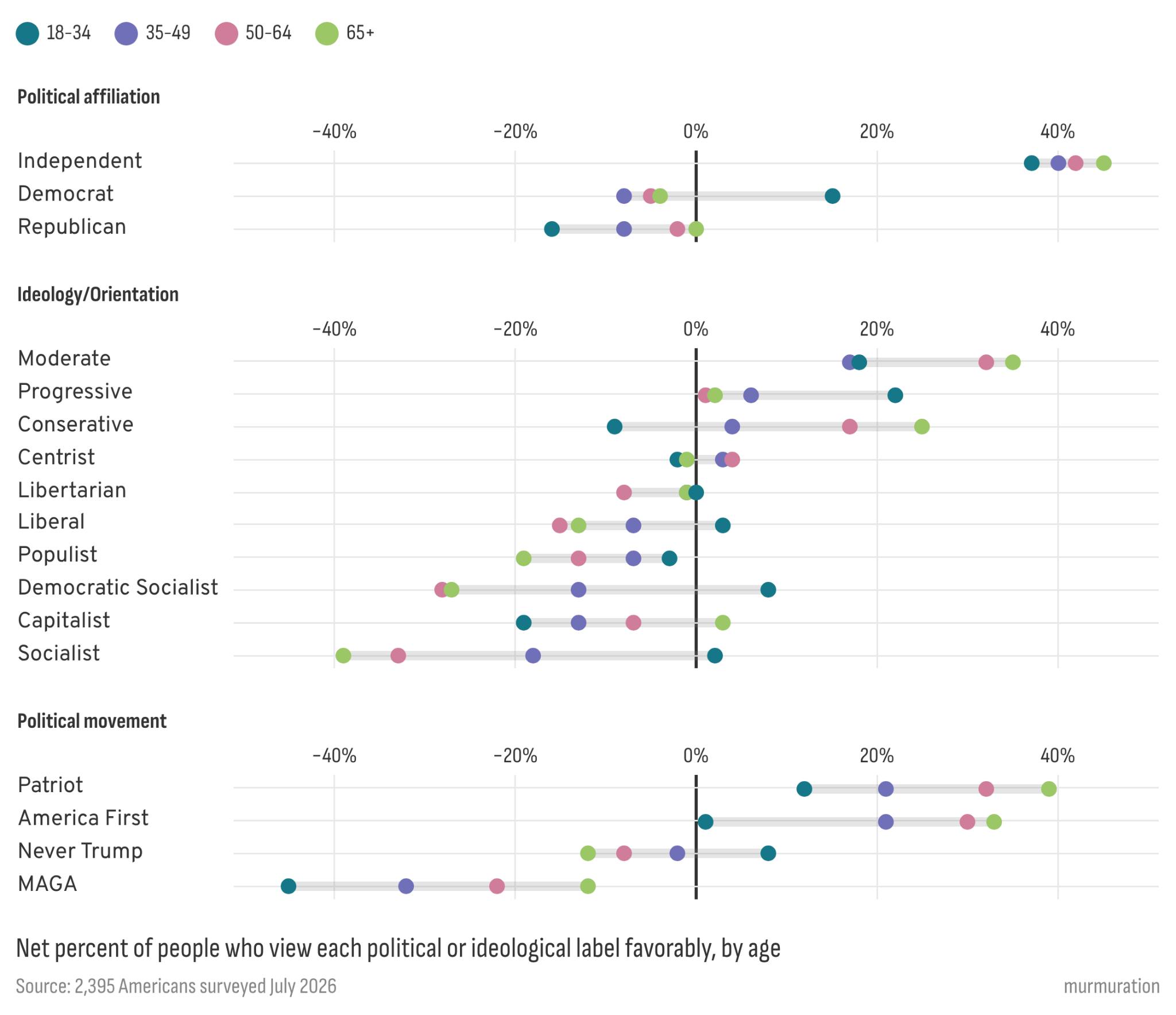
There are important exceptions. Young adults remain strongly negative toward MAGA, with 45% reporting very negative feelings toward the label, higher than among adults 65 and older. Likewise, they are substantially less favorable toward Republican and conservative than older generations.
This is not evidence that younger Americans have moved beyond polarization altogether. Instead, it suggests something more nuanced. The traditional ideological vocabulary of American politics may be losing some of its emotional intensity, even as movement-based identities remain highly polarizing. Labels associated with broad political philosophies, such as liberal, progressive, or socialist, elicit less hostility among younger adults than they do among older Americans. Labels attached to contemporary political movements continue to divide sharply.
Final Thoughts
Younger Americans are not telling us that political identity no longer matters. They are telling us that identity is more layered than the categories they have inherited. They are more likely to see labels as incomplete, less likely to assign them intense emotional weight, and more likely to believe that understanding someone requires looking beyond the words they use to describe themselves. In a political culture that increasingly asks us to sort one another into camps before we’ve had a conversation, that shift may prove more consequential than any change in ideology.
It also raises a number of questions that extend well beyond this survey:
If younger Americans are becoming less attached to traditional political labels, what will replace them as the primary way people organize their political identities?
Can our political parties, campaigns, and media adapt to a generation that appears less interested in fitting neatly into the categories those institutions were built around?
And if Americans increasingly believe that actions reveal more than labels, how might our politics change if we spent less time asking what people call themselves and more time asking what they actually care about?
Perhaps the future of American politics is not one without labels, but one where labels return to being what they were always meant to be: a starting point for understanding rather than the conclusion. Because if people are more complicated than the words we use to describe them, our politics should make room for that complexity too.
Understanding begins where labeling ends.
This research was supported by the Walton Family Foundation, which has funded Murmuration’s Gen Z research efforts since 2021. Learn more about our ongoing research partnership and findings on the youngest generation of voters here.
Murmuration is a non-profit that organizes a network of partners and equips them with the insights, tools, and services needed to help communities build and activate the power to transform America into a nation where everyone thrives. murmuration.org