


“Corruption” is everywhere right now.
It shows up in arguments about redistricting and campaign finance. In debates over lobbying, insider trading, and political donations. In reaction to local decisions—zoning changes, school board fights, contracts awarded behind closed doors. It’s used to describe everything from clear ethical violations to outcomes people simply don’t agree with.
The word carries weight. But it’s also doing a lot of work. Because when people think everything can be deemed corruption, it raises a more basic question: what do people actually mean when they use the word?
What emerges is a clearer picture of how people are interpreting power and fairness—what feels compromised, what feels functional, and how they’re deciding whether the system is working at all.
Seeing Corruption
Corruption shows up in headlines and political debates, but it also takes shape through the specific examples people carry with them—the stories they hear, the patterns they notice, the moments that confirm a broader suspicion about how the government works.
When we asked what people had seen or heard recently that made them think, “this is what government corruption looks like,” the responses were varied but often concrete: abuse of political power (11%), foreign wars (10%), or simply “everything” feeling corrupt (8%), alongside concerns about economic issues like inflation (7%), welfare fraud (6%), the Epstein files (6%), partisan blame toward Democrats (5%), abuse of enforcement power (5%), and election or voting issues (2%) or media retaliation (2%). A significant share explicitly mention Trump (26%).
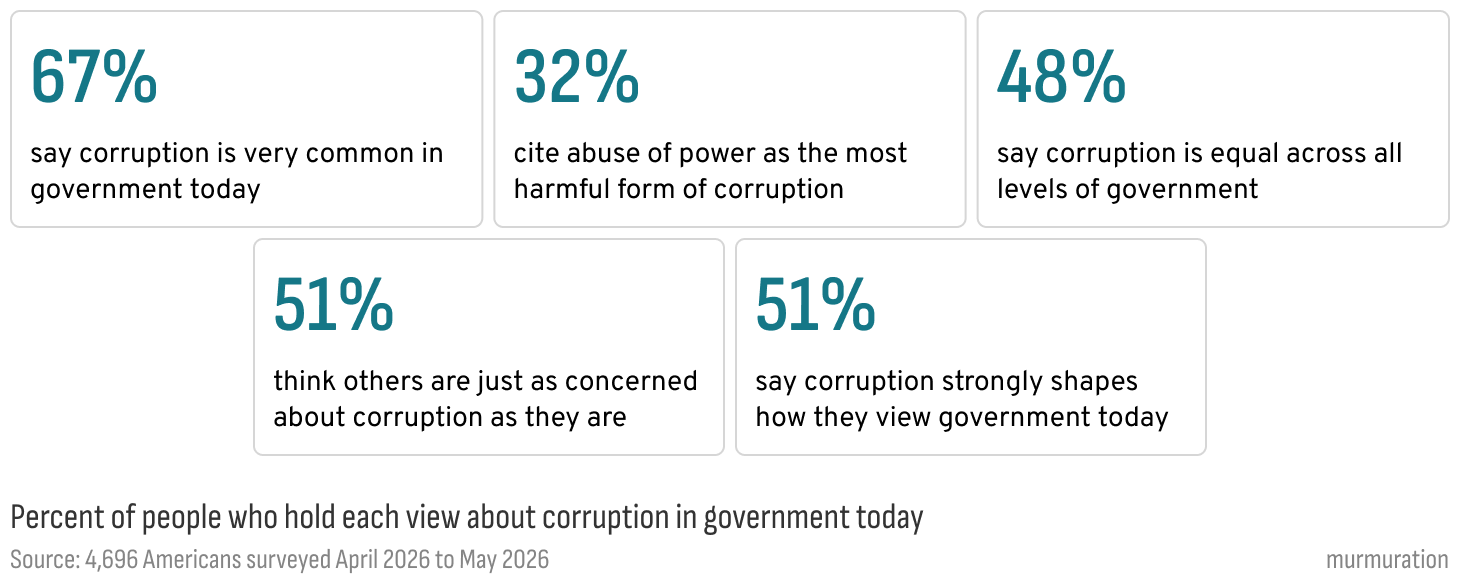
These perceptions are widespread. A majority of people say corruption is very common (67%), with more describing it as somewhat common (27%). But views differ on where it shows up most. Some point to national politics (35%), where stakes and visibility are highest, while others see it as distributed across all levels of government (48%), though few believe it concentrates at the local government (only 3%).
What stands out is how people define the harm. It’s not just about illegal behavior, but about a sense that the system is not working as intended—whether that’s abuse of power (32%), leaders putting their own interests ahead of the public (28%), misuse of funds (15%), or influence from donors (11%). And when asked who is most likely to be involved, responsibility doesn’t fall in just one place. People point to elected officials (28%), political parties (22%), wealthy actors (17%), and corporations (9%)—suggesting that corruption is understood as something systemic, not isolated.
For many, concern about corruption isn’t abstract. A majority (51%) say it strongly influences their views today (another 34% say it has some influence), reinforcing skepticism and shaping expectations about what is possible. This concern also feels widely shared: 51% believe others are just as concerned about government corruption as they are.
When Government Works
At the same time, people aren’t only noticing what’s broken. Alongside concerns about corruption in government are moments—albeit less frequent—where the government appears to function as it should.
When we asked what people had seen or experienced that made them think government can work, many struggled to point to anything concrete: 43% said they had no example, with another 6% unsure.
Among those who did, the examples were often practical or situational—hypothetical reforms or ideas about how government could work (10%), local community efforts (9%), or positive views of the current administration (8%). Others pointed to accountability and transparency (7%), effective government services and responses (6%), or past administrations (5%).
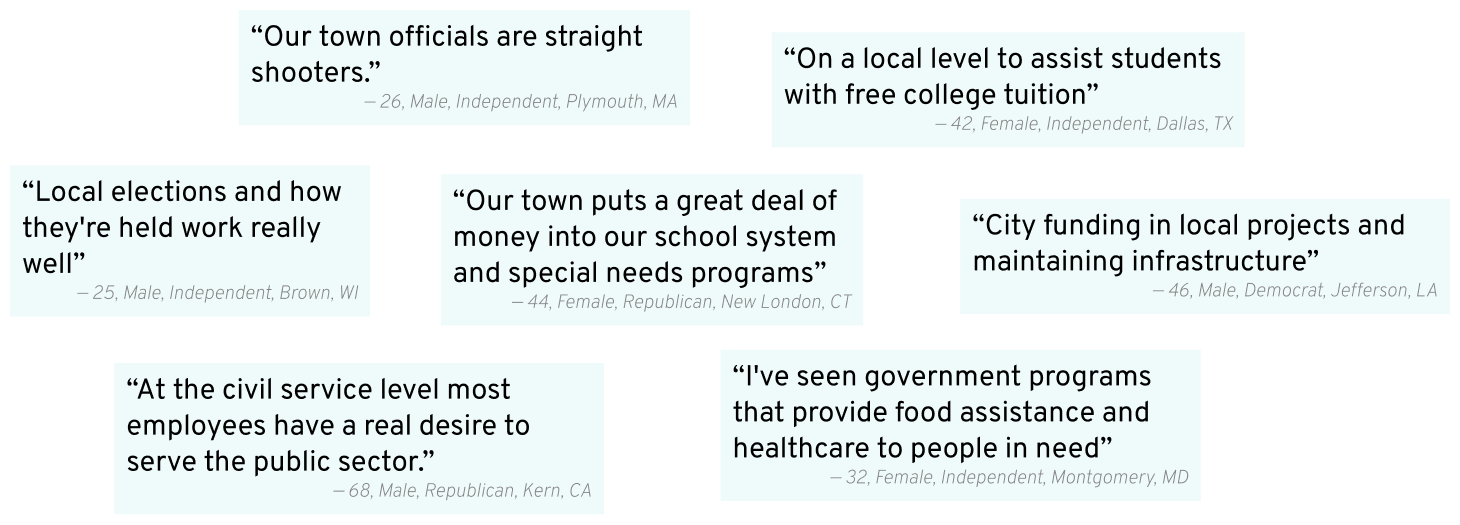
But these moments are less consistently visible. While some people say they notice examples of government working regularly (7% say daily and 12% say weekly), many describe them as occasional (29% monthly) or rare (52%). That imbalance matters because what people see most often tends to shape what they believe is typical.
When we asked the most important signal that the government is working well, the answers were distributed: responsiveness to the public (24%), accountability (20%), adherence to rules (18%), transparency (17%), and fairness (13%). These aren’t abstract ideals—they’re observable behaviors people use to evaluate whether institutions are functioning as they should.
Final Thoughts
What emerges is not just distrust, but imbalance. People are more consistently exposed to signals of what’s going wrong than to signals of what’s working—even if both are present.
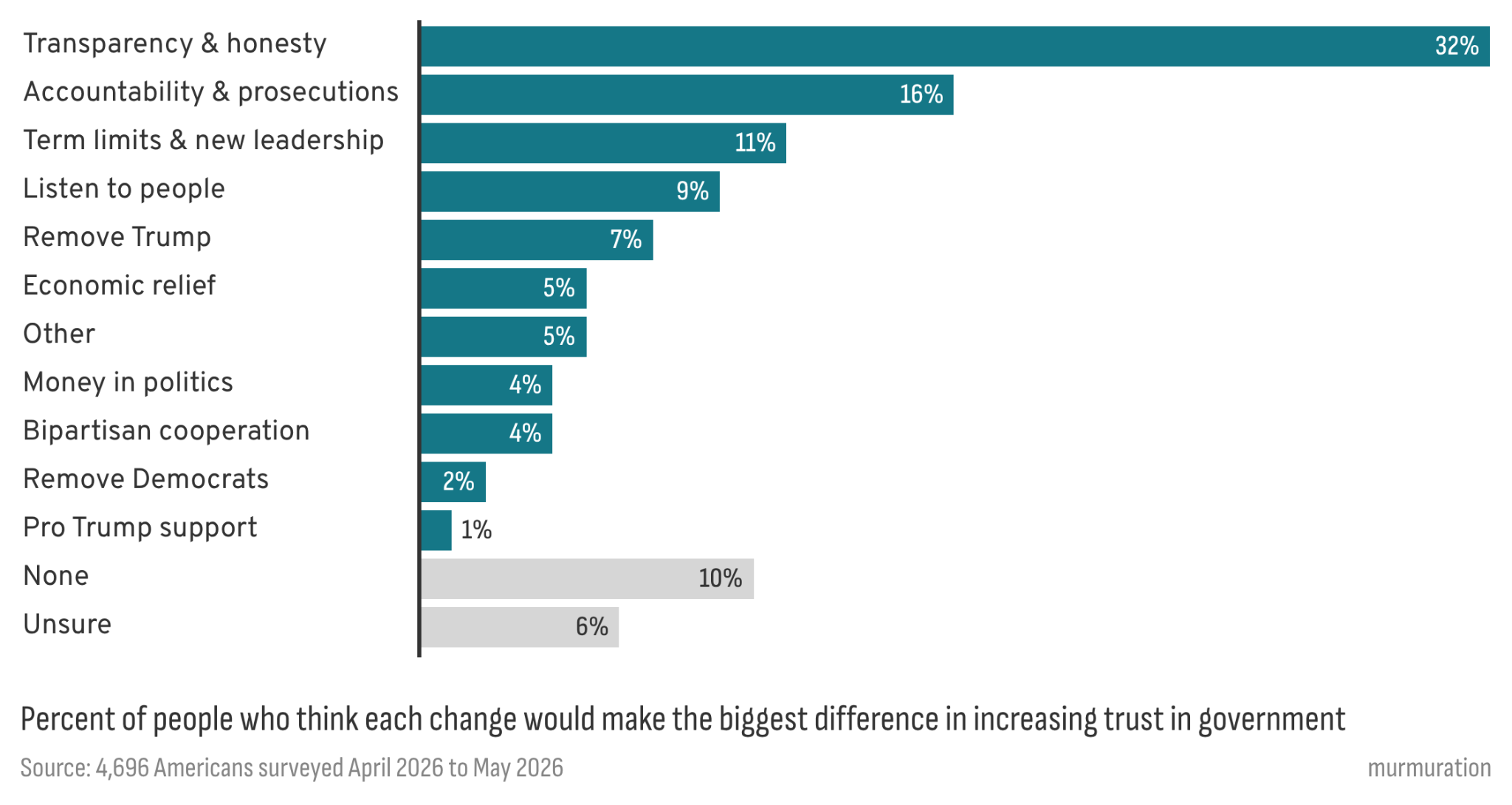
When we asked what would make the biggest difference in increasing trust, the answers again focused on conditions: clearer communication, stronger accountability, and visible consequences for wrongdoing. In other words, trust isn’t just about outcomes—it’s about whether people can see how decisions are made and believe the system is operating fairly.
So we’re left with a set of questions that go beyond identifying problems:
What would it take for examples of government working to be as visible as examples of failure?
How do you build trust in a system people believe is vulnerable to misuse?
And what signals—consistently delivered—would actually change how people see the government over time?
There’s also a deeper civic implication in these findings. Trust in government shapes whether people believe participation actually matters. When institutions are seen as corrupt or unaccountable, civic engagement can start to feel less meaningful and less capable of creating change. For some people, that distrust fuels activism or protest. But for others, it leads to something else: disengagement, cynicism, or the sense that individual action won’t make a difference. In that sense, visibility matters not only for trust, but for democracy itself. People need to believe institutions can respond, improve, and remain accountable for participation to feel worthwhile.
Proof over promises.
Murmuration is a non-profit that organizes a network of partners and equips them with the insights, tools, and services needed to help communities build and activate the power to transform America into a nation where everyone thrives. murmuration.org