


Every year, we are given the opportunity to make choices about the people who will represent us and the direction our communities will take. In between elections, there are many ways to participate in civic life, but voting remains one of the few moments when nearly every eligible American is invited to exercise the same formal power.
This year, that opportunity extends well beyond a handful of high-profile races. Voters across the country will help determine control of Congress, elect governors and state legislators, choose attorneys general, judges, mayors, school board members, and local officials whose decisions shape daily life in tangible ways.
At a moment when Americans are questioning many of the institutions around them, we wanted to understand how they think about one of democracy’s most fundamental acts: voting. How many people believe their vote matters? More importantly, what helps people feel that their actions—including voting—can make a difference?
What Shapes Our Belief in Voting?
Nearly four in ten Americans (37%) believe their vote makes either a great deal or a lot of difference. Another 42% say it matters some. An uncomfortably high 18% say their vote makes no difference at all, while 3% are unsure.
So what distinguishes Americans who believe their vote matters from those who don’t?
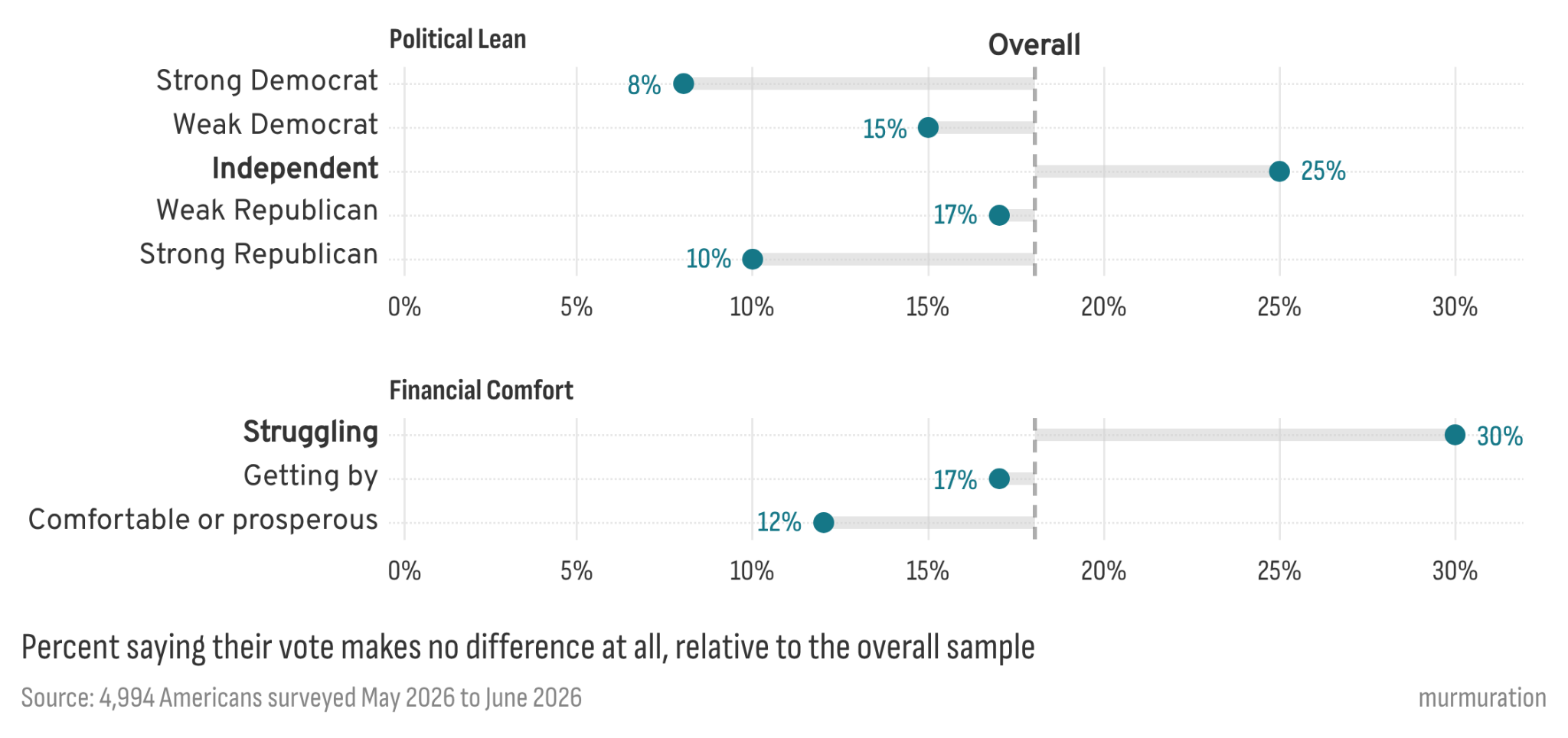
The first factor is political identity. Strong Democrats and strong Republicans look remarkably alike. Only 8% of strong Democrats and 10% of strong Republicans say their vote makes no difference. Weak partisans fall somewhere in the middle, while Independents stand apart. One in four Independents (25%) say their vote makes no difference at all, more than double the rate among strong partisans.
The second factor is financial comfort. Over the past several months, we’ve written repeatedly about how financial comfort shapes Americans’ daily lives, explaining differences in stress, hope, belonging, trust, and life satisfaction. It emerges here as well.
Among Americans who describe themselves as financially prosperous or comfortable, only 12% say their vote makes no difference. Among those who are financially struggling, that figure more than doubles to 30%. Financial circumstances don’t just shape how people experience everyday life. They also appear to shape whether people believe they can influence the world around them.
These two patterns don’t exist independently. Among strong Democrats and strong Republicans, financial hardship changes relatively little. Whether they are financially comfortable or struggling, most continue to believe their vote has value. Among strong Democrats, the share saying their vote makes no difference rises from just 5% among the financially comfortable to 15% among those who are struggling. Among strong Republicans, it increases from 9% to 15%.
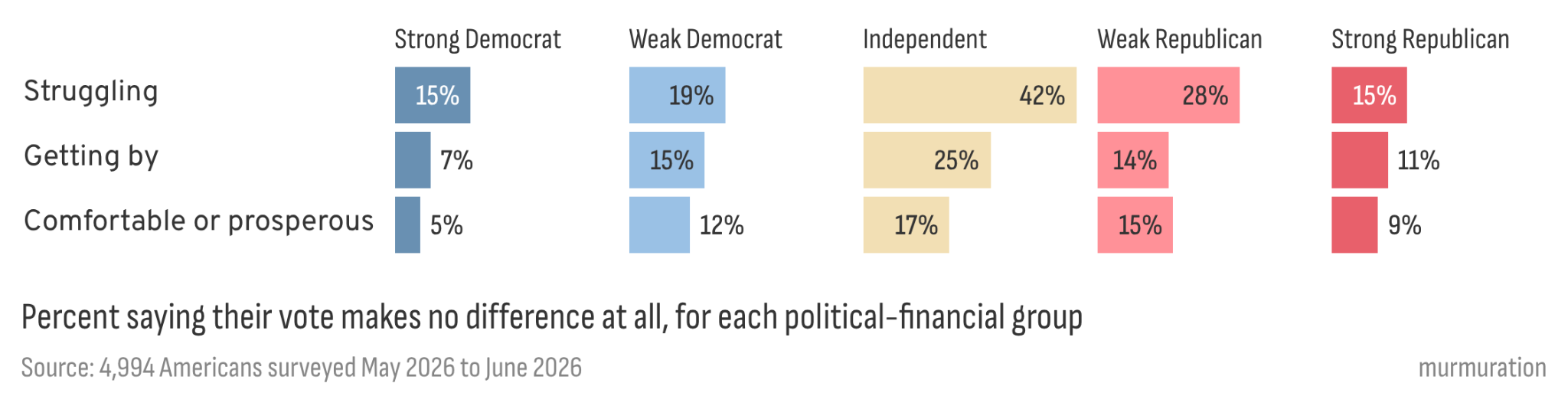
Independents tell a very different story. Even among financially comfortable Independents, 17% say their vote makes no difference—already higher than every group of strong partisans. Among those who are getting by, that rises to 25%. Among Independents who are financially struggling, more than four in ten (42%) believe their vote doesn’t matter at all. That’s a 25-point increase driven by financial circumstances alone.
A Broader Sense of Agency
Political identity and financial comfort help explain who believes voting matters. But both appear to reflect something even deeper: a person’s broader sense of agency.
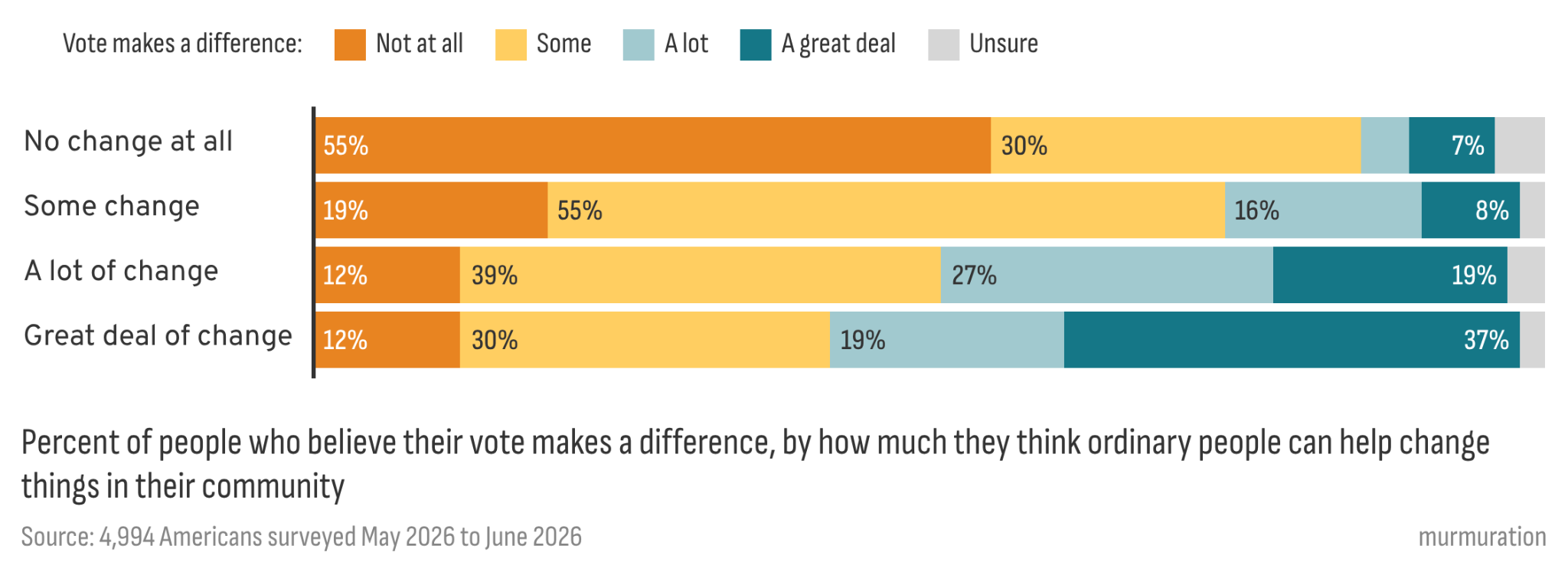
Among Americans who say they have a great deal of control over the direction of their own life, only 12% believe their vote makes no difference. Among those who feel they have no control at all, that figure more than triples to 39%. The pattern becomes even more striking when we move beyond the individual and ask about communities. Among people who believe ordinary people can make a great deal of difference where they live, only 12% say their vote doesn’t matter. Among those who don’t think ordinary people can change much of anything locally, that rises to 55%.
That broader sense of agency also shapes how people think about change itself. When we asked Americans where real change comes from, those who believe their vote matters were most likely to say “ordinary people and local communities” (+9pp). Those who believe their vote doesn’t matter were most likely to point to “major crises or hard times” (+5pp). The distinction is about where people locate the source of change. One group sees change as something people build together. The other is more likely to see change as something imposed by circumstances beyond anyone’s control.
It also shapes how people choose to participate. Americans who believe their vote matters are much more likely to see voting as a meaningful civic act. Those who don’t believe their vote matters mostly favor helping someone directly instead, with nearly half saying the most meaningful thing they can do is help another person, while very few choose voting.
Final Thoughts
Belief that a vote matters appears to grow from the same conditions that shape so many other parts of civic life: feeling financially secure, feeling connected to something larger than yourself, and believing that your actions can change what happens around you.
That may also be the opportunity. If confidence in democracy reflects a broader sense of agency, then strengthening democracy isn’t only about Election Day. It’s about creating more opportunities for people to experience that their choices matter in their neighborhoods, workplaces, schools, and communities.
A few questions:
What are the earliest experiences that teach people their actions can make a difference, and are we creating enough of them?
If financial comfort is so closely tied to political agency, what does that mean for how we think about strengthening civic life?
How might our approach to democracy change if we focused as much on building agency between elections as we do on participation during them?
In that sense, confidence in voting may be less a cause of civic engagement than a consequence of it. The more people experience that they can shape the world around them, the more likely they are to believe that casting a ballot is another way to do the same.
Vote of confidence.
Murmuration is a non-profit that organizes a network of partners and equips them with the insights, tools, and services needed to help communities build and activate the power to transform America into a nation where everyone thrives. murmuration.org