


Each year on the Fourth of July, we gather beneath fireworks and flags to celebrate America—not just the country, but the idea of it. The promise. The project. The place we call home and the dream we were told it could be.
But what does it really mean to be American right now?
Recent polling has shown that pride in being American is in decline, with a 56 pt gap between Republicans (92%) and Democrats (36%). But numbers like that leave us wondering: why?
So this week, we turned to Civic Pulse to do a deep dive with 5,000 people to understand how people actually feel about being American, including what they believe this country stands for and whether it’s still worth believing in.
The Identity Question
On the surface, the numbers paint a clear picture: 64% of respondents said they very strongly identify as an American, 25% somewhat strongly, 9% not very strongly, and 1% not at all. But once you break it down by both political party and age, deeper patterns emerge.
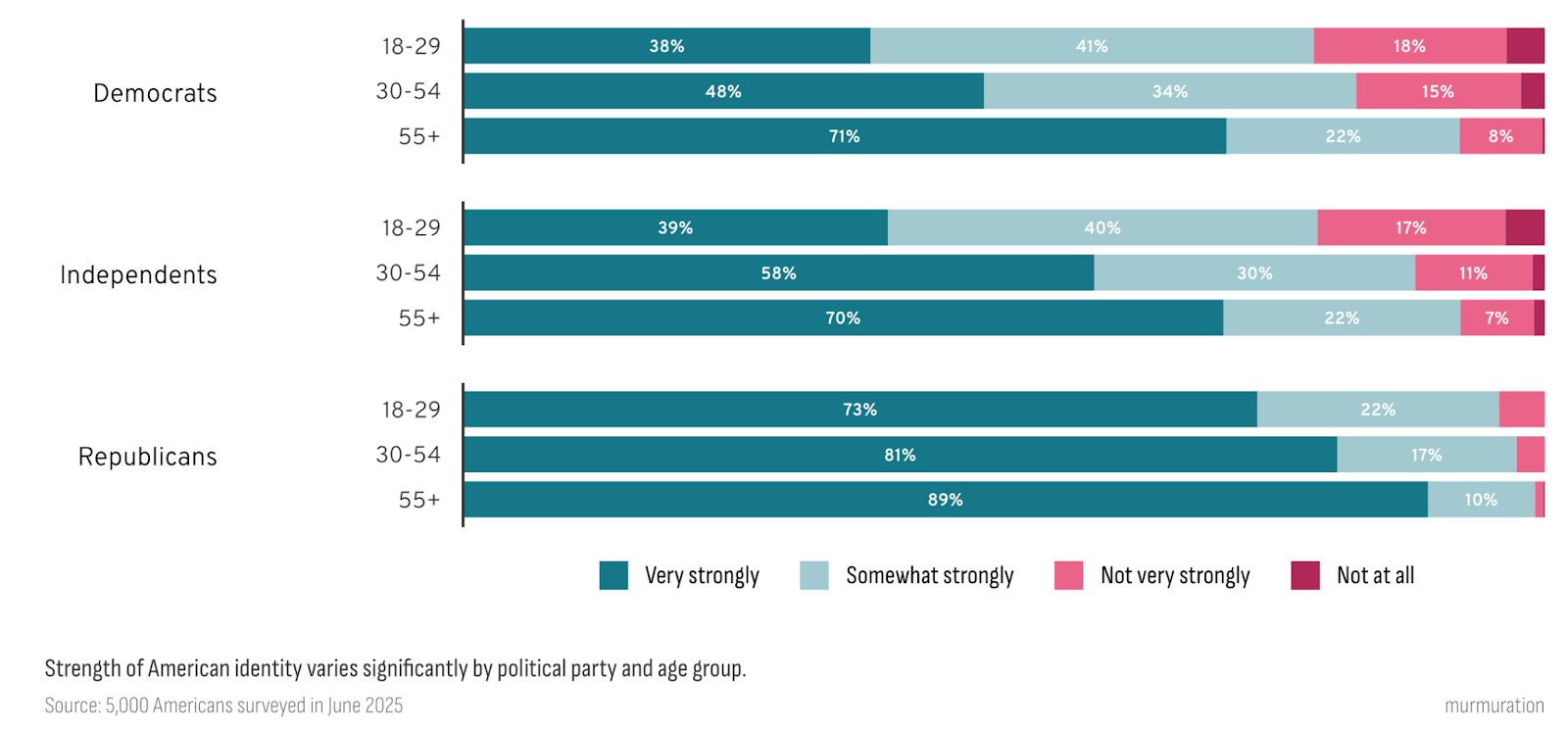
Republicans express the strongest and most consistent sense of national identity across all age groups, with even younger Republicans reporting high levels of identification. In contrast, Democrats and Independents show more variation, with the percentage who very strongly identify as American rising steadily with age, from just 38–39% among those under 30 to 70–71% among those 55 and older.
But what does it even mean to be American? We asked. Spoiler alert: for most, it’s freedom.
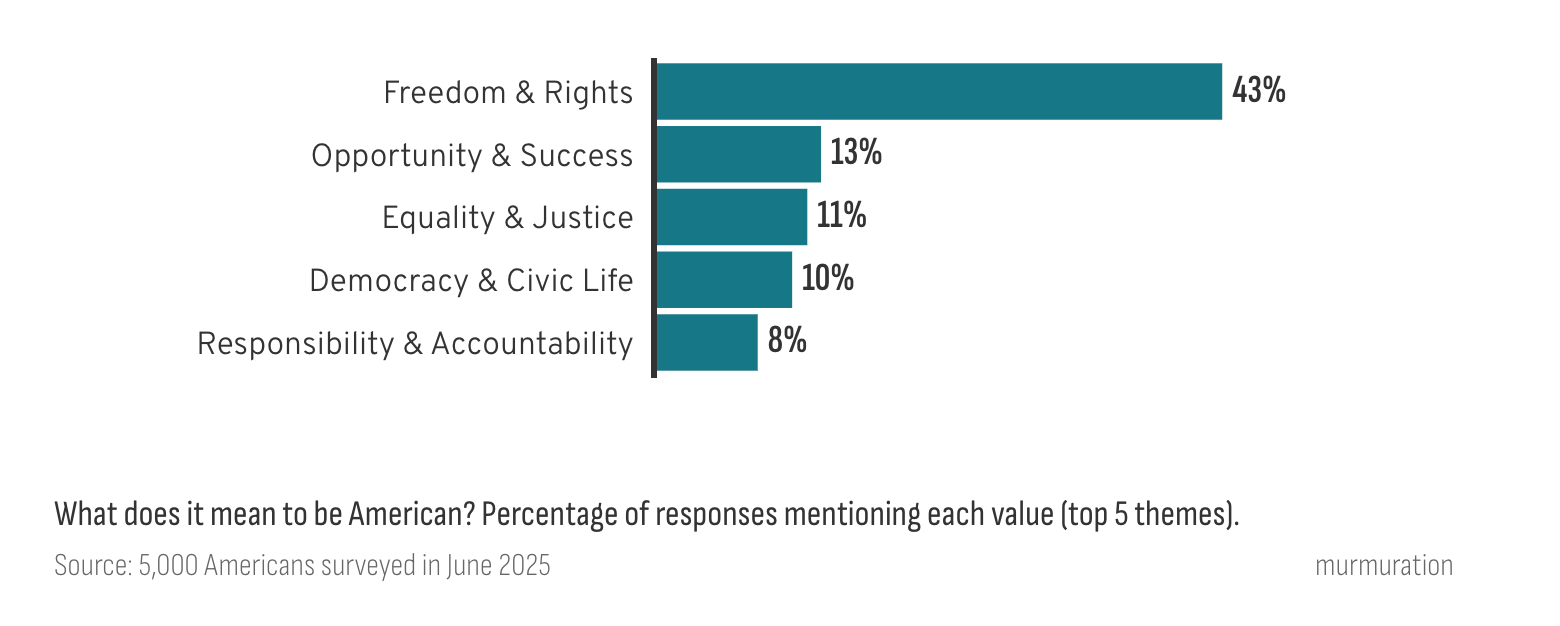
At first glance, freedom seems to be the great unifier in American life. It’s the most frequently mentioned value across political, geographic, and demographic lines. While its prominence dips some—by 10 points among adults under 30 and 8 points among those earning under $25,000—it still tops the list for all. But when you look more closely, it becomes clear that although Americans use the same word, they often mean very different things.
In our data, we’ve seen Americans invoke freedom to mean dominance, with strong borders, gun rights, national sovereignty, and law enforcement. Others use it to mean autonomy, focused on bodily choice, gender and sexual identity, and personal relationships. Still others speak of freedom as expression, including protest, religion, speech, and the vote. And for many, especially those living at the margins, freedom is about survival including the ability to live, work, and care for your family.
American Values
So, next we asked: What values do you believe should define America at its best?
In these responses we begin to see different visions for the American ideal. Democrats, along with many Independents, stress values like respect, tolerance, equality, and justice which are values that prioritize pluralism and diversity. On the other hand, Republicans emphasize patriotism. One that everyone seems to value somewhat: opportunity and success (the hallmarks of the American Dream; see section below).
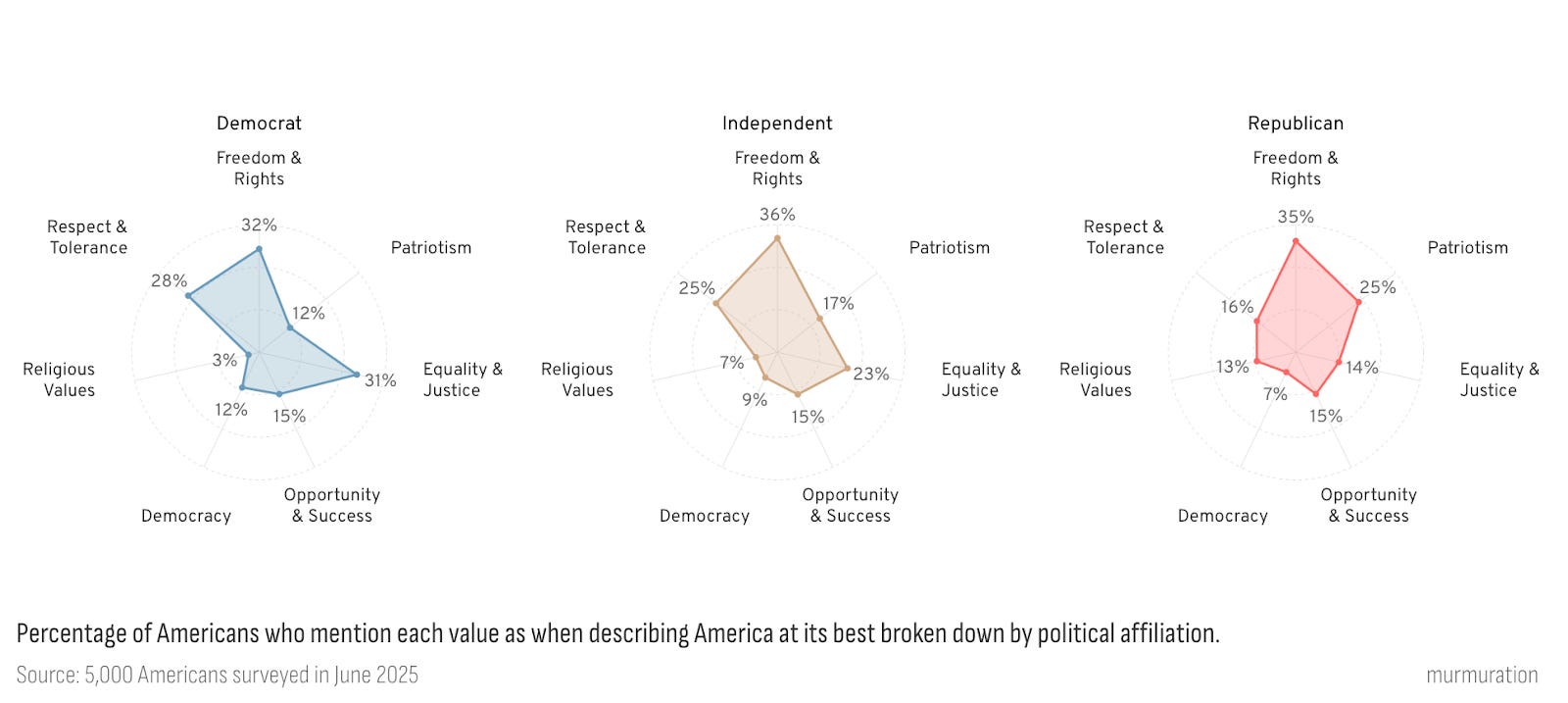
We also continue to see a shift for the younger generation too. In this case they’re less likely to state values around democracy and civic life (7% vs. 13% for 65+) as well as religious values and faith (4% vs. 12% for 65+).
In people’s own words, how they talk about American values reads like:
“Acceptance, tolerance, understanding, respecting differences, always being willing to help those who need it regardless of beliefs, circumstances, situation, etc.” – 44, male, Democrat Clark, WA
“Freedom, democracy, civility, personal responsibility, morality, caring for those who cannot care for themselves, being generous, being neighborly, believing in the dignity of work, equality of opportunity.” – 62, female, Independent, Clark, NV
“Patriotism…love our country and what it stands for, back our armed forces, take care of our veterans.” — 60, female, Republican, Brown, TX
Are We Living Up to It?
We also asked: How well do you think the country is living up to those values today? Here’s the short version: not well.
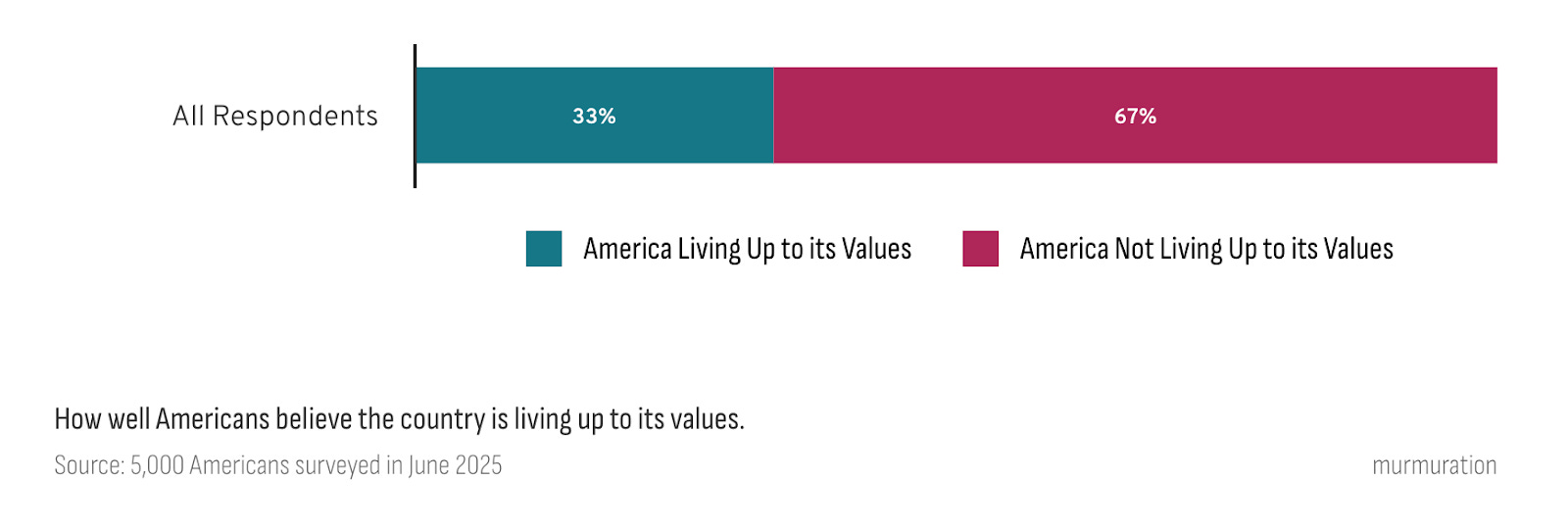
“Supposedly, America is about everyone being equal under and before the law. That isn't the case (if it ever was).” – 48, male, Democrat, Mercer, NJ
To better understand the emotional and moral landscape behind responses like this, we took a closer look at how people described the values they believe America should represent. Here's a breakdown of those unique words and what they reveal about our collective civic imagination.
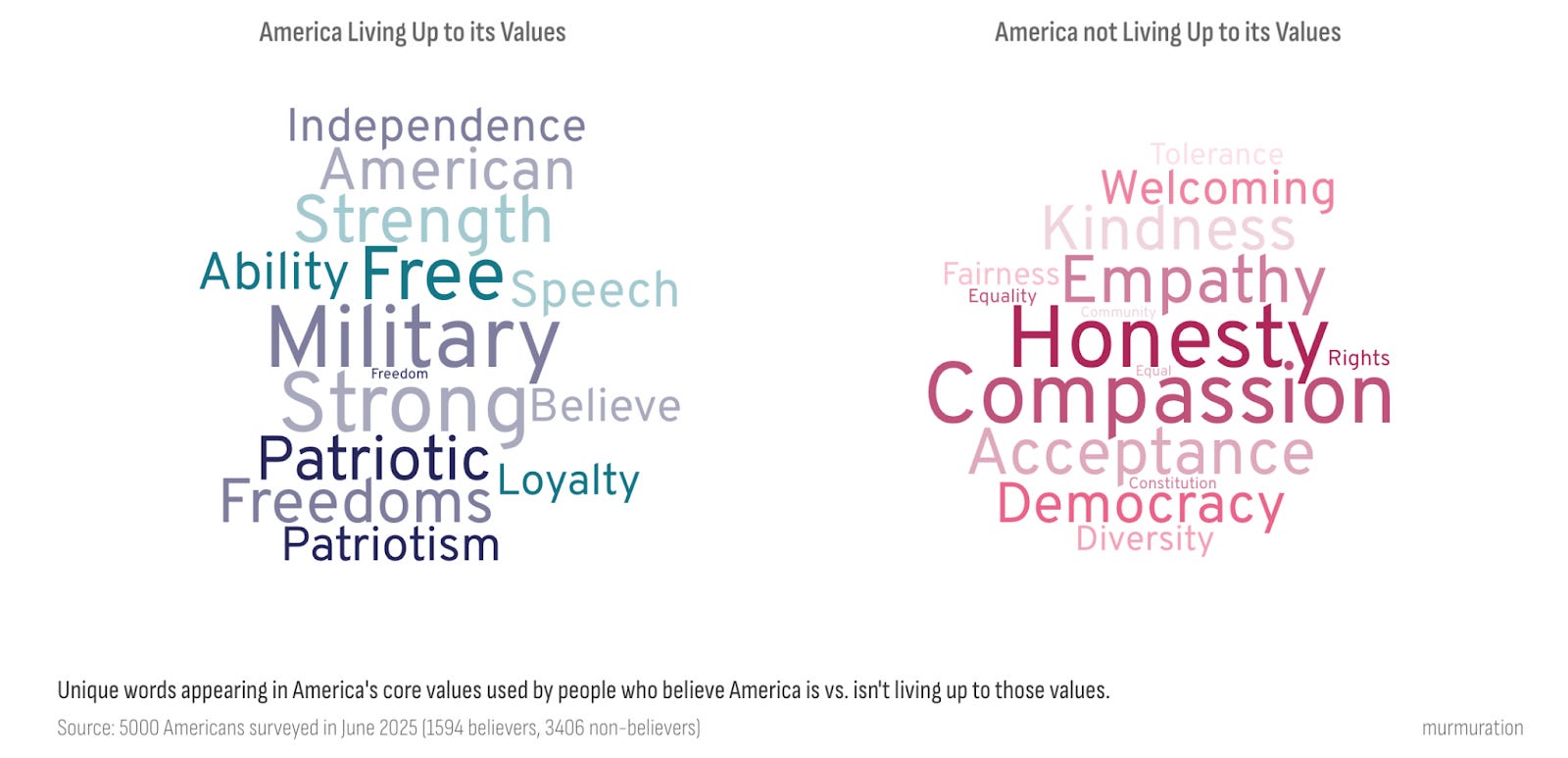
The left side of the image—words used by respondents who believe America is living up to its values—centers on strength, freedom, patriotism, and military might. Words like “Military,” “Patriotic,” “Strong,” and “Freedom” dominate, suggesting a focus on national resilience, loyalty, and liberty as traditionally understood. This language reflects a more institutional or nationalistic definition of values: about what America is and defends.
The right side—words from those who think America is not living up to its values—shows a strikingly different set of terms: “Honesty,” “Compassion,” “Empathy,” “Acceptance,” and “Democracy.” These words lean heavily into relational, emotional, and communal dimensions. Rather than focusing on power or identity, this vocabulary prioritizes connection, fairness, and care as qualities seen as lacking in the current moment.
What’s fascinating is that many of the values are not contradictory, but rather represent different dimensions of what a country might aspire to. Freedom and empathy aren’t inherently at odds but they sit in stark contrast here. This suggests that while Americans may agree that values matter, they disagree sharply about which values define the nation at its best, and which ones we are failing to uphold.
We also see similarly fascinating and fracturing differences when breaking down the data by party, age, and gender. The language people use to describe what America should stand for varies not only in substance but also in tone, emotional register, and imagined audience.
Still Believing in the Dream?
So, finally, we asked: Do you believe the American Dream (the idea that anyone can get ahead through hard work) is still achievable today?
29% said yes, for most people.
35% said yes, but only for some.
28% said no, not anymore,
And a smaller group (6%) said they never believed in it to begin with.
“If you work hard you should be able to live the American Dream.” – 71, female, Republican, Jackson, WI
On the surface, this is about optimism and fairness. But underneath it’s about financial comfort, stability, and whether effort still pays off the way it is supposed to. In this context, belief in the American Dream is not just a symbol of national identity. It is a gut-check on whether the system still works for regular people. And depending on who you ask, the answer varies widely.
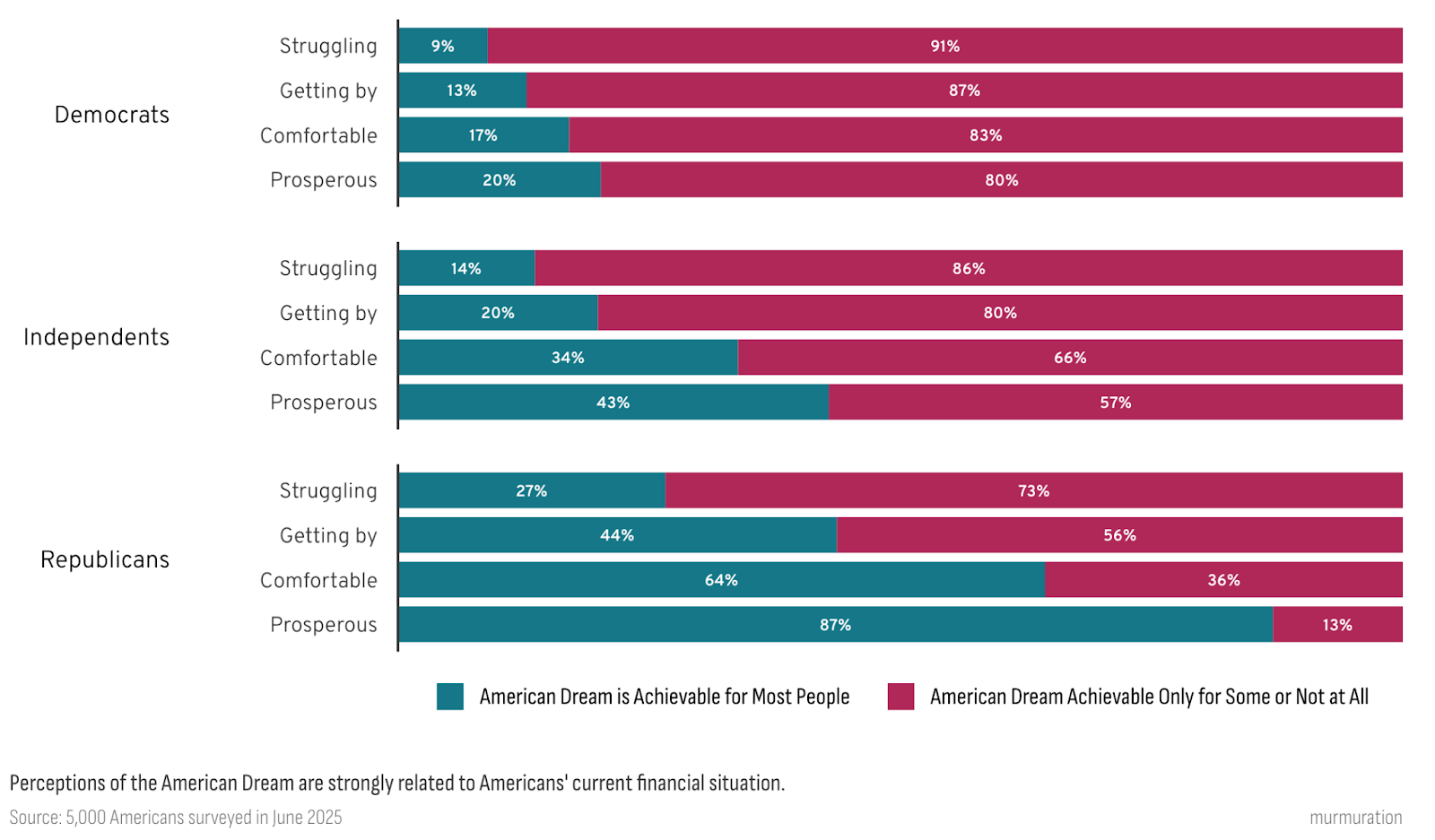
The chart tells a clear story: While belief in the achievability of the American dream is undeniably political, there’s also a powerful financial undercurrent that reveals something deeper. People's optimism in the system tends to mirror their own position within it.
Among Democrats, only 9% of those who are struggling believe the Dream is still achievable for most people, compared to 20% of those who describe their financial situation as prosperous.
Independents show a similar trend: just 14% of those struggling believe in the Dream for most, versus 43% who feel prosperous.
The biggest shift appears among Republicans, where belief in the Dream jumps from 27% among those struggling to a staggering 87% among those who feel prosperous.
It’s worth noting that this sharp divide may soon be deepened by a sweeping legislative package currently advancing through Congress, one that, according to independent analyses, would impose significant cuts most acutely felt by the very communities already facing the greatest economic hardship.
Final Thoughts
We’re a nation of people who still want to believe. We want to feel proud. We want our values to mean something beyond the bumper stickers and campaign slogans.
We want to believe that words like “freedom,” “justice,” and “opportunity” still hold power, that they still belong to all of us, not just some of us.
But we use these same words to describe very different things. So in this moment of reflection about being American, we’re wondering:
What could being American mean and who gets to decide?
Are we asking the right questions when we talk about “freedom,” “equality,” or “opportunity”? Or have the words drifted too far from their meaning?
If the American Dream isn’t working the way it used to, what could we build in its place?
And finally, what would it look like to rebuild national pride without erasing national pain?
Because the real test of American identity isn’t what we claim to value. It’s whether we can recognize, and reckon with, how unevenly those values are lived.
Here’s to lighting sparklers and asking hard questions. Happy Fourth of July.